
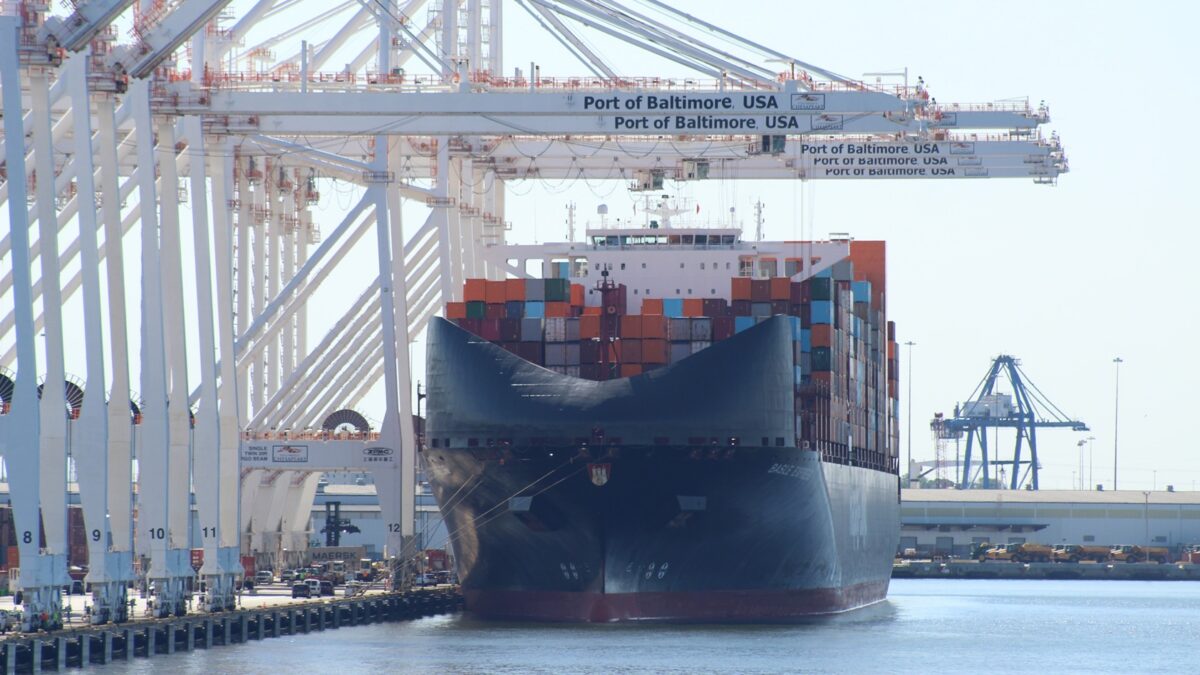
The State of Maryland has reached a major $2.25 billion settlement with the companies behind the containership Dali. This agreement is the largest legal recovery in maritime history and a significant step following the tragic collapse of the Francis Scott Key Bridge in Baltimore.
This settlement addresses the claims made by Maryland against Grace Ocean Private Limited and Synergy Marine Pte. Ltd., the owner and operator of the Singapore-flagged M/V Dali, which crashed into the bridge on March 26, 2024, resulting in its collapse and the deaths of six construction workers.
The announcement of the settlement was made on Tuesday by attorneys from the Maryland Attorney General’s Office along with several external law firms.
The settlement covers damages caused by the bridge’s destruction, environmental harm, lost toll revenue, disruptions at the Port of Baltimore, and various economic losses throughout the state.
“This settlement is a crucial step towards restoring Maryland,” said Maryland Attorney General Anthony G. Brown earlier this year when the initial agreement was revealed in April.
The total amount of the settlement far exceeds the approximately $43.7 million liability limit that Grace Ocean and Synergy sought under the Limitation of Liability Act of 1851, which allows shipowners to limit their liability based on the vessel's value after an accident.
The agreement was finalized just weeks before the trial was scheduled to start concerning whether the vessel owner and operator could utilize these legal protections.
While this settlement resolves Maryland's claims against the shipowner and operator, the state has kept open claims against other potentially responsible parties, particularly regarding the ship's design and modifications.
The legal situation became more intense this week when federal prosecutors unsealed criminal charges against Synergy Marine and its associated management, including technical superintendent Radhakrishnan Karthik Nair.
Prosecutors claim the companies operated the Dali with unsafe modifications, which compromised essential electrical systems on board. This led to a blackout just moments before the ship crashed into the bridge.
According to the indictment, investigators say the operators relied on a pumping system that was not designed to restart automatically after a power failure, leading to a second outage after the initial electrical failure.
The shipbuilder HD Hyundai Heavy Industries has claimed that the vessel's operators ignored built-in safety features by replacing automatic fuel pumps with a single non-redundant pump.
The National Transportation Safety Board previously found that a loose signal wire in a high-voltage switchboard caused the first blackout on the nearly 1,000-foot containership.
The bridge's collapse caused the Port of Baltimore to be shut down for weeks, disrupted local supply chains, and forced over 34,000 vehicles to use detour routes around the harbor each day.
Total economic losses from the incident are estimated at over $5 billion, while the costs to replace the Francis Scott Key Bridge are expected to be between $4.3 billion and $5.2 billion, with completion anticipated around 2030.
William J. Jackson, a partner at Kelley Drye and Assistant Counsel for Maryland, described the settlement as “historic,” praising the legal teams for their efforts in securing this recovery for the state and its agencies.
Kelley Drye worked alongside attorneys from Liskow & Lewis. David Reisman, Liskow’s maritime shareholder and lead trial counsel, expressed hope that this settlement—one of the largest in maritime history over the past two decades—provides not only financial resolution but also a sense of closure and the resources needed for Maryland and its residents to rebuild.