
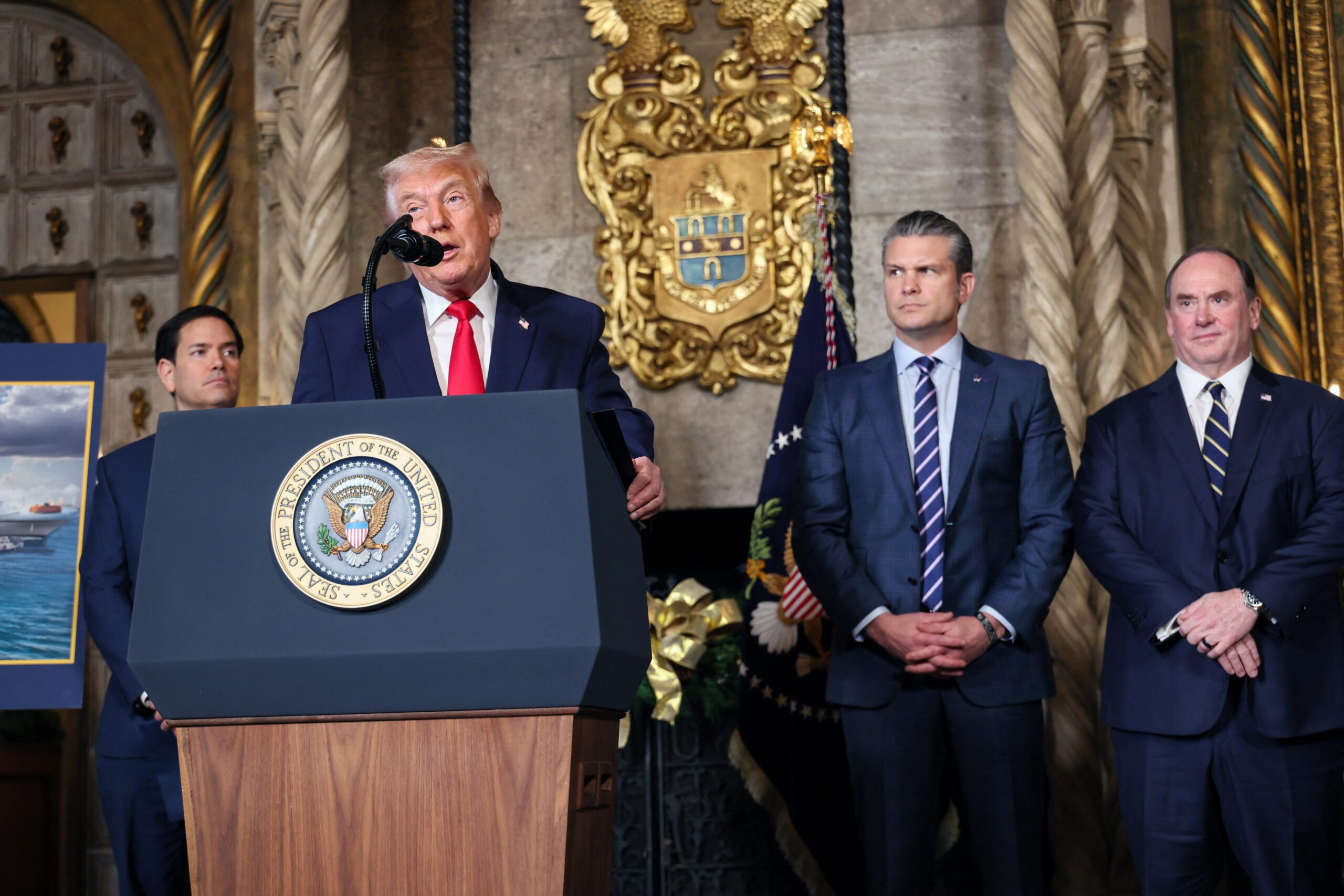
On Monday, President Donald Trump announced the launch of a new class of battleships for the U.S. Navy. This unexpected announcement marks the return of battleships, which have not been built for nearly 80 years, as the Navy faces delays and cancellations in its current shipbuilding programs.
During the event at his Mar-a-Lago resort, alongside Secretary of State Marco Rubio, Defense Secretary Pete Hegseth, and Navy Secretary John Phelan, Trump introduced the "Trump-class battleships." He claimed that these ships would be "100 times more powerful" than any previously built battleship, with the first ship in the class named USS Defiant (BBG 1).
Trump stated, "If you take the biggest one, it’s 100 times more powerful," adding that the new battleships would weigh between 30,000 and over 40,000 tons.
The Trump-class battleships will be central to the president's proposed "Golden Fleet" for the Navy. Officials indicated to the Wall Street Journal that this class would be complemented by new aircraft carriers also announced during the event.
Initially, two ships will be built, with plans for eight more, eventually aiming for a total of 20 to 25 battleships.
Navy Secretary Phelan described these battleships as "the largest, deadliest, most versatile, and best-looking warships on the oceans."
"The Iowa was designed for attack with the biggest guns, and that’s what the Trump-class battleships will be known for," Phelan noted. He mentioned that the new class would also carry nuclear-armed cruise missiles launched from the sea.
In comparison, the USS Iowa had a full-load displacement of about 58,000 tons and was equipped with nine 16-inch guns, the largest ever used by the U.S.
The new battleship class is expected to be roughly three times larger than an Arleigh Burke-class destroyer, providing much more firepower and larger missile storage. The ships will be capable of launching hypersonic weapons and nuclear-armed cruise missiles.
Operationally, the Navy says these ships could work alongside carrier strike groups in traditional defense roles or operate independently as the flagship of a surface action group, managing surface and anti-submarine warfare missions. They will also be designed for long-range hypersonic strikes and to serve as command-and-control hubs for fleet operations.
"As we look to the future of our Navy’s Fleet, we need a larger surface combatant, and the Trump-class Battleships fulfill that need,” said Adm. Daryl Caudle, the 34th Chief of Naval Operations. “We will aim for continuous improvements and effective deterrence and victory in the 2030s and beyond, ensuring a Fleet unmatched in lethality, flexibility, and power.”
This announcement occurs as the Navy confronts many challenges in its shipbuilding programs, including recent cancellations and shifts in strategy that highlight difficulties in modernizing the fleet effectively.
Just last Friday, the Navy announced a new frigate class based on the Legend-Class National Security Cutter design by Huntington Ingalls Industries, which comes after the cancellation of four Constellation-class vessels. Navy Secretary Phelan confirmed that the service would acquire the new FF(X) frigate through a faster process than typical shipbuilding methods.
The decision to cancel the four Constellation-class frigates was prompted by major delays, pushing the lead ship's expected delivery from April 2026 to April 2029, a three-year setback.
The announcement of the FF(X) represents the latest in a series of changes to federal shipbuilding programs under the Trump administration, which has also cancelled the Coast Guard’s planned eleventh Legend-class cutter and has partially paused the troubled Offshore Patrol Cutter program.
Construction and Industrial Base
The Navy plans to develop the battleships through a collaborative design effort with the industry to accelerate both design and construction. The program will rely on a broad industrial base with over 1,000 suppliers across nearly every state.
Simultaneously, the Navy will continue producing Arleigh Burke-class destroyers (DDG-51) as the primary component of the surface fleet while advancing the FF(X) program, aiming for faster fleet expansion by balancing high-end capabilities with simpler, more economical platforms.
Earlier this month, Phelan announced the selection of the LST-100 landing ship design by Dutch shipbuilder Damen for the Medium Landing Ship program, after terminating four vessels from the Constellation-class frigate program. This Medium Landing Ship program anticipates acquiring between 18 and 35 new amphibious ships to support Marine Corps operations, especially in potential conflict scenarios with China in the Western Pacific.
The introduction of a new battleship class marks a significant shift from modern naval strategies. According to the U.S. Naval History and Heritage Command, battleship construction for the U.S. Navy ended in 1947 with the suspension of the incomplete Kentucky (BB-66). From 1888 to 1947, the Navy completed 59 battleships of 23 different designs.
Once regarded as "Queens of the Sea," battleships were seen as vital for national defense. However, their dominance faded with the advent of aircraft capable of striking from greater distances during World War II. Battleships were repurposed for shore bombardment, leading to their return to active duty on three occasions after the war.
These decisions are made as U.S. naval and Coast Guard leaders express concerns that American shipyards and industrial resources lag far behind China's maritime production capabilities.
Trump-Class Technical Specifications
Dimensions & Performance
- Length: 840–880 ft
- Beam: 105–115 ft
- Draft: 24–30 ft
- Displacement: >35,000 t
- Speed: 30+ kts
- Crew: 650–850
- Class Size: 20–25 ships
Armament
Main Battery
- Surface Launch Cruise Missile–Nuclear (SLCM-N)
- 12 cells CPS
- 128 cells Mk 41 VLS
Secondary Battery
- 1 × 32 MJ Railgun with HVP
- 2 × 5" guns with HVP
- 2 × 300 kW or 2 × 600 kW lasers
Defensive Battery
- 2 × RAM launchers
- 4 × 30 mm guns
- 4 × ODIN lasers
- 2 × Counter-UxS systems