
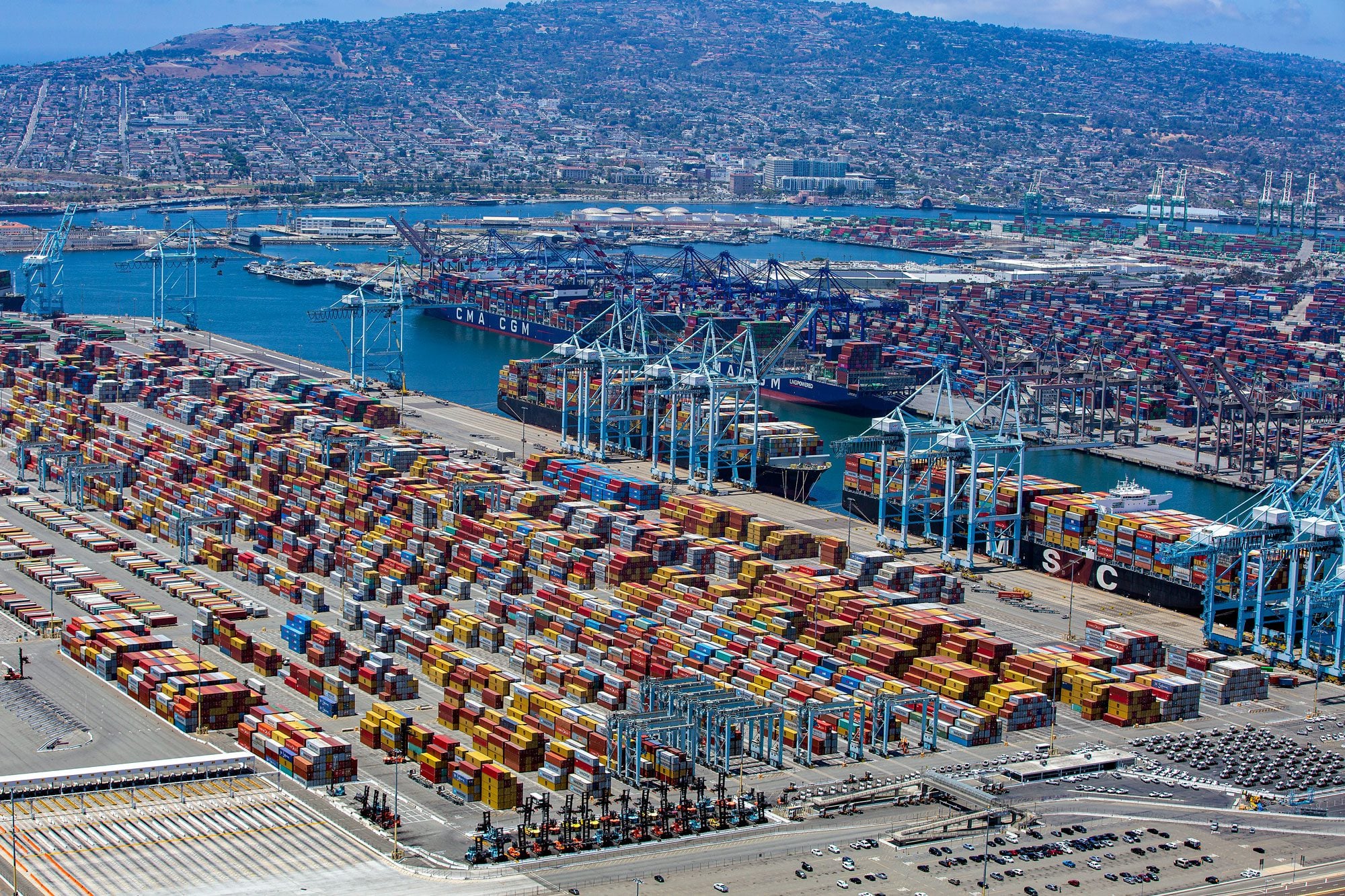
The Port of Los Angeles, the busiest container seaport in the U.S., processed over 1 million twenty-foot equivalent units (TEUs) in June, marking the port's most active June in its 118-year history.
Gene Seroka, the port's executive director, stated, “This was also our third-best month ever, and it is the third time we’ve surpassed the 1 million TEU mark. No other port in the Western Hemisphere has ever hit this number even once.”
In June, the port handled 535,000 import TEUs, which is a 13% increase compared to last year and 18% higher than the five-year average, making it the third-highest month for imports on record.
Seroka noted that “containers are moving differently now.” He explained that many retailers are changing their strategies and moving away from traditional shipping timelines, opting to advance cargo whenever they find an opportunity rather than waiting for ideal conditions.
He added that uncertainty surrounding fuel prices and tariffs is making it hard to predict cargo volumes for the latter half of the year.
“Data suggests another strong month ahead with volumes exceeding 900,000 container units,” Seroka mentioned. “However, the landscape is constantly changing. Retailers are adjusting in real time, influenced by trade policies. The Section 122 tariffs end after July 24, but we expect the Section 301 tariffs to take effect.”
Even though June imports were robust, exports remained mostly unchanged at 126,000 TEUs. On the other hand, shipments of empty containers returning to Asia—a key indicator of future demand—rose by 17% compared to last year, reaching 345,000 TEUs.
Seroka emphasized that “Consumers are still buying.”
However, he raised concerns that the ongoing situation with Iran and upcoming changes in tariffs could disrupt supply chains and raise transportation costs.
Seroka pointed out that rising fuel prices are particularly troubling for ocean carriers, railroads, and trucking companies.
“They handle about two-thirds of all cargo in and out of the Port of LA daily,” Seroka explained. “In Southern California, gasoline prices have risen by 18% to 20% over the past year. Diesel prices have also increased by more than 25%, which is a significant concern for many truckers in the harbor community.”
Douglas Irwin, an economics professor at Dartmouth College, mentioned that the forced-labor tariffs are mainly a continuation of the existing Section 122 tariffs and do not signify a major change in policy.
“The big uncertainty is around the excess-capacity Section 301 tariffs,” Irwin added. “We haven’t received information on what these rates will be or how they will vary by country. I believe it is unlikely that they will apply a uniform low rate across all countries.”
Irwin suggested that the administration might adopt a structure similar to the "Liberation Day" tariffs.
“It’s more likely we’ll see something akin to what happened with Liberation Day—higher tariff rates that differ by country based on how much they are seen to contribute to the excess capacity issue,” he stated. “That remains the big unknown, and we are all waiting for clarification.”
Seroka warned that increasing bunker fuel costs could have a ripple effect on global supply chains.
“Fuel now likely makes up more than 30% of the overall cost of a vessel’s journey,” he said. “That’s a significant amount for shipping companies.”
He predicted that carriers will likely raise bunker adjustment factors or fuel surcharges, which would ultimately be passed on to importers and exporters.
“Normally, shipping companies base their surcharge adjustments on fuel costs over a three-month period,” Seroka explained. “That’s what will happen next. You can expect those surcharges to increase, and even when fuel prices drop, these surcharges often remain high for some time before returning to more normal levels.”
In the first half of 2026, the Port of Los Angeles processed 5.1 million TEUs, which is 3% ahead of last year's pace and 4% above the five-year average.
June also marked the end of the port's fiscal year, with total throughput reaching 10.4 million TEUs, making it one of the strongest fiscal years in the port's history.
Despite the ongoing uncertainties, Seroka noted that cargo owners are continuing to adapt.
“We’re operating in a dynamic cargo environment,” he said. “The first half of the year was stronger than expected, built through planning, investment, and adaptability.”