
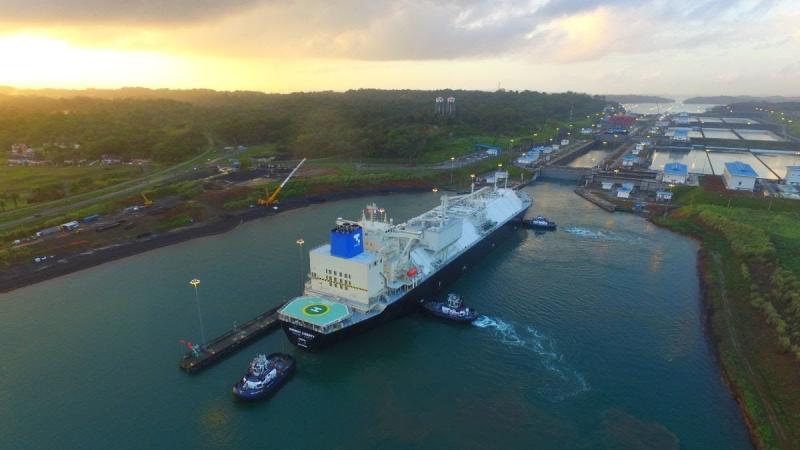
LNG Bookings Rise as Panama Canal Becomes Key Alternative for Middle East Energy
LNG shipments through the Panama Canal are increasing as disruptions in the Strait of Hormuz continue.
According to the Panama Canal Authority, there is an average of one LNG vessel booked per day from April 1 to April 13.
“Our booking system shows that about 65% of these vessels are headed south towards the Pacific, while the remaining 35% are moving north. This trend highlights a growing LNG market, especially influenced by recent events in the Middle East,” the Authority stated.
This information follows comments from Ricaurte Vasquez, Administrator of the Panama Canal Authority, indicating that the Canal might become a vital alternative for energy transport if disruptions in the Strait of Hormuz persist, as discussed at the Connecticut Maritime Association (CMA) Shipping Conference and Expo 2026.
The Authority reassured that it is equipped to handle any increase in LNG traffic in the short term. They mentioned that the recent reintroduction of exclusive booking access for LNG 30 and 15 days before scheduled transit dates will further aid LNG carriers amid challenging market conditions.
“The US has an abundance of natural gas, but it still needs to transport it to markets,” said Kevin Book, managing director of ClearView Energy Partners. “While the disruptions are in the Middle East, the effects are felt worldwide, influencing global prices.”
Ship owners believe the energy trade is robust, and operators will continue to find ways to ensure the trade flows smoothly.
“We’re noticing a diversification in trade routes, with more products being shipped from the US Gulf to Australia and Europe,” stated Jake Scott, COO of Clear Ocean Partners. “There’s also an increase in product shipments to California.”
Scott noted that rising tanker day rates indicate two major capacity issues: longer shipping routes and the additional capacity needed for transporting Venezuelan oil, which is no longer under sanctions.
This has led to a spike in prices for Very Large Crude Carriers (VLCCs), with the VLCC Kalamos being reportedly fixed at a record-setting $770,000 per day on March 6, 2026.
“The reality is that there isn’t much capacity left,” said Smith. “Considering that building a new tanker takes about three years, it creates pressure on capacity. Moreover, around 20% of the fleet will soon be over 20 years old. Oil companies prefer ships that are 15 years or younger, which adds further strain on the fleet.”
Looking ahead, Smith warned that the tanker market's capacity issues could worsen if ownership of Iranian oil changes.
“There are millions of barrels per day of Iranian crude that could now be transported by non-sanctioned vessels, which are already limited. The big question is who will have access to these ships? Right now, it’s uncertain. So, we may see high day rates persist for an extended period as available tonnage continues to shrink,” Smith added.
Clear Ocean currently manages nine chemical tankers and two offshore construction vessels.
“Day rates have soared due to disruptions and a lack of effective vessel supply,” said Jelle Vreeman, an independent shipbroker. “Although flows into Northwest Europe remain steady, the price increase is mainly driven by expanding ton-miles and disruptions in the fleet, not just by increased demand. As long as the Strait remains closed, this situation is likely to continue.”
The Panama Canal started allowing LNG carrier transits in 2016 with the opening of its expanded “neopanamax” locks.