
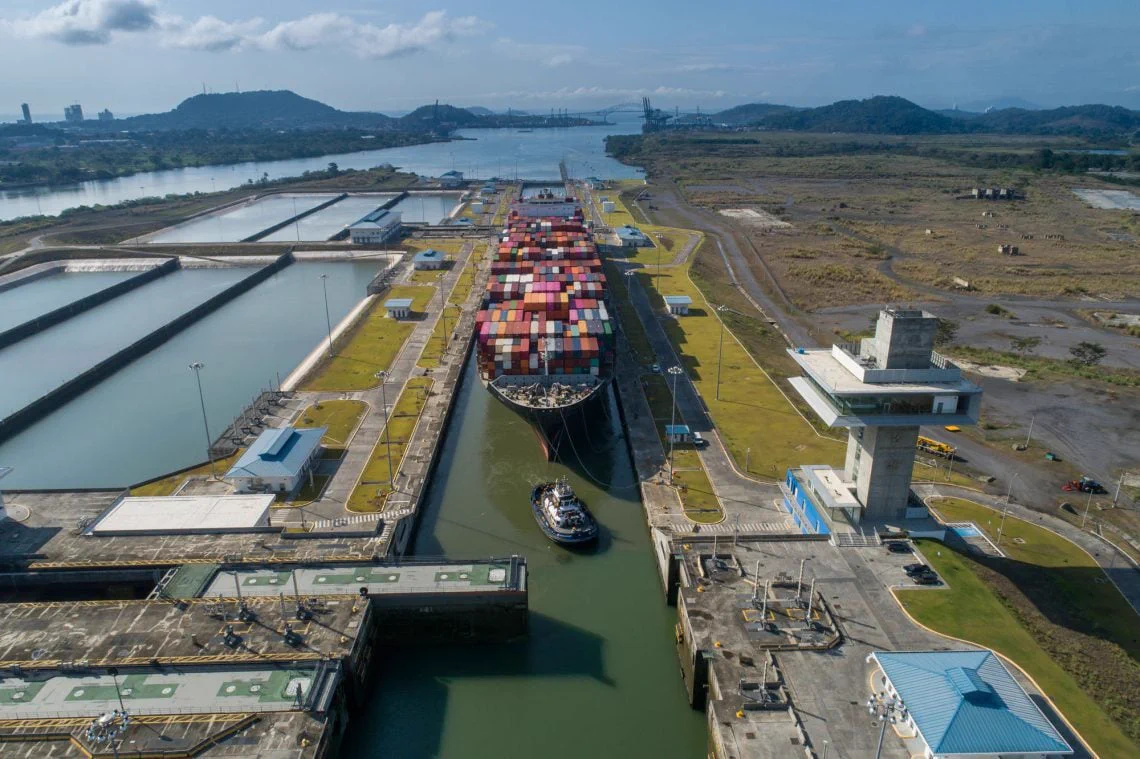
The Panama Canal is easing some of its Neopanamax booking rules temporarily, allowing shipping companies to have more flexibility in securing transit slots. This change comes as the canal prepares for reduced capacity and ongoing challenges with its water supply.
On Friday, the Panama Canal Authority (ACP) announced that customers will now be able to book more than one Neopanamax reservation for the same date and secure slots on consecutive days. This reverses previous restrictions that were in place. The new rules will start on August 30 for bookings beginning September 13.
These adjustments are made as the canal experiences high demand from vessels and a worsening situation regarding water availability.
Each week, 63 Neopanamax reservation slots will be available, which includes allocations from the canal's Long-Term Slot Allocation (LoTSA) and NetZero programs.
The ACP mentioned that these temporary changes were made based on feedback from customers and aim to share available capacity more fairly among different market segments while favoring ships that use water more efficiently.
Under the new system, fully loaded containerships will get at least five slots per booking date, while LPG carriers will have a minimum of three slots. LNG vessels will receive at least three slots each week, with another three slots kept for vehicle carriers, RoRos, bulkers, and other types of vessels.
For containerships, the ACP will use the vessel Transit TEU Allowance (TTA) to allocate slots. This approach gives the canal a way to encourage operators to move more cargo while consuming less water during each transit.
This strategy reflects comments made by Panama Canal Administrator Ricaurte Vásquez in a recent interview. “We are asking them to consolidate cargo to bring in larger vessels at a specific draft,” Vásquez explained, noting the canal's focus on cargo moved per cubic meter of water in its planning.
The updated rules also allow some flexibility if there is low demand in a specific vessel category. For instance, unused containership slots can be reassigned to LNG and LPG carriers, and then to vehicle carriers, RoRos, bulkers, and other vessels. The same redistribution policies apply in other market segments.
Customers will also have the option to swap or substitute vessels after receiving a slot, as long as the new vessel has the same or greater TTA capacity. Partners in alliances or vessel-sharing agreements can join in these swaps and substitutions, provided they do not exceed their allotted slot limit. Booking dates can also be changed under similar terms.
These changes come shortly after Vásquez warned that vessels arriving without reservations are increasingly vying for costly auction slots.
The number of ships arriving without appointments has risen from about 10% to between 20% and 25%, according to Vásquez. Competition for auction slots has intensified, with as many as 18 vessels competing for one slot, and a recent auction hit a record of $5.3 million.
The ACP is also getting ready to reduce transit capacity after rainfall in the canal watershed fell short of expectations. Starting September 3, Neopanamax capacity will drop to nine daily slots, while Panamax capacity will initially be limited to 25 slots, dropping to 23 on September 15.
Vásquez has cautioned that the canal is anticipating El Niño conditions that may persist for about eight months, emphasizing the need to conserve water during the upcoming dry season.
“As long as the water deficit continues in the Canal watershed, using the Transit Reservation (Booking) System is the only way to ensure a transit date,” the advisory noted. “Vessels without a reservation may face indefinite delays.”
The canal will keep monitoring rainfall and water conditions and will make additional adjustments as necessary.