
By Ron Bousso
LONDON, Aug 18 (Reuters) – The oil market is starting to act as if disruptions to energy supplies from the Middle East are part of a new normal rather than just a temporary issue.
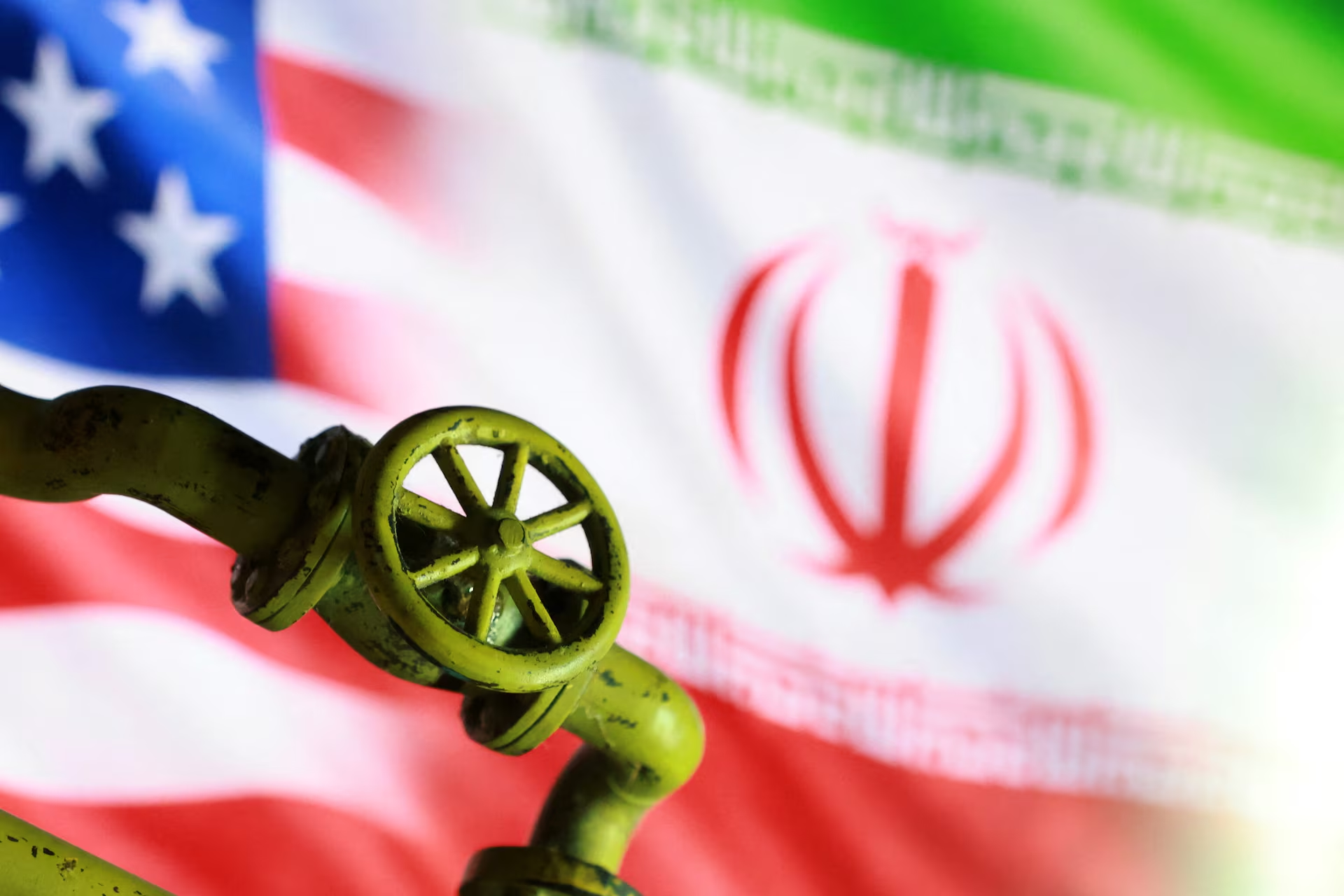
Nearly six months after the conflict began between the U.S. and Iran, hopes for a peaceful resolution have diminished. An interim ceasefire, which was agreed upon on June 17, has fallen apart, and the period for negotiations has ended without any compromises from either Washington or Tehran.
Both sides are firmly entrenched in their positions.
Iran warned on Monday that it would ramp up tensions unless the U.S. fully adhered to the interim peace agreement soon. A senior Iranian official stated that if diplomatic efforts fail, Tehran would launch a “timely and precise” attack to disrupt the U.S. naval blockade. U.S. President Donald Trump had declared the agreement “over” on July 7, and he has since claimed that the U.S. is nearing a victory over Iran.
This deadlock is forcing traders to deal with shipping restrictions in the Strait of Hormuz, which is crucial for oil transport, and these restrictions could last for months.
The change in expectations is one reason why crude oil prices have levelled out around $90 a barrel. While prices have gone down from the initial panic, they remain about 50% higher than at the beginning of the year. The market seems to have moved past fears of an immediate supply collapse, but it also does not expect a quick return to stability.
MOUNTING PAIN
Beneath the political rhetoric, both sides are facing economic hardships.
Iran is experiencing increasing pressure from the ongoing conflict and U.S. blockade. According to an ISNA report, inflation soared above 80% in July compared to the previous year, while crude exports have plummeted to 294,000 barrels per day (bpd) this month, a significant drop from 1.7 million bpd in 2025, as reported by analytics firm Kpler.
The U.S. is not immune to the fallout either. Trump has cautioned Americans to brace for higher fuel prices, a tough statement for a president who campaigned on the promise of reducing energy costs, especially with congressional elections approaching in November. The average gasoline price was $4.06 per gallon on Monday, up 29% from a year ago, as per the American Automobile Association.
Despite the diplomatic deadlock, the oil market is adjusting.
SMOKE AND MIRRORS
A major uncertainty revolves around the extent of supply disruptions. The flow of crude and refined products through Hormuz, which averaged about 18 million bpd before the conflict, dropped to 4.8 million bpd in July and has averaged about 2 million bpd in August due to Iranian attacks and the U.S. blockade, according to Kpler.
Some of this lost volume has been compensated for by increased exports from the Fujairah terminal in the UAE and from Saudi Arabia's Red Sea coast. However, these alternative routes are also facing challenges, as Yemen's Iranian-aligned Houthis have imposed a blockade on Saudi exports through the Bab el-Mandeb Strait.
Overall, Middle East exports averaged 9.5 million bpd this month, which is less than half of the 21 million bpd reported in 2025, according to Kpler.
However, these figures may not accurately reflect the true levels of exports, as more regional oil is being transported clandestinely.
Evidence is emerging that Gulf producers are increasingly using ships that turn off their tracking systems while passing through Hormuz and Bab el-Mandeb. The UAE, in particular, seems to have developed a network of "dark tankers" that transport crude through Hormuz before transferring their cargoes in the Gulf of Oman.
This has created a unique situation where traders are aware that supplies have been disrupted, but they cannot assess the extent of these disruptions.
Currently, UAE crude exports have averaged 3.38 million bpd in August, compared to 3.2 million bpd in 2025. However, these volumes might decrease after Iran reportedly attacked several tankers linked to Abu Dhabi National Oil Company while they were traveling through Hormuz.
The actual amount of oil reaching consumers has become one of the largest uncertainties in the market. As long as the situation in Hormuz remains unresolved, energy markets will be shrouded in uncertainty.
Other indicators suggest that high oil prices may remain even if crude exports stabilize.
REFINING PRECIPICE
The market for refined fuel is becoming extremely tight. Global refinery throughput in July was about 5 million bpd lower than a year earlier, at 81 million bpd, according to the International Energy Agency, reflecting losses in refining capacity in the Middle East and damages to Russian facilities from drone attacks.
This shortfall has been partially offset by a surge in U.S. fuel exports, with American refineries operating at or near record levels. However, this support may diminish. Seasonal maintenance before winter and the hurricane season could restrict operations along the U.S. Gulf Coast.
Reduced refining activity will make it harder to restock depleted fuel inventories, contributing to sustained high product prices and refining margins, which have reached all-time highs.
The inventory situation is particularly alarming. Global oil stocks saw a decrease of 2.4 million bpd in the second quarter, marking the largest quarterly drop in a decade. In the U.S., diesel inventories are at their lowest for this time of year in three decades, while gasoline stocks are at their weakest seasonal level since 2012.
Freight markets are conveying a similar message.
Benchmark rates for very large crude carriers shipping oil from the Middle East to China have skyrocketed from around $300,000 per day in early July to $490,000, which amounts to $5 a barrel and is nearly ten times higher than at the beginning of the year.
These rates highlight shipowners’ hesitance to enter conflict zones, as well as the increasing demand for tankers to transport oil and fuel from more remote suppliers like the U.S. and Brazil.
The longer the deadlock in Hormuz continues, the less this appears to be a temporary supply shock and more a fundamental change in the global oil trade.
Markets are struggling to adapt to a world with unclear supply flows, dwindling fuel inventories, strained refining capacity, and no viable diplomatic path to restoring trade through the Gulf. This growing understanding, more than developments on the battlefield, may keep oil prices high well into next year.