
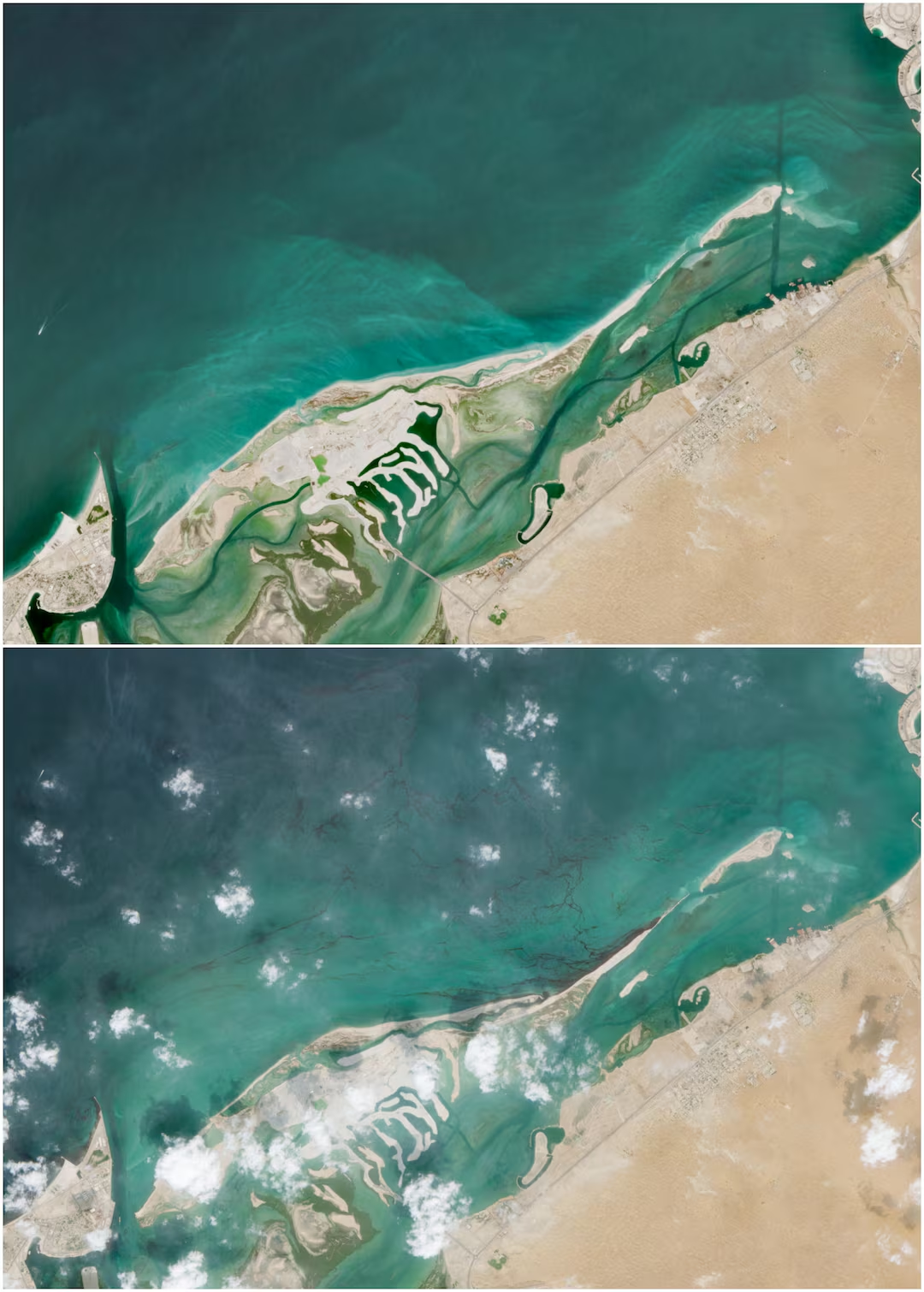
DUBAI, Oct 26 – An oil spill from a damaged tanker off the coast of the United Arab Emirates has expanded, according to satellite images, leading to more beach closures and raising concerns for the environment.
Images from the European Union's Copernicus satellite network, taken on October 24, indicate that the oil spill has grown over the last few days, nearing the shores of the northern emirate of Umm Al Quwain, with dark patches of oil spreading both in the sea and along the coastline.
Since the beginning of the conflict between the US-Israel and Iran, there have been increased security risks and worries about the environmental impact due to attacks on commercial vessels in Gulf shipping lanes.
October has seen the highest number of attacks on commercial shipping in the Strait of Hormuz and surrounding areas, based on data from the Washington Institute for Near East Policy.
On Friday, the UAE announced that efforts were ongoing to manage the oil leak from the tanker, with the Ministry of Climate Change and Environment conducting an environmental assessment.
Authorities have not disclosed the name of the tanker involved or the cause of the spill. However, experts suggest that the spill is coming from a tanker named Gem No.2, which was reportedly struck by an unidentified projectile last month, resulting in a fire that was eventually put out.
Satellites from the EU's Copernicus Sentinel-2 provided images showing a significant oil spill emanating from the tanker.
In response to the spill, authorities in the northern emirates have restricted access to coastal areas.
The Ministry of Climate Change and Environment announced on Friday that all beaches and coastal areas around Umm Al Quwain would be temporarily closed, while Sharjah authorities closed access to Al Hamriyah Beach as a safety measure.
“The reported oil spill off Umm Al Quwain is a serious environmental concern. The temporary closure of beaches and coastal areas is a wise precaution as the extent of the spill and movement of the oil are evaluated," said Nidal Hilal, a Professor of Engineering and Director of New York University Abu Dhabi's Water Research Center.
In Ras Al Khaimah, famous for its beaches and luxury resorts, officials announced on Saturday that all beaches in the emirate would remain closed until further notice.
According to the International Union for Conservation of Nature (IUCN), the UAE's marine life is diverse, with over 500 different species of fish, including dolphins and sea turtles, in the Gulf waters.