
By Jonathan Saul and Catherine Cartier
LONDON, Aug 12 (Reuters) – A large oil spill in the Gulf is quickly becoming one of the worst environmental disasters in recent years, as it has spread almost without control for weeks, according to various international organizations, satellite images, and environmental groups.
Reports indicate that the oil slick from a grounded tanker carrying Russian crude oil reached the mainland of Oman by Wednesday, according to the U.N. shipping agency.
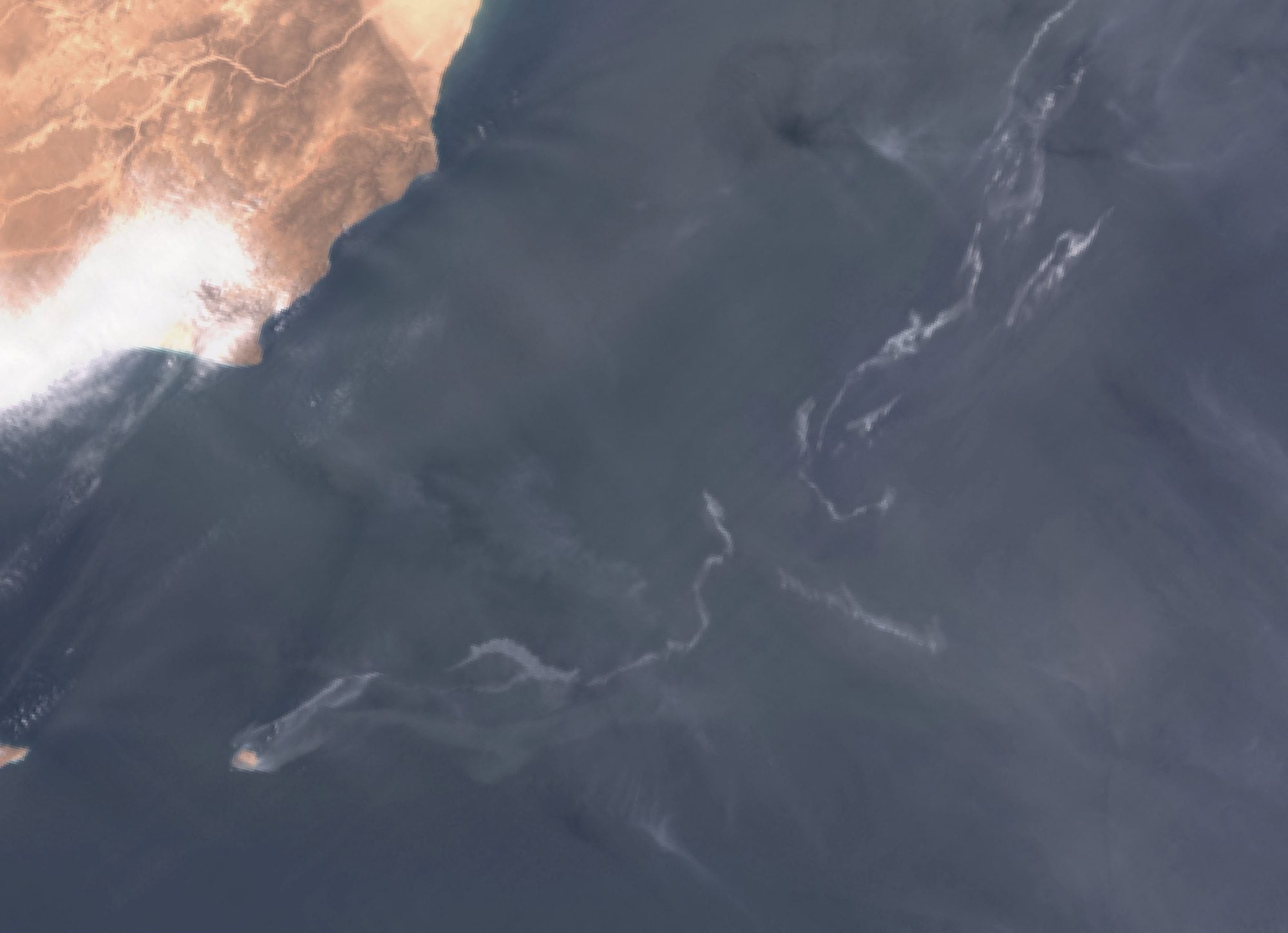
The slick now covers over 2,000 square kilometers, as noted by John Amos, an oil spill expert who analyzed satellite images provided to Reuters.
The Caroline Bezengi, which was carrying about 800,000 barrels of Russian oil and is subject to international sanctions, ran aground on June 30 near an Omani island that is part of a marine nature reserve.
The ship first reported issues off the coast of Yemen on June 8, with maritime sources suggesting an explosion may have occurred on board the Caroline Bezengi.
While no one has claimed responsibility for the alleged attack, the vessel was navigating through two ongoing conflicts on its way from Russia to India.
In April, it left the port of Novorossiysk on the Black Sea, a key location in the Russia-Ukraine conflict. Ukraine has targeted a shadow fleet carrying Russian oil, including the Caroline Bezengi.
The ship then passed through the Suez Canal at the end of May, and later sailed past Yemen, where Houthi militants aligned with Iran are engaged in a broader regional conflict involving the U.S., Israel, and Iran.
A complex web of war-related rules and sanctions is complicating the response efforts and may hinder attempts to prevent a major environmental disaster, according to insurers and analysts.
The IOPC Funds, an intergovernmental agency that handles compensation for tanker spills, stated it would not participate in cleanup costs since the incident is being classified as an “act of war” rather than an accident.
Additionally, the 25-year-old tanker is not covered by any recognized insurance from Western providers.
“A nightmare scenario is developing where there is no proper response to avert the worst consequences,” stated John Amos, CEO of SkyTruth, a nonprofit focused on environmental conservation using satellite imagery.
Amos explained that if the situation continues, the vessel may “break apart due to ongoing wind and wave action, potentially leading to a spill of 40 to 50 million gallons of oil,” which could rival the size of the 1989 Exxon Valdez disaster.
The tanker is similar in size and capacity to the Sanchi, an Iranian vessel that collided with a freighter off China in 2018, which was considered one of the worst oil tanker disasters in decades.
RAPIDLY SPREADING SLICK
The spill was first detected by analysts in early July and has started reaching the Omani mainland, the U.N. International Maritime Organization (IMO) reported.
“Oil is drifting offshore to the northeast of Oman’s Al-Qibliyyah Island, with reports of some oil reaching the mainland. Oil spill contingency plans are in place,” an IMO spokesperson informed Reuters.
The IMO has also indicated that seasonal monsoon conditions have hindered access to the tanker, delaying salvage efforts.
Satellite images reveal that the tanker is grounded at Al-Qibliyyah Island, in a nature reserve home to endangered wildlife including turtles, humpback whales, and coral reefs.
Oman reported on Monday that the slick covers nearly 400 square kilometers. The country has not responded to inquiries from Reuters about containment efforts but mentioned using booms to try to limit the spread.
Environmental agencies and oil spill experts estimate the slick to be several times larger than that, noting a dramatic acceleration in expansion since early August.
Greenpeace reported on Tuesday a rapid increase in the spill's area.
“The affected area expanded from about 45 square km by the end of July to 150 square km at the start of August. Within just two days, it quadrupled to 600 square km by August 4 or 5,” said Hanen Keskes, political campaigns lead for Greenpeace in the Middle East.
Amos's assessment of 2,000 square km indicates that it has grown by more than 40 times since early August.
He emphasized that beyond using booms, critical actions like stabilizing the vessel and transferring any remaining crude oil to another tanker are necessary.
“The longer we wait, the more damaged and decayed the tanker becomes, making the salvage operation more complicated, difficult, and potentially dangerous,” he added.
(Reporting by Jonathan Saul in London, Catherine Cartier in Beirut, Kate Abnett in Brussels, Dmitry Zhdanikov in London, Imad Creidi in Dubai; writing by John Davison; editing by Alison Williams and Jason Neely)