
By Weilun Soon and Julian Lee
July 24, 2026 (Bloomberg) – Millions of barrels of Saudi crude oil continue to be shipped from the country’s Red Sea coast to the global market, despite threats and attacks from Yemen’s Houthi militants that could further disrupt the global oil trade.
Just days after the Iran-supported group announced a blockade against Saudi Arabia, shipowners from the West are looking for ways to avoid the Bab el-Mandeb strait, located at the southern end of the sea. Some are navigating through it with their transponders turned off. Meanwhile, ships from nations with ties to Iran, like China, are still passing through while carrying Saudi oil.
Oil tanker owners and traders are on high alert for disruptions in the region after the blockade warning issued on Monday and a subsequent attack on at least one Saudi ship.
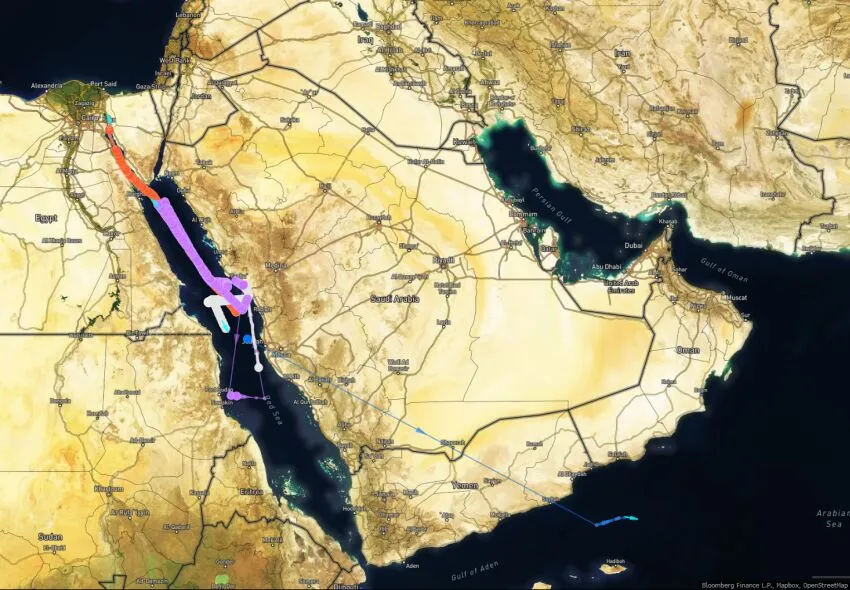
The Red Sea port of Yanbu is a crucial alternative for the oil market while Iran attempts to impede oil transport through the Strait of Hormuz. Recent satellite images from the European Union, taken two days after the blockade was announced, show tankers docked at four of Saudi Arabia's seven crude export berths.
A Greek-owned tanker carrying Saudi crude left the Red Sea while its transponder was off, as it passed through the Bab el-Mandeb strait, the narrow exit route. The Merbabu later appeared in the Arabian Sea on Thursday, having previously broadcast its position in the Red Sea. Ship charter documents indicate it is heading to India.
Additionally, the New Explorer, a supertanker owned by Hong Kong, was heading toward Bab el-Mandeb after being idle since Tuesday. Two Chinese tankers had already exited through the same route. The oil traffic in the waterway looks busy, as several ships are transporting Russian oil to India and beyond.
Important Decisions
For Western-operated vessels transporting Saudi oil, shipowners are facing challenging decisions about whether to risk passing through Bab el-Mandeb or take a more expensive and lengthy route around the African continent to reach Asian destinations. This detour requires navigating north through the Suez Canal and could almost double some voyage times.
With tensions in the Red Sea remaining high, a Danish-owned product tanker, Torm Innovation, turned around towards the northern route through the Suez after loading at Yanbu. The vessel is reportedly heading for Japan.
If Torm Innovation takes the Suez route, it follows the path of the Gas King, a liquefied natural gas carrier that opted for the diversion two days earlier and has started its journey through the canal.
The uncertainty in the Red Sea appears to be prompting some Asian oil buyers to consider sourcing Saudi cargoes outside of the Red Sea. Some are discussing with Saudi Aramco the possibility of rerouting shipments around Africa.
At least one very large crude carrier has been tentatively scheduled to pick up a cargo from Egypt’s northern coast for delivery to South Korea via the Cape of Good Hope, according to booking reports, marking the first of its kind in years.
Suez Bound
In another development, the very large crude carrier Olympic Luck, owned by Greeks, is also heading north from Yanbu. Its automated data indicates it is halfway full, allowing it to transit the Suez Canal without unloading any cargo. Fixture data show its destination is east of Saudi Arabia.
The Houthi attacks have introduced a new dimension to the conflicts in the Middle East, which have already limited shipping activity in the Strait of Hormuz. On Friday, vessel tracking showed that the strait was nearly deserted, with the supertanker Noble appearing to have entered the Persian Gulf with its transponders off. Recently, three supertankers exited the Gulf without broadcasting their positions.
The European Union's naval force has recommended that merchant vessels turn off their transponders if they visit ports in Saudi Arabia.
Loading activities at Yanbu, a key export facility in Saudi Arabia, do not seem to have significantly slowed down but have become less transparent. Tankers are disabling their signals as they approach the loading areas.
Satellite images from the European Union’s Sentinel 2 orbiters taken Wednesday show tankers moored at four of the seven crude berths at the two Yanbu terminals. Only two of these ships were visible on automated tracking systems.
Although automated signals showed no tankers docked on Friday, the absence of ships from tracking screens as they neared the terminals on Thursday strongly suggests that loading operations are ongoing, though the level of activity is unclear until the ships reappear or new satellite images are released.