
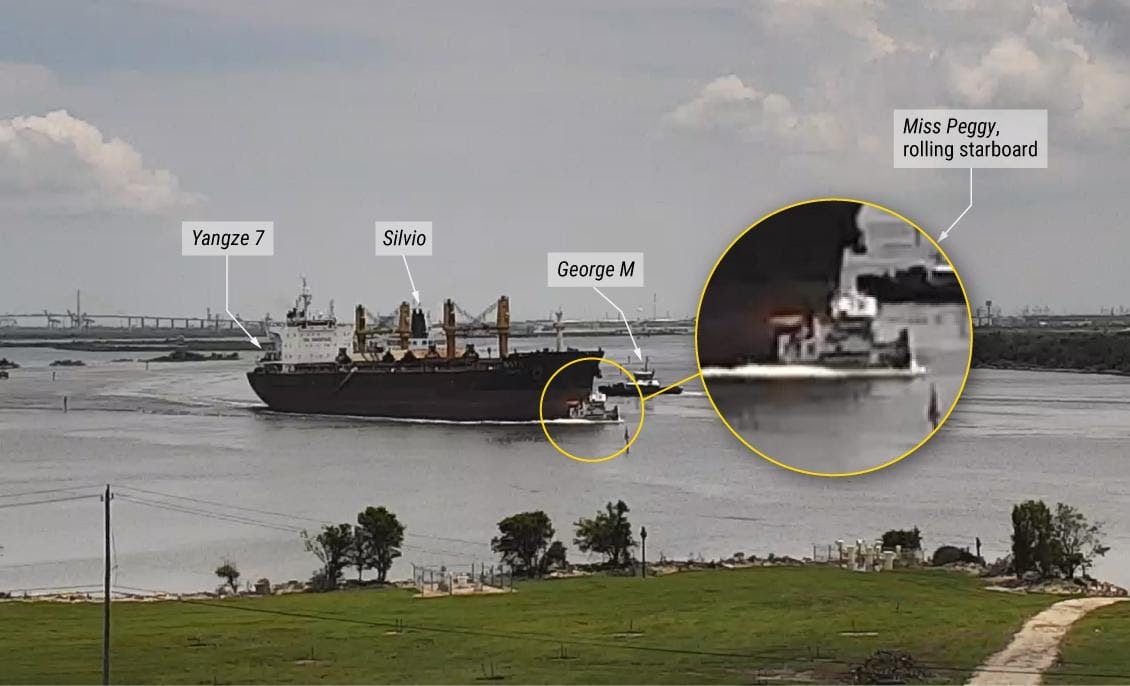
An investigation by the National Transportation Safety Board (NTSB) has revealed that a prolonged personal phone call by a Houston ship pilot, along with a lack of proper lookout, caused a fatal collision in 2024 between the bulk carrier Yangze 7 and the towing vessel Miss Peggy in the Houston Ship Channel.
The incident occurred on July 19, 2024, near Lynchburg, Texas, resulting in the Miss Peggy capsizing and sinking with five crew members aboard. Four of the mariners were rescued by a nearby vessel, but the fifth was later found dead in the wreck. One crew member suffered serious injuries, another had minor injuries, and some oil was spilled into the waterway. The total damage and cleanup costs reached about $3.7 million, while the Yangze 7 remained undamaged.
The NTSB found that the pilot of the 656-foot bulk carrier was on a non-work-related call with another pilot for 39 minutes before the crash. The call ended just over two minutes before the collision, but it distracted the pilot enough to lose sight of the towing vessel ahead.
The investigation also highlighted that the Yangze 7 bridge crew did not step in even after noticing the pilot was engaged in personal conversations, indicating poor bridge resource management. At least one officer expressed he was "very afraid" because the pilot was talking on a Bluetooth device while giving helm commands and the topics were irrelevant to navigation.
Similarly, the captain of the Miss Peggy failed to keep a proper lookout and did not see the bulk carrier approaching from behind. The Yangze 7 bridge crew only noticed the towboat when it was less than a ship's length away. The NTSB determined that all three parties—the pilot, the bridge crew, and the towing vessel's captain—lost situational awareness due to inadequate lookout practices.
The investigation revealed that at the time, there was no policy in place at the Houston Pilots regarding the use of personal electronic devices for non-work-related purposes while directing vessels. Investigators noted that this absence of policy likely made such practices seem acceptable, increasing safety risks for both vessels and crews.
The NTSB has urged the U.S. Coast Guard to ban the non-operational use of personal electronic devices for anyone directing vessel movements in U.S. waterways. They also called on the American Pilots’ Association to create guidance that prohibits pilots from using such devices while navigating and to encourage member associations to implement similar rules.
This report underscores a concerning trend of distraction-related accidents in marine environments. The NTSB found that distractions from personal electronic devices were either contributing factors or the main causes in at least 10 marine accidents from 2009 to 2024, resulting in three fatalities and 45 injuries.
The complete 92-page Marine Investigation Report identifies the loss of situational awareness among the Houston pilot, the Yangze 7 bridge crew, and the Miss Peggy captain as the main cause of the accident due to failure in maintaining proper lookouts. The report concludes that the pilot’s lengthy personal phone use, combined with the lack of a policy against it, directly contributed to the tragic outcome.