
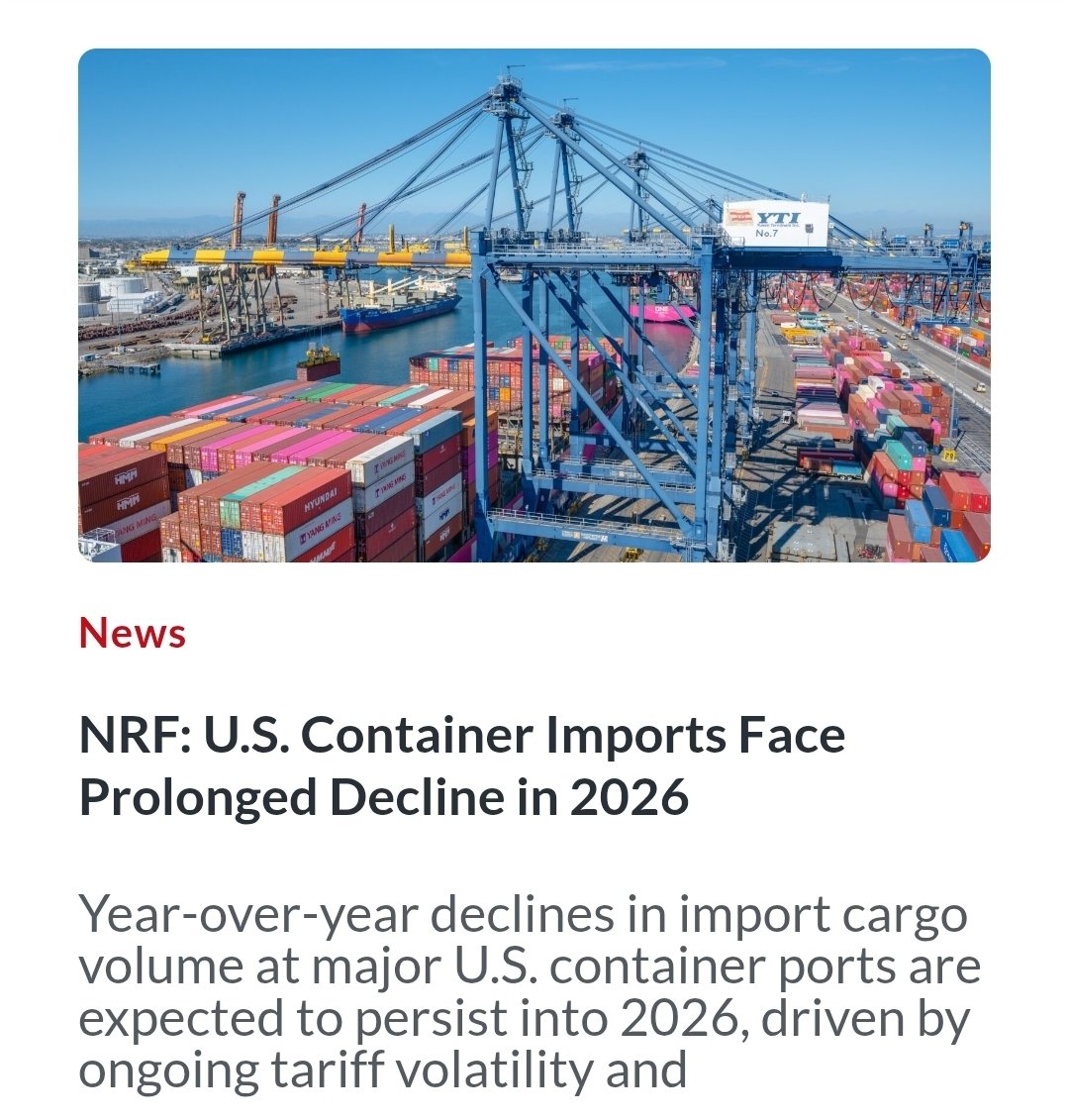
Major U.S. container ports are expected to see a continued drop in import cargo volume through 2026, mainly due to ongoing tariff fluctuations and changes in trade policy, according to the latest Global Port Tracker report from the National Retail Federation (NRF) and Hackett Associates.
The effects of increasing tariffs have continued to impact global supply chains, with demand for container shipping to the U.S. considerably weakening in the last quarter of 2025 and into early 2026. “We are experiencing the effects of tariffs, leading to a decline in cargo demand from the fourth quarter this year well into the first half of next year,” said Ben Hackett, founder of Hackett Associates. “Shipping rates for containers are already lowering on both coasts because there’s less need for space for goods coming from Asia and Europe.”
As stated in the Global Port Tracker report, U.S. ports processed 2.07 million Twenty-Foot Equivalent Units (TEU) in October, which is a decline of 7.9% compared to last year. The downturn is expected to become more pronounced, with November estimated at 1.91 million TEU (a drop of 11.6%) and December forecast at 1.86 million TEU (a 12.7% decrease). December is projected to be the slowest month since June 2023, following a high of 2.39 million TEU in July.
While the months of November and December are usually slower, the significant annual declines are due to various factors. Imports in late 2024 were higher because of fears of port strikes, and many retailers brought in goods earlier this year to avoid tariffs. This strategic approach has left store shelves well-stocked for the holiday season but created an empty cargo space in the following months.
“Stores are well-stocked and prepared for a record-breaking holiday season, but there's still a lot of uncertainty about trade policy in 2026,” said Jonathan Gold, NRF Vice President for Supply Chain and Customs Policy. “No matter what happens, retailers will adjust their supply chains and aim to provide consumers with affordable options while shopping.”
The landscape of trade policy is ever-changing. Recently, the administration lowered tariffs on some food items, but the fate of other tariffs under the International Emergency Economic Powers Act is being reviewed by the Supreme Court. Even if these tariffs are lifted, the administration is likely to look for other trade authorities to reinstate them.
For the full year 2025, the forecast is now set at 25.2 million TEU, which is a slight decline of 1.4% from 25.5 million TEU in 2024. This is an improved outlook compared to earlier estimates, which expected a decline of 5.6%. Looking forward to 2026, challenges remain, with January predicted at 2 million TEU (down 10.3%), February at 1.86 million TEU (down 8.5%), March at 1.79 million TEU (down 16.8%), and April at 1.97 million TEU (down 10.9%).
Despite these challenges in the maritime sector, the NRF is predicting that holiday sales will exceed $1 trillion for the first time, an increase of between 3.7% and 4.2% compared to 2024. This gap between strong consumer demand and lower import volumes shows how effective retailers' strategies have been in managing costs despite tariff pressures.
As the maritime industry moves through this uncertain period, experts agree that tariff policy will continue to be the main factor influencing cargo movement into 2026, with the container shipping market still adjusting to lower demand along both coasts.