
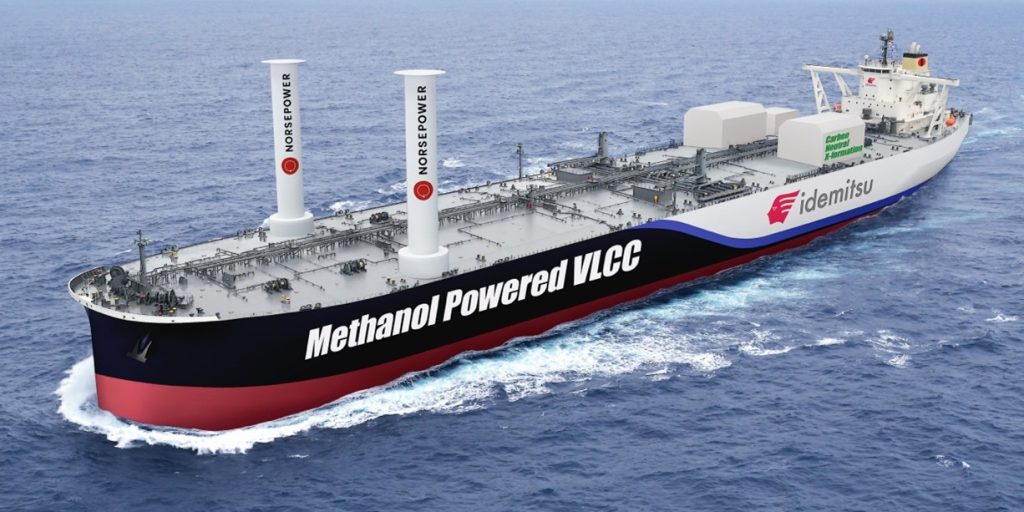
Norsepower and Idemitsu Tanker Co., Ltd. have teamed up to add advanced wind-assisted propulsion technology to two Very Large Crude Carriers (VLCCs). This is the first time that the world’s largest oil tankers will use mechanical sail power to cut down on emissions.
The ships are being built by Japan Marine United Corporation and Nihon Shipyard Co., Ltd. Each vessel will have two 35x5m “explosion-proof” Norsepower Rotor Sails installed when the first VLCC is completed in late 2028. This technology uses the Magnus Effect, which involves spinning cylinders that capture wind energy to provide clean propulsion.
This partnership highlights Idemitsu's commitment to sustainable shipping practices. In addition to the rotor sails, the VLCCs will come equipped with advanced energy-saving technologies and will be prepared for future low-carbon fuels, such as methanol.
Representatives from Idemitsu Tanker said, “We are speeding up the use of new technologies and are dedicated to achieving a carbon-neutral society through stable energy transportation and lower environmental impact. By adding the Norsepower Rotor Sail to our new VLCCs, we're not just investing in saving fuel and reducing emissions; we are also taking a crucial step toward decarbonizing long-haul shipping. This project reflects our goal of combining reliable operations with innovation to meet global energy needs responsibly.”
This agreement highlights Norsepower's growing presence in the tanker market, where they now have 22 rotor sail units on various vessels, including chemical tankers and both medium- and large-range tankers. Installing rotor sails on VLCCs marks a significant technical achievement and market validation for wind propulsion in the largest crude oil transport sector.
For Norsepower, this partnership also means major geographical growth. Heikki Pöntynen, the CEO of Norsepower, stated, “This is a landmark moment for both Norsepower and wind propulsion in global shipping. Working with Idemitsu Tanker and JMU on these first VLCCs equipped with rotor sails, especially as our first newbuild project in Japan, is a huge step forward. Japan has become the largest market for Norsepower projects, and this partnership confirms the trust in our technology and its applicability in all tanker sectors.”
The rotor sail technology offers measurable performance improvements. Each installation includes digital control systems that optimize operations in real time, adapting to wind conditions and routing for maximum efficiency. Norsepower claims these systems can typically reduce fuel consumption by 5 to 25 percent, with even greater savings possible in favorable wind scenarios.
As shipping companies face growing pressure to lower greenhouse gas emissions and adhere to new environmental regulations, wind-assisted propulsion technologies are becoming more popular as effective tools for decarbonization. The VLCC project serves as a model for how traditional fossil fuel transportation can embrace clean energy solutions while maintaining operational effectiveness.