
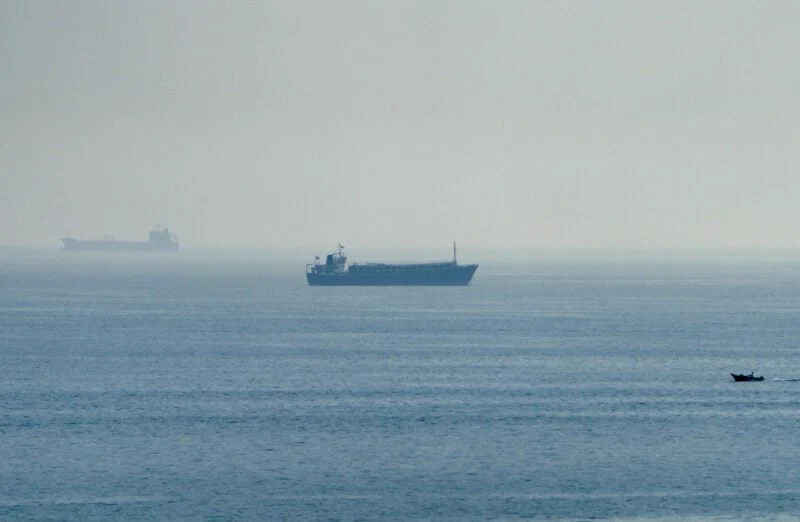
A tanker was hit by two unknown projectiles in the Persian Gulf on Sunday night, adding to a string of attacks on commercial shipping in the Strait of Hormuz. These incidents have damaged vessels, started fires on board, and led to the evacuation of 25 crew members.
The UK Maritime Trade Operations (UKMTO) reported that this latest attack occurred at 11:47 PM UTC on November 1, about 72 nautical miles east of Ras Al Khafji, Saudi Arabia.
The tanker was heading southeast when it was struck on the port side by two projectiles. All crew members were safe, and there was no reported environmental damage. UKMTO did not disclose the name of the vessel or the extent of the damage.
This attack followed another incident earlier that day in the Strait of Hormuz, where the captain of a merchant vessel reported a Mayday call received over VHF Channel 16 from another ship that had also been hit by an unknown projectile.
UKMTO issued Warning 191-26 for this earlier incident, which happened at 3:09 PM UTC. The details of the vessel, the damage, and the crew's condition remain unclear.
These two incidents are part of an increasing trend of attacks that threaten commercial shipping in the Arabian Gulf and the Strait of Hormuz.
Oman Evacuates 25 Crew Members
On Friday, the Royal Navy of Oman confirmed it evacuated 25 crew members from the Panama-flagged tanker RITI after the vessel was attacked and caught fire near the Musandam Peninsula.
The evacuation was coordinated with Oman’s Maritime Security Centre, and the rescued crew received medical attention.
A November 1 advisory from the Joint Maritime Information Center noted that RITI was hit by an unknown projectile on October 29 while leaving through the Strait of Hormuz near Khasab, Oman. This caused a small fire and loss of propulsion.
The advisory also mentioned another tanker, LOUISE 1, that was attacked on October 29 about 25 nautical miles northeast of Khasab.
In that incident, a small boat reportedly approached the tanker and attached two explosive devices to its hull above the waterline. The explosions caused a fire in the engine room and temporarily disabled the ship.
Luckily, the crew was safe, and the tanker was able to continue its journey.
A third tanker, the VLCC ARZANAH, was also hit by an unknown projectile while traveling through the Strait of Hormuz on October 28. While the vessel was damaged, its crew was safe.
Qatar Condemns Attack on LNG Carrier
The violence has escalated further into the Arabian Gulf.
Qatar's state-owned LNG shipping company Nakilat confirmed that its LNG carrier AL MAYEDA was hit by unknown objects while navigating the Gulf on October 30.
JMIC stated that this attack occurred approximately 40 nautical miles south of Iran's Lavan Island, resulting in a fire on board.
Nakilat reported that there were no injuries or environmental damage, and the vessel remained safe and operational.
In a statement on November 1, Qatar's Ministry of Foreign Affairs condemned the attack, calling it a serious threat to maritime navigation and global energy security.
The ministry expressed its intention to take necessary steps under international law to protect its ships and crews, while authorities investigate the incident to identify the culprits.
It also highlighted the potential environmental risks of targeting energy carriers, especially for the Gulf's marine environment and regional water security.
Maritime Security Threat Remains Severe
In its latest advisory, JMIC maintained a SEVERE threat assessment for the Strait of Hormuz, warning that more deliberate attacks are likely.
The center recorded 18 confirmed attacks in the Strait since October 6 as of its November 1 assessment, prior to including the latest UKMTO warnings.
JMIC also noted ongoing activities by the Iranian Revolutionary Guard Corps, including surveillance, UAV overflights, radio hailing, and pressure on merchant vessels to use Iranian-controlled routes.
Commercial traffic remains well below pre-war levels. JMIC reported 119 U.S.-facilitated transits between October 29 and 31, while about 490 vessels were waiting outside the Strait of Hormuz as of November 1.
The recent attacks highlight the ongoing risks faced by merchant vessels, even as U.S. naval forces coordinate shipping movements through this vital waterway.
With tankers and LNG carriers being targeted both within the Strait and deeper into the Arabian Gulf, the security threat extends beyond the narrow shipping corridor, raising further concerns about global energy supplies and regional maritime operations.