
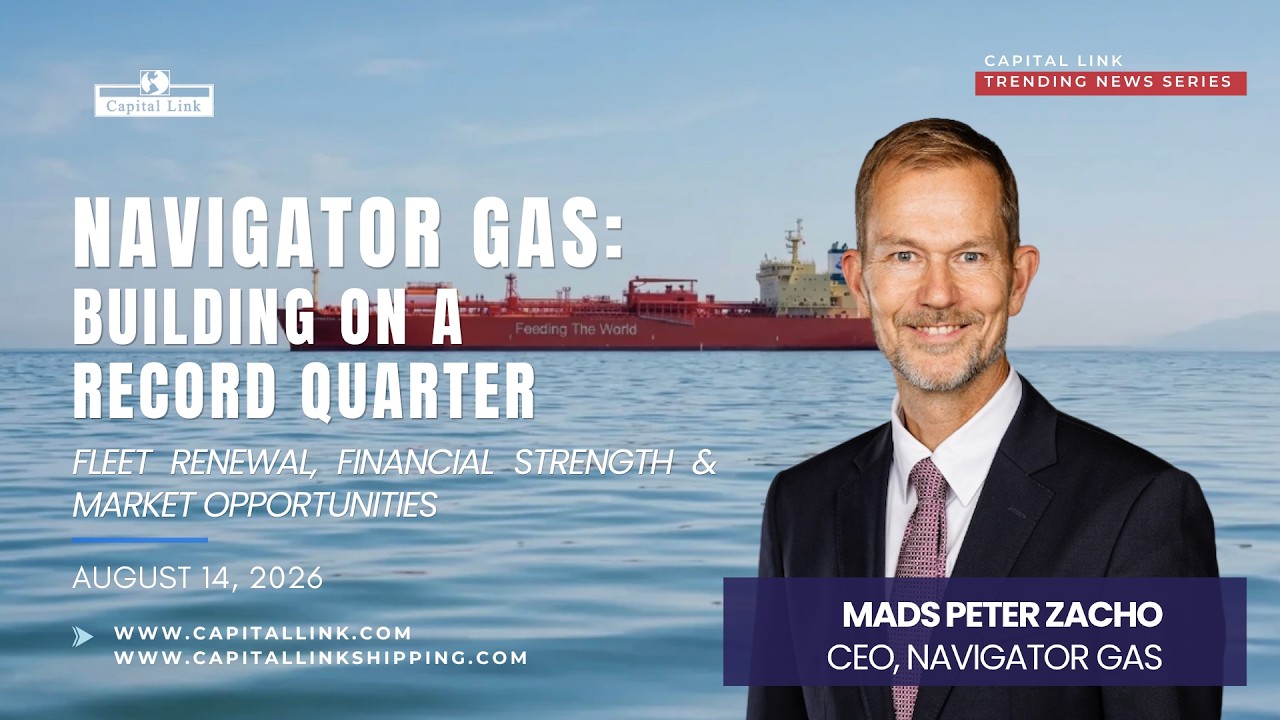
(Capital Link) – Navigator Gas has achieved its best quarterly results in 25 years, thanks to a surge in U.S. gas exports and longer shipping routes that have boosted earnings and terminal volumes to record levels.
In the second quarter, the company reported a net income of $53 million, or 86 cents per share, while EBITDA was $101.6 million. Adjusted EBITDA reached $86.4 million. The average daily earnings from charters hit a record of $33,946, with fleet utilization at 90.8%.
During a webinar hosted by Capital Link, CEO Mads Peter Zacho mentioned that this quarter showcased the earning potential of Navigator’s combined shipping and terminal operations, especially as geopolitical tensions are altering global gas trade patterns.
A significant factor driving these results was the handysize ethylene market, where longer trips and strong demand have reduced available vessel capacity. Navigator’s average earnings per day rose from $28,216 a year ago.
Additionally, Navigator has indirectly benefited from disruptions in the Middle East. Currently, the company does not transit through the Strait of Hormuz, and only about 3% of its export volumes came from the Gulf prior to the conflict, limiting exposure to risks.
The wider disruption has led some Asian buyers to seek suppliers farther west, increasing shipping distances and utilizing more vessel capacity.
Zacho pointed out that these longer shipping routes have supported fleet utilization and freight rates, making North American LPG, ethane, and petrochemical exports more appealing for buyers looking to diversify their supply sources.
U.S. Ethane Exports Boost Growth
Navigator views ethane as having the best growth potential among its main cargoes, which also include LPG, ethylene, and ammonia.
U.S. ethane remains a cost-effective petrochemical feedstock compared to naphtha, and expanding export infrastructure is enabling higher volumes to flow from North America to Asia. Ethylene similarly benefits from competitive pricing in European and Asian markets.
As a result, Navigator is adjusting its fleet accordingly.
Four new vessels capable of transporting ethane and ethylene are set to be delivered between December 2026 and December 2027, providing the company with additional capacity to engage in the growing trades. Overall, Navigator has six new vessels on order, with funding already secured.
The supply dynamics also appear favorable, with the handysize gas carrier order book at about 11% of the current fleet, and around 17% of vessels being over 25 years old.
Navigator anticipates that vessel retirements could result in limited or negative net fleet growth in the years ahead. Combined with increasing U.S. exports and longer travel distances, this may continue to support freight rates, even as conditions start to normalize after the unusually strong second quarter.
Morgan’s Point Achieves Record Volumes
The Morgan’s Point ethylene export terminal, which Navigator partly owns (50%), also reported record results.
The terminal’s throughput reached 374,278 tons this quarter, nearing its maximum capacity, generating $7.1 million in equity earnings for Navigator. Management expects the terminal to achieve its highest annual throughput in 2026.
Since the beginning of the year, four new offtake agreements have been signed, and discussions are ongoing with additional customers.
The terminal could also be a new capital source for Navigator. It has no debt currently, and Zacho stated that adding some debt could potentially free up as much as $150 million, although this is seen more as financial flexibility rather than an immediate plan.
Fleet Modernization Accelerates
Meanwhile, Navigator is selling off older and less essential vessels as it updates its fleet.
The company sold the Navigator Pegasus for net proceeds of $30.5 million, realizing a gain of $15.3 million. It has also agreed to sell eight gas carriers along with its stake in Unigas International B.V. for approximately $183 million, anticipating gains between $66 million and $69 million.
Management expects that the new vessels and newer secondhand ships will reduce the average age of its fleet, improve fuel efficiency, and increase earning potential.
As of June 30, Navigator had $225.9 million in unrestricted cash, which rose to about $362 million with restricted cash by August 3. The net debt to trailing 12-month Adjusted EBITDA ratio was 2.2 times.
This stronger financial position allows Navigator to pursue growth while still returning cash to shareholders.
The capital return policy targets a mix of fixed dividends and a variable component equal to 35% of net income attributable to shareholders. The board has approved an increase in the fixed quarterly dividend to 8 cents per share, starting with the results for the third quarter of 2026.
With the recently announced capital return, Navigator expects to have returned about $306 million to shareholders since December 2022.
Looking forward, the company is contemplating further purchases of secondhand vessels, newbuildings, and energy infrastructure investments, emphasizing that future projects should either complement its shipping operations or strengthen its position in the ammonia, ethane, and ethylene supply chains.
Overall, Navigator is betting that the rise in U.S. gas exports, the slow growth of the handysize fleet, and increasingly complex global trade routes will continue to create opportunities beyond just the record numbers seen in the second quarter.
The Capital Link webinar titled Navigator Gas: Building on a Record Quarter can be viewed below or here on Youtube.