
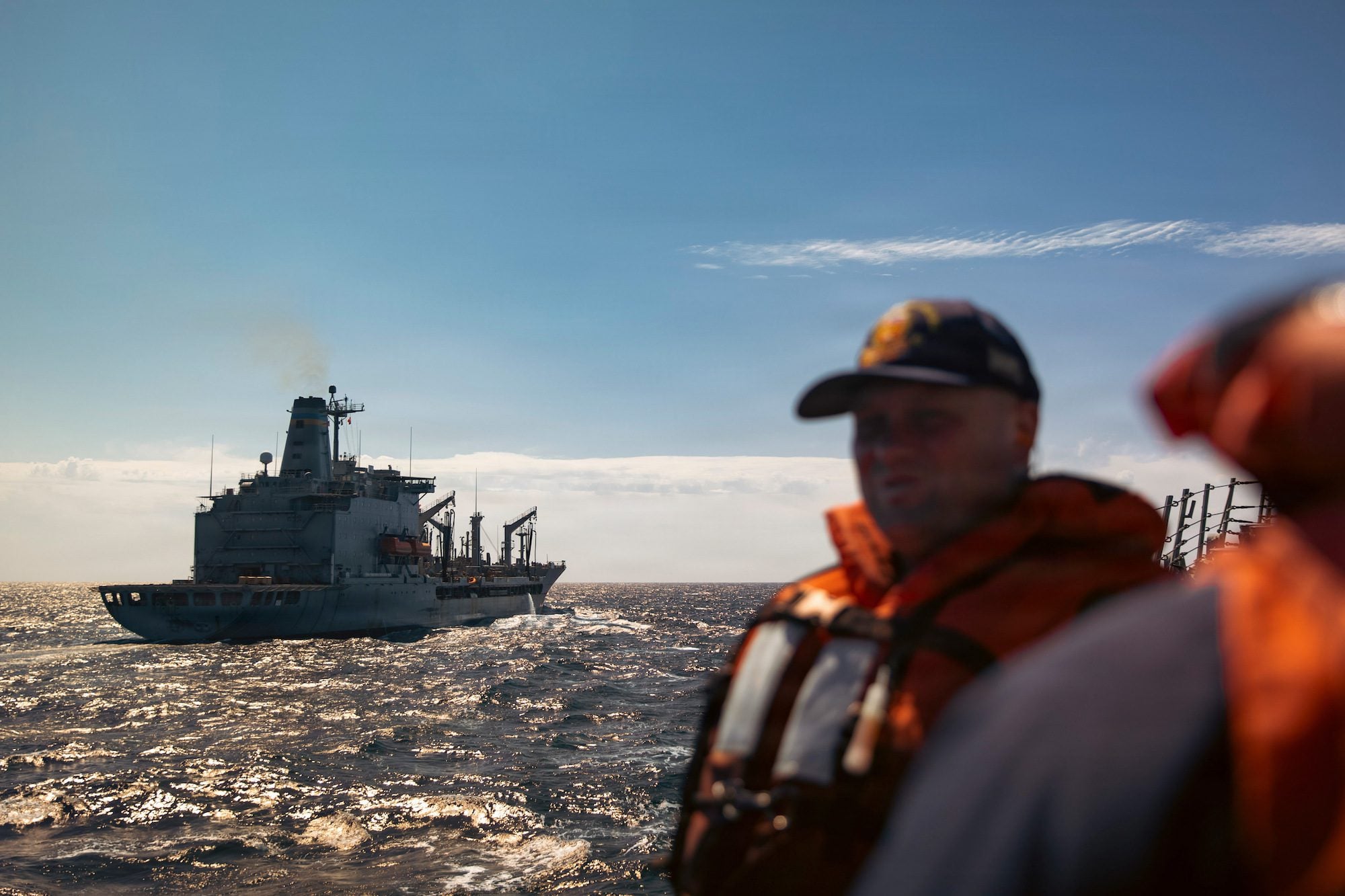
For the first time in its 77-year history, two ships from the Military Sealift Command have been awarded the Presidential Unit Citation (PUC). This award recognizes the contributions of civilian-crewed vessels that supported the Gerald R. Ford Carrier Strike Group during Operation Epic Fury.
On Tuesday, the Military Sealift Command announced that the fleet replenishment oiler USNS Kanawha (T-AO 196) and the dry cargo and ammunition ship USNS William McLean (T-AKE 12) have received this prestigious award for their vital logistics support to U.S. Navy and allied forces during their deployment.
The Presidential Unit Citation is one of the highest awards given to military units and is granted for extraordinary heroism in action against an armed enemy.
During a seven-month deployment, these two Combat Logistics Force ships completed 41 replenishments at sea, delivering 3.4 million gallons of jet fuel, 5.2 million gallons of F-76 marine diesel fuel, and 2,304 pallets of cargo. They also managed to process over 160 pallets of incoming aviation cargo, which was essential for the sustained operations of the strike group at sea.
In addition to the unit citation, 20 Civil Service Mariners (CIVMARs) on board Kanawha will receive individual awards for their outstanding performance during the deployment.
Adm. Karl Thomas, the commander of U.S. Fleet Forces Command, is set to present the Presidential Unit Citation to the crew of Kanawha in a ceremony at Naval Station Norfolk on July 17. A separate ceremony for William McLean will be announced later.
This recognition is a significant achievement for Military Sealift Command, which operates more than 140 civilian-crewed ships that provide logistics support for the U.S. Navy by delivering fuel, ammunition, supplies, and equipment to deployed forces around the world.
The USNS Kanawha, the 10th ship in the Henry J. Kaiser-class fleet oiler program, has been in service since 1991 and is run by a crew of 114 Civil Service Mariners. Along with ships like William McLean, the Combat Logistics Force allows U.S. and allied naval vessels to stay on station for longer periods without needing to return to port for resupply.
Throughout its 77 years, the Military Sealift Command has conducted hundreds of thousands of replenishments at sea in support of U.S. and coalition naval operations.