
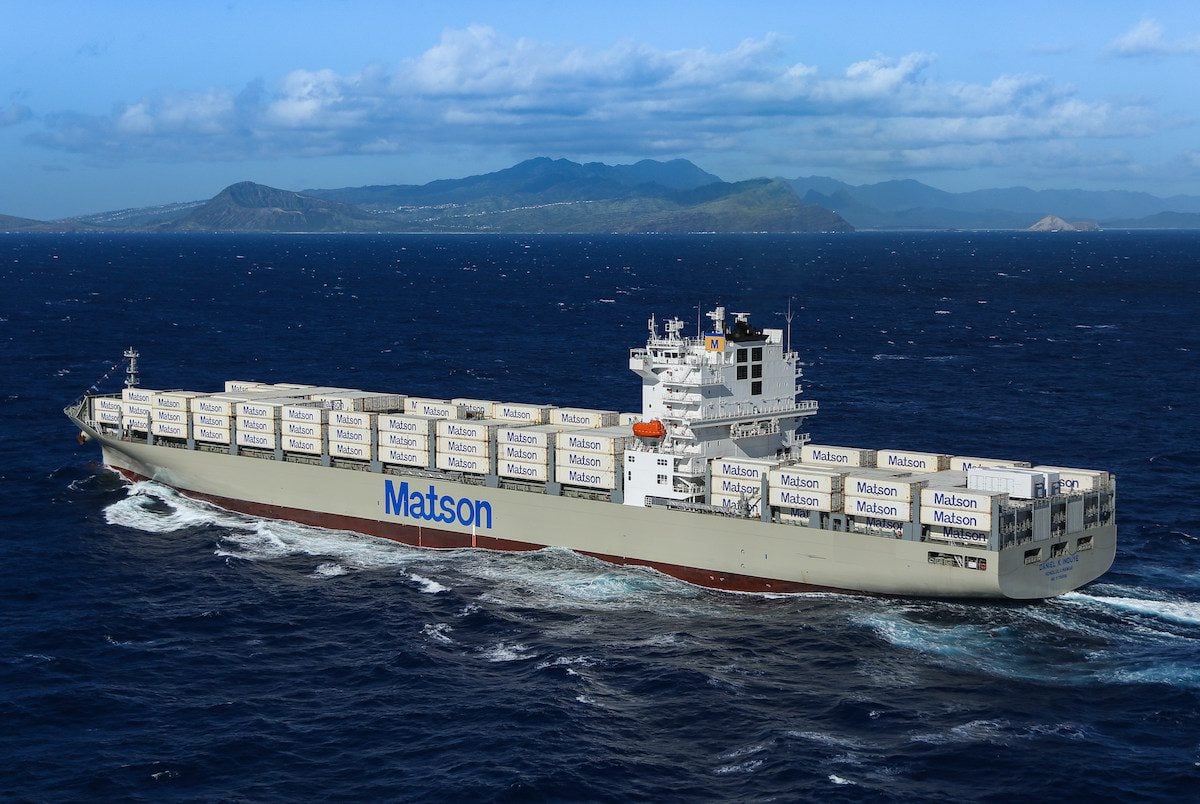
Matson’s $1 billion Aloha Class fleet renewal project reached an important milestone on Tuesday with Hanwha Philly Shipyard making progress on the construction of the second and third LNG-powered containerships intended for Jones Act trades.
This milestone follows the steel-cutting ceremony for the first vessel, which took place in October 2024 and marked the resumption of commercial containership construction at the Philadelphia yard, after years focusing mainly on government contracts and repairs.
On Tuesday, the construction team mounted the first grand block assembly for the second vessel at the dock, marking the beginning of hull assembly, and also officially cut the steel for the third ship in the series.
The three vessels will be used for Matson’s Hawaii and China-Long Beach Express (CLX) services, with deliveries expected in 2027 and 2028. They will replace three older vessels in Matson’s fleet and continue the company's effort to reduce emissions.
Like Matson’s current Aloha Class ships, Daniel K. Inouye and Kaimana Hila, built in 2018 and 2019, the new ships will be 854 feet long, with a capacity of 3,600 TEU and operational speeds over 23 knots, which is essential for Matson’s premium expedited Pacific services.
The new vessels will be equipped with LNG dual-fuel capability and additional energy-efficient technologies, supporting Matson’s goals for reducing greenhouse gas emissions.
This project highlights the increasing importance of Hanwha Philly Shipyard in the U.S. commercial shipbuilding industry, especially after its acquisition by South Korea’s Hanwha Group. This ownership change, completed after the original order announcement in 2024, marked the first significant Korean investment in a U.S. commercial shipyard and has reinvigorated Jones Act shipbuilding amidst a renewed focus on enhancing domestic maritime capacity.
According to Hanwha Philly Shipyard, they have delivered about half of all large ocean-going Jones Act commercial ships built in the United States since 2000.
In addition to the Matson project, the yard is also building National Security Multi-Mission Vessels for the U.S. Maritime Administration and an offshore subsea rock installation vessel named Acadia for Great Lakes Dredge & Dock.