
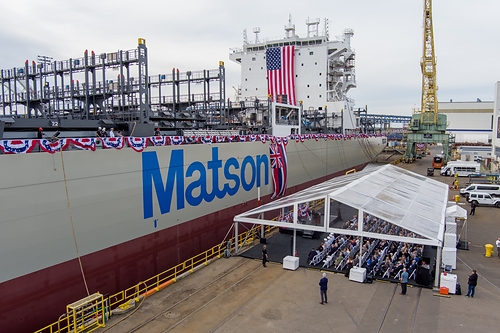
Matson has officially named the first of three new containerships built under the Jones Act at Hanwha Philly Shipyard. This event marks a significant point in the company's $1 billion plan to renew its fleet as the Philadelphia yard grows its commercial shipbuilding operations under South Korean ownership.
The new ship, Makua, was named on Saturday, October 10, in a ceremony that was attended by around 300 people, including shipyard workers, union representatives, company officials, and government dignitaries.
Jenai Wall, a member of the Matson board, traditionally broke a champagne bottle to christen the vessel. Notable attendees included Mark Johnson, Deputy Administrator of the U.S. Maritime Administration, and Lt. Gen. Jered P. Helwig, Deputy Commander of U.S. Transportation Command.
The ship, which has a capacity of 3,600 TEUs, is set to be delivered in the first quarter of 2027. It will serve in Matson's routes between Hawaii and the China-Long Beach Express (CLX).
Makua is the first of three new Aloha Class containerships that Matson has ordered as part of its roughly $1 billion investment. The next ship is expected to be delivered in the third quarter of 2027, while the third will arrive in the second quarter of 2028.
These new ships will replace three older vessels and are designed to increase capacity and enhance efficiency in Matson's Pacific services.
The new vessels share design features with Matson's existing Aloha Class ships, Daniel K. Inouye and Kaimana Hila, which were built by the Philadelphia yard in 2018 and 2019. Those ships set records as the largest containerships ever constructed in the U.S.
Each new ship will be about 850 feet long, have a capacity of 3,600 TEUs, and reach speeds of nearly 24 knots, enabling Matson to maintain rapid transit times for its premium services in the Pacific.
Additionally, each vessel will come equipped with LNG-ready dual-fuel engines, which can run on both traditional marine fuels and liquefied natural gas. They will also feature fuel-efficient hull designs and freshwater ballast systems.
“We look forward to putting Makua into service for our customers early next year,” said Matt Cox, Chairman and CEO of Matson.
Cox noted that these new ships will enhance reliability and capacity, while also supporting hundreds of jobs in U.S. shipyards and creating opportunities for American mariners over their operational lifespan.
This christening also signifies Hanwha's continued growth in U.S. shipbuilding since its acquisition of the former Philly Shipyard in late 2024.
Construction of the three vessels has progressed steadily over the last two years. Steel cutting for Makua began in October 2024, with hull assembly starting in August 2025. In May, the shipyard began work on the second ship, Malama, and started cutting steel for the third ship, Makena.
This program is part of a broader effort at the Philadelphia facility, where Hanwha is increasing its commercial orders while also seeking more U.S. government and naval shipbuilding projects. The yard has produced National Security Multi-Mission Vessels for the Maritime Administration and has received orders for tankers and LNG carriers.
“The naming of Makua is particularly significant because Matson has been a vital part of this shipyard since its early days,” said David Kim, CEO of Hanwha Philly Shipyard.
“Our partnership has lasted for generations of ships and shows a strong commitment to American shipbuilding and the maritime industry in the U.S.”
The relationship between Matson and the Philadelphia shipyard goes back more than twenty years. Prior to building the first two Aloha Class vessels, the yard delivered four Jones Act containerships to Matson between 2003 and 2006.
The names of the latest vessels continue Matson's tradition of reusing names from its early fleet. Makua, Malama, and Makena were originally freighters that Matson acquired in the 1920s, built for the United States Shipping Board.
In Hawaiian, the name Makua means parent, elder, ancestor, or family.