
By Lori-Ann LaRocco – Political tensions, lack of clear data, vessel attacks, and the political climate are changing trade patterns in the Middle East.
“Geopolitics is changing maritime markets, and we are starting to factor in a long disruption,” said Richard Meade, editor-in-chief of Lloyd's List.
The conflict between the U.S. and Iran has been ongoing for 173 days. After the Memorandum of Understanding ended, U.S. President Donald Trump has warned of economic consequences for countries supporting Iran.
“An agreement between the U.S. and Iran is unlikely to happen soon,” noted Dina Arakji, an analyst at Control Risks. “Trump’s strategy involves applying economic pressure on Iran to strengthen the U.S. position without escalating military conflict.”
Iran claims that this "economic warfare" will not succeed. Recently, the UAE, Iran’s second-largest trading partner, announced it has halted trade with Iran following missile attacks.
Meade added, “Any resolution will have to involve the GCC, Gulf States, Iran, and the U.S. Trade is not expected to return to pre-conflict levels; we are still far from agreement.”
According to Arakji, Iran is taking a long-term negotiation approach, hoping that rising energy prices in the U.S. will create economic strain on American consumers and increase political pressure before the U.S. midterm elections.
“For now, military escalation seems to have decreased somewhat,” said Arakji. “However, the risk remains, and we believe any such events will be temporary and not on the scale seen earlier this year.”
One reason for the reduction in military tensions, Arakji pointed out, is the dwindling offensive and defensive weapons of the U.S. and its Gulf allies.
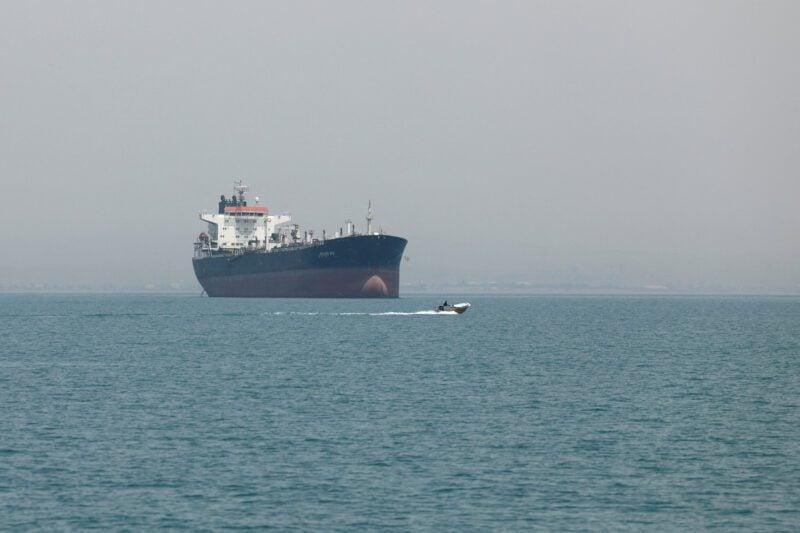
The situation at the Strait of Hormuz remains unchanged. Both parties claim control over their routes, but no Iran-related Very Large Crude Carriers (VLCCs) have been spotted transiting for four weeks.
“The flow of vessels in and out of the Strait of Hormuz is about 50/50,” said Bridget Diakun, maritime intelligence director for Lloyd's List Intelligence. “Tankers are making most of the transits, along with some bulk carriers.”
In a recent update on the Iran conflict, Lloyd's List Intelligence recorded 39 tanker movements, a drop from 48 the previous week. Diakun emphasized that these figures are subject to change because many ships are operating without detection.
“There's not enough reliable information,” Diakun said regarding CENTCOM's announcement that the U.S. military is moving 10 million barrels of oil daily through the Strait of Hormuz.
“It’s challenging because ships often travel at night, while satellite imagery is typically captured during the day,” she added. “We know tankers are moving, and we trust our data. However, the Joint Maritime Information Center run by the U.S. Navy does not reflect the numbers stated by the U.S. It's a tough situation, and we're doing our best to provide accurate information.”
Tanker operators are navigating the situation differently. Saudi Aramco and Adnoc are using ship-to-ship transfers and rerouting exports through Egypt's Sidi Kerir terminal.
Conversely, Cosco Shipping Energy Transportation and China Merchants Energy Shipping have mostly stopped sending tankers through the Strait of Hormuz and Bab el Mandeb.
However, this could change soon.
“I've heard discussions this week about China reconsidering that decision,” said Cichen Shen, maritime intelligence director for APAC at Lloyd's List. “There are talks that the Chinese government is evaluating plans to resume trade in the Persian Gulf.”
Shen mentioned that if that occurs, crude imports would likely increase, leading to more Chinese tankers returning to the Middle East for cargo.
“The Middle East is not the only source for China, but it remains a significant player in crude imports,” Shen stated. “This is something to monitor going forward.”
Geopolitical factors also play a role.
Chinese President Xi Jinping is set to meet Trump in the U.S. on September 24. Trump's warning of economic repercussions for countries supporting Iran could influence trade discussions.
“If China decides to send its ships back through the Strait of Hormuz, they will likely need to navigate through Iran-approved routes,” said Shen. “If they do, they will also have to negotiate with the U.S. for clearance.”
Previous briefings suggested that vessels using Iranian-controlled routes likely incur a toll for safe passage.
However, insurers view any such payment as voiding the vessel's insurance in case of damage.
Recently, a Chinese-chartered vessel, the GasLog Shanghai, was attacked in the Middle East.
“Chinese lessors are becoming increasingly cautious about sending their vessels into the region,” said Shen. “They are concerned about the safety of their assets and insurance coverage.”
“Who will take on that loss?” Shen asked. “The legal, compliance, and commercial teams of Chinese vessels are now closely reviewing all contracts to better understand the risks of operating in that area.”