
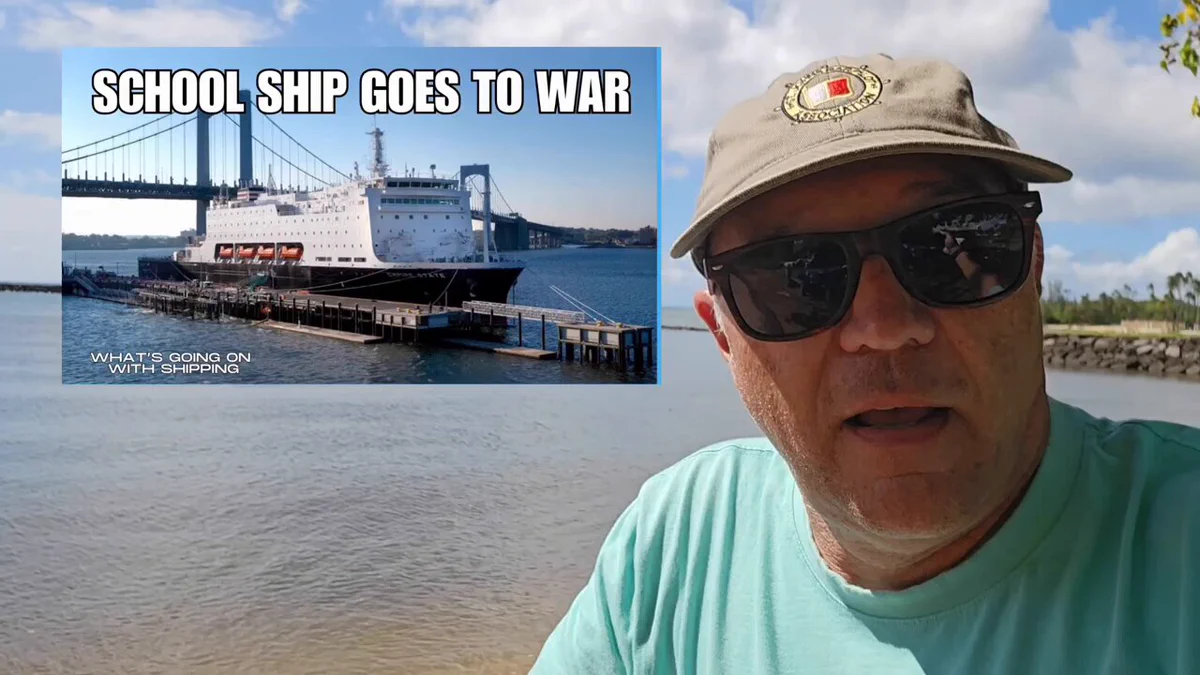
The U.S. Maritime Administration has decided to activate SUNY Maritime College’s Empire State VII for a classified national security mission because no other suitable vessel is available for an urgent Military Sealift Command need, based on a decision memo reviewed by gCaptain.
In a memorandum dated August 28, signed by Maritime Administrator Stephen M. Carmel, details were provided about the decision to take the newly built training ship from SUNY Maritime for about 170 days starting September 1.
MARAD stated that the activation followed a specific operational request from the Commander of Military Sealift Command, facilitated through U.S. Fleet Forces Command, and described the mission as a "compelling strategic necessity."
“The mission requires a vessel with NSMV Empire State VII’s capabilities at a time when no other suitable vessel is available,” Carmel noted.
The exact details of the mission are classified as SECRET, according to the memorandum.
This situation raises questions about the U.S. sealift capacity and how SUNY Maritime is reacting to the activation.
The seven-page memo highlights MARAD’s authority to temporarily take control of Empire State VII, emphasizing that the federally owned vessel must be available for priority missions and that the academy cannot impede the activation.
“Approval from the academy is not needed and is not being sought,” Carmel stated.
MARAD also explains procedures for any potential disputes, noting that while SUNY Maritime can appeal operational instructions regarding the activation, they must comply during any appeals.
The wording suggests that MARAD expected objections about the decision or its impact on the college, though the memo does not indicate whether SUNY Maritime has formally opposed the activation.
SUNY Maritime President Rear Admiral John A. Okon took a cautious approach in addressing the activation, informing the college community that “there is still much that we do not know” and recognized that the decision might cause “anxiety and stress.”
“We have a lot to figure out, but our immediate responsibility is to prepare the vessel for federal use while remaining focused on our ongoing mission of training the next generation of maritime leaders,” Okon remarked.
This might lead to significant disruption as Empire State VII is the main training vessel for SUNY Maritime, and a mission lasting about 170 days starting in September could keep the ship out of service until around February 2027.
MARAD promised to work with the college to reduce academic disruption and find alternative ways for affected cadets to meet their sea-time and credentialing needs.
The activation also raises concerns regarding U.S. sealift readiness.
The memo does not specify what exact capabilities MSC needs from Empire State VII, nor does it clarify why another government or commercial vessel cannot satisfy the requirement, or why this ship was chosen over other National Security Multi-Mission Vessels.
MARAD indicated that Empire State VII is “urgently required to support our troops, fulfill national defense requirements, and serve the United States.”
The mission request is currently undergoing final review by the Under Secretary of Defense for Acquisition and Sustainment, as noted in the memorandum.
This activation represents the first federal use of a National Security Multi-Mission Vessel, which is a new class of ships aimed primarily at training future U.S. Merchant Marine officers while also providing vessels for emergency and national security tasks.
Delivered to MARAD in September 2023, Empire State VII is the first of five NSMVs assigned to the country’s state maritime academies.
Although operated by the academies, the ships are still federal property and part of the National Defense Reserve Fleet.
These vessels are designed with capabilities that go beyond cadet training. Each can carry up to 600 cadets during missions, and up to 1,000 people during emergencies. They also have hospital facilities, helicopter landing pads, roll-on/roll-off ramps, and storage for personnel, vehicles, and supplies.
MARAD is invoking provisions from its agreement with SUNY Maritime that allow the vessel to be reserved for federal use as needed.
“Training Ships shall be available for emergency and other priority uses whenever deemed necessary by the Administration without liability to the Academy for such use,” the agreement states, as referenced in the memo.
The memo underscores that Empire State VII is not owned by SUNY Maritime and remains a public vessel of the United States. MARAD clarified that the requirements for using the ship for training while in academy custody do not prevent the government from reclaiming it for priority missions.
In conclusion, MARAD stated that the academy “must therefore make the vessel available and assist in the temporary transfer of custody.”
However, the academy's permanent officers and crew cannot be forced to participate in the mission.
MARAD may appoint a general agent to operate the vessel and arrange personnel as needed. Qualified SUNY officers and crew can volunteer due to their familiarity with the ship, but the memo states that “the mission will proceed with or without that participation.”
The details regarding the mission's nature and destination have not been made public.
Unverified reports have suggested that Empire State VII may support military logistics at Diego Garcia, a crucial U.S.-British military base in the Indian Ocean, amid ongoing U.S. operations related to the conflict with Iran. However, gCaptain has not confirmed these details, and the MARAD memo does not mention Diego Garcia, Iran, or any other specific destination.
The activation comes during a time of increased U.S. military logistics needs due to operations in the Middle East and growing focus on the aging state of the nation's sealift fleet.
Military Sealift Command manages the Navy’s fleet of government-owned support and sealift vessels, while MARAD maintains additional ships through the Ready Reserve Force for military needs. The Pentagon can also access U.S.-flagged commercial vessels for more capacity.
The memo does not disclose whether other MSC ships, Ready Reserve Force vessels, or commercial U.S.-flagged ships were considered before deciding that Empire State VII was necessary.
However, it is clear from the memo that no other suitable vessel was available within the required timeframe. “This activation is a matter of compelling strategic necessity,” Carmel concluded.