
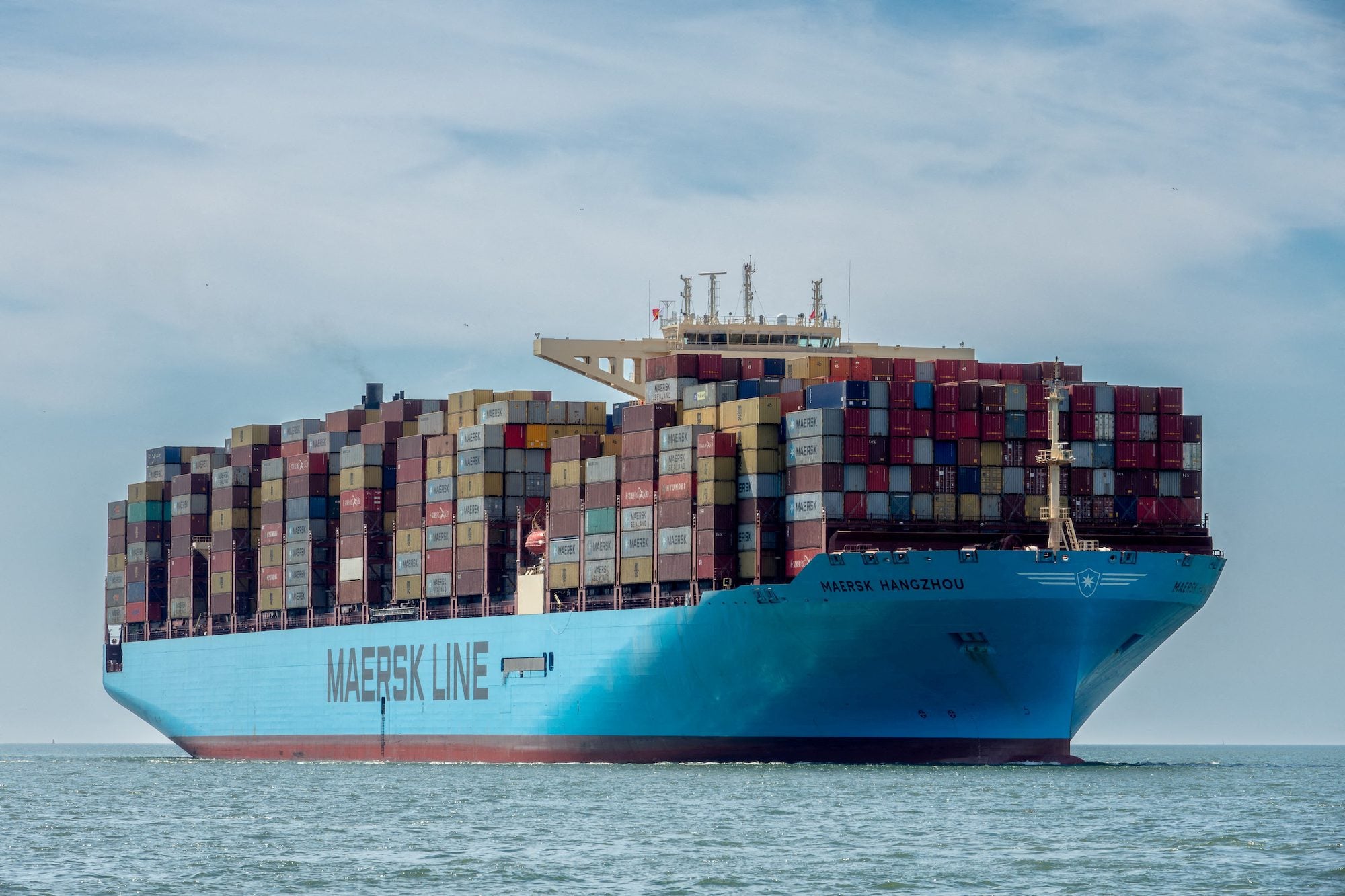
Maersk is maintaining significant cargo limitations and emergency fees in the Persian Gulf. This indicates that commercial shipping is still far from back to normal, despite recent news of a U.S.-Iran agreement to reopen the Strait of Hormuz.
In an operational update released on Tuesday, the Danish shipping company expressed that the situation in the Middle East is still “highly volatile” and cautioned customers that conditions can change quickly.
Maersk is continuing to suspend or limit bookings for various types of cargo across Iraq, Kuwait, Qatar, Bahrain, certain parts of Saudi Arabia, and the United Arab Emirates. Restrictions are still in place for refrigerated cargo, hazardous materials, and oversized items, while dry cargo bookings are also restricted in several markets.
Additionally, Maersk is introducing a new Emergency Freight surcharge for the Strait of Hormuz to cover the costs associated with rerouting cargo, temporary storage, and other emergency measures. The fees are set at $1,800 for a 20-foot container, $3,000 for a 40-foot container, and $3,800 for refrigerated, special, and hazardous materials containers.
This advisory illustrates that the supply chain is still functioning under conditions similar to wartime, even as diplomats discuss reopening the most important shipping lane in the region.
“Due to the volatility of the ongoing situation, there is a need for alternative solutions to transport your cargo to its final destination, including finding alternate routes and transit storage,” Maersk stated.
Instead of returning to traditional shipping routes, the company is relying on alternative methods developed during the crisis. Cargo heading to Kuwait, Iraq, Qatar, Bahrain, and parts of the UAE is being rerouted through Salalah and Khor Fakkan, before being transported overland and reconnecting with regional feeder services.
Maersk mentioned that cargo already in transit might be stored temporarily until it is safe and practical for onward transport. The company also warned that it may declare “abandonment of carriage” in some cases if the disruptions continue.
The uncertainty also affects insurance markets. While Maersk Cargo Insurance is still available, the company pointed out that some insurers have reduced or withdrawn coverage for shipments passing through the Red Sea, Gulf of Oman, and Persian Gulf, especially for the vessels themselves.
This update highlights a point that shipping executives and maritime organizations have stressed in recent days: reopening the Strait of Hormuz does not automatically mean that normal trade flows will resume.
Even if diplomatic agreements hold, carriers, insurers, and cargo owners must still deal with security concerns, rerouted supply chains, and increased operating costs after months of disruption in one of the world’s most strategically significant maritime routes.