
By Derek Wallbank
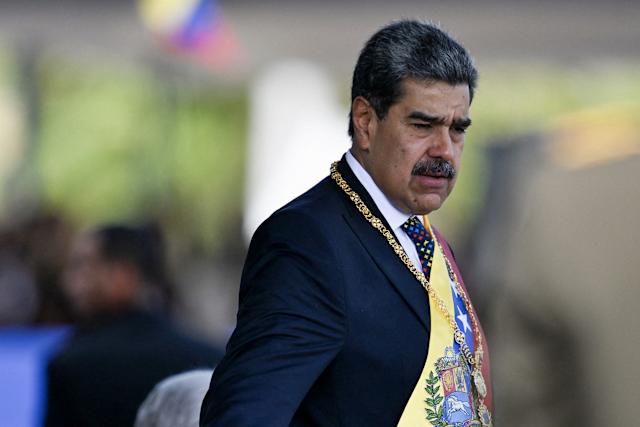
Jan 3, 2026 (Bloomberg) – President Nicolás Maduro has been charged in the US after being captured and flown out of Venezuela. This follows a series of airstrikes that represent a significant escalation in the Trump administration’s ongoing campaign against the country.
“The United States has successfully carried out a major strike against Venezuela and its leader, President Nicolás Maduro, who, along with his wife, has been captured and taken out of the country,” President Donald Trump stated on social media Saturday.
US Attorney General Pam Bondi announced on X that Maduro and his wife, Cilia Flores, have been indicted. Maduro faces serious charges including “Narco-Terrorism Conspiracy, Cocaine Importation Conspiracy, Possession of Machineguns and Destructive Devices, and Conspiracy to Possess Machineguns and Destructive Devices against the United States.”
Trump indicated there would be a press conference scheduled for 11 a.m. at Mar-a-Lago, his estate in Palm Beach, Florida.
The capture of Maduro marks an unprecedented intervention and a dramatic fall for a leader who has been in power since 2013. The airstrikes drew condemnation from Maduro's supporters, including Russia’s foreign ministry and Colombian President Gustavo Petro, who called for a meeting of the United Nations Security Council. Conversely, Trump allies such as Argentina's President Javier Milei celebrated the news.
Maduro has been the focus of a US pressure campaign since Trump's first term. The Trump administration has accused him of leading a drug-trafficking organization that poses a national security threat, while Trump has also referenced Venezuela's vast oil reserves.
Although many international companies are hesitant to operate in Venezuela due to US sanctions, Houston-based Chevron Corp. remains a significant partner with the state oil producer, under a special license from the Treasury Department. The company has not responded to requests for comments sent outside regular business hours.
For months, Trump has been mobilizing American military forces in the region, authorized attacks on alleged drug-running boats, and organized a blockade of sanctioned oil tankers related to Venezuela.
Some Democratic lawmakers criticized the military operation on social media before Maduro’s capture was announced.
Arizona Senator Ruben Gallego stated, “This war is illegal; it’s embarrassing that we went from being the world cop to the world bully in less than a year. There is no reason for us to be at war with Venezuela.”
Last month, Trump warned his campaign would “only get bigger, and the shock to them will be like nothing they have ever seen before.” Secretary of State Marco Rubio described Venezuela’s ties with drug traffickers and terrorists as a direct threat to US national security.
US Senator Mike Lee, a Republican from Utah, reported that Rubio said Maduro will face trial on criminal charges in the US. According to Lee's phone conversation with Rubio, no further actions are expected in Venezuela now that Maduro is in US custody.
European Union foreign policy chief Kaja Kallas also expressed the need for restraint and reiterated the bloc's position that Maduro lacks legitimacy.
The Russian Foreign Ministry condemned the US for what it called “an act of armed aggression against Venezuela,” urging for the avoidance of further escalation. Colombia's President Petro rejected “the aggression against the sovereignty of Venezuela and of Latin America,” adding that internal conflicts should be resolved peacefully by the involved peoples.
Explosions in the capital began around 2 a.m. local time, with aircraft visible and audible overhead for hours. Multiple blasts targeted the Fuerte Tiuna military base in Caracas.
The Venezuelan government claimed military and civilian targets were hit in three states, describing it as an attempt by the US to seize the country's oil resources. Unverified videos showed aircraft flying over Caracas and missiles striking urban areas.
The government urged “the peoples and governments of Latin America, the Caribbean, and the world to mobilize in active solidarity against this imperial aggression.”
Despite having some of the world’s largest oil reserves, Venezuela's role in global markets has declined due to a significant drop in oil production that began in 2015. Currently, it produces just under a million barrels a day, contributing less than 1% of global output, most of which is sent to China. Oil markets are experiencing a surplus, which is expected to continue early this year, allowing for a management of any disruptions in Venezuela's output.
On Friday, Maduro received a high-level Chinese delegation in Caracas, including Special Representative of the Chinese Government on Latin American Affairs Qiu Xiaoqi. It's unclear if these diplomats were still in the country at the time of the attack.
The American operation coincided with the anniversary of Panamanian leader Manuel Noriega's surrender to US troops in 1990 after seeking asylum in the Vatican embassy. He was flown to Miami for trial and imprisonment.
Maduro’s removal could mark a turning point for Venezuela and its people, who have struggled for years to replace him through elections that have faced accusations of fraud and repression.
The focus now shifts to opposition leader María Corina Machado, who is currently in hiding, and her stand-in candidate for the 2024 presidential elections, Edmundo González, who is viewed as a potential winner based on a parallel vote count and is currently exiled in Spain.
After her delayed appearance in Oslo to collect the Nobel Peace Prize in mid-December, Machado mentioned she would return to hiding in Venezuela.
Maduro's presidency has been characterized by a prolonged political, social, and economic crisis, facing widespread accusations of authoritarianism, human rights violations, and repression of dissent. Under his leadership, Venezuela has experienced hyperinflation, severe shortages of food and medicine, and the migration of over 8 million Venezuelans, marking one of the largest migration waves globally.
The capture of Maduro after a series of airstrikes contrasts sharply with Trump’s previous promises to end wars and refrain from initiating new conflicts. His first 11 months in office have seen military actions against Iran, the Houthis in Yemen, and suspected Islamic State targets in Nigeria and Syria.
Trump had previously warned against such interventions, stating to an audience in Saudi Arabia that “interventionists were getting involved in complex societies they did not understand.”
“In recent years, many American presidents have fallen into the trap of believing that it's our job to judge foreign leaders and to use US policy to enact justice for their wrongdoings,” he remarked at that time.