
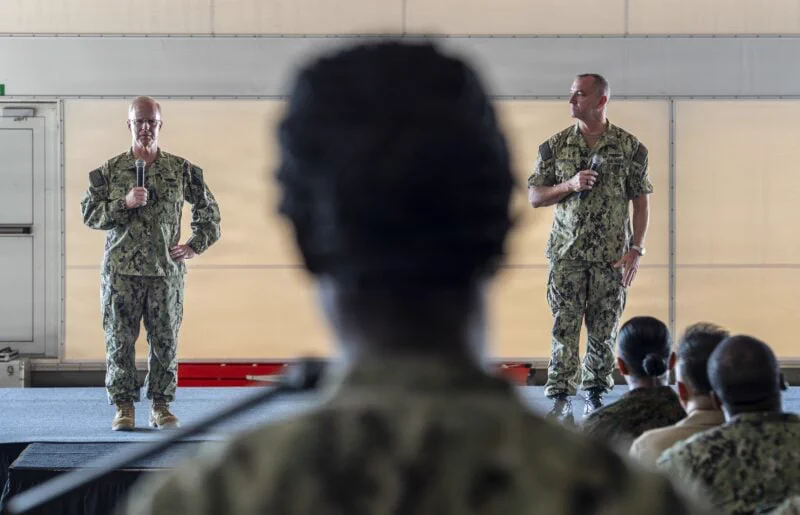
By Chris Servello (OpEd) The Navy may see ten and eleven-month deployments becoming the norm for the next few years. This was the message shared by Chief of Naval Operations Admiral Daryl Caudle and Master Chief Petty Officer of the Navy (MCPON) John Perryman last week. While this news isn’t particularly hopeful, it’s essential information that Sailors and their families should know.
Both leaders deserve credit for being honest about the situation.
For a long time, the Navy has struggled to meet growing demands with a shortage of ships. Deployments are often prolonged, maintenance schedules are delayed, and crews find themselves away from home longer than expected. This has been ongoing, but it matters that top Navy officials recognize that longer deployments may soon be standard.
MCPON Perryman highlighted that uncertainty makes these deployments particularly challenging. Families can prepare for a ten-month separation, but it’s much tougher when a seven-month deployment turns into eight, nine, or even ten months, especially when extensions are announced just as a homecoming seems near.
Admiral Caudle is also correct that the ultimate solution is to have a larger Navy with increased capacity and flexibility. This has been needed for a long time, and the urgency has intensified.
However, constructing new ships and expanding shipyard capacity requires time. It also takes time to address maintenance backlogs and to recruit more qualified Sailors. Even if the Navy acts swiftly today, significant improvements are years away.
This brings us to an immediate question: What can the Navy do now to make these longer deployments more manageable?
Retired Admiral Bill Moran, who has served as Chief of Naval Personnel and later as Vice Chief of Naval Operations, often emphasized three key principles for managing Navy personnel: Trust, Balance, and Stability.
These principles provide a solid framework for what needs to happen next.
Start With Trust
Trust is built by being open with people, especially when the news isn’t positive.
If deployments are expected to last ten or eleven months, communicate that clearly. Don’t create optimism around a seven-month deployment when it’s likely to extend. And whenever plans change, provide explanations as soon as operational security permits.
Families make real-world decisions based on deployment timelines. Childcare, jobs, finances, school schedules, and family obligations all depend on knowing when someone will return. Frequent extensions make challenging situations significantly harder.
It’s understood that the Navy can't predict every crisis or operational need, and no one expects it to. But there’s a significant difference between uncertainty due to military operations and uncertainty stemming from poor communication.
Trust also involves listening to families. Navy families know where support systems work and where they fall short. Commanding officers and senior leaders should have the flexibility to address these issues without bureaucratic hurdles for reasonable requests.
Find Some Balance
No one joins the Navy expecting life to be easy. Long deployments and missed significant moments are part of the job. Sailors understand this, and their families usually do as well.
However, accepting these sacrifices doesn’t mean the Navy should make life harder than necessary.
If ten and eleven-month deployments become commonplace, the Navy should explore every possible way to alleviate this burden.
While at sea, this includes protecting port visits when possible, improving communications with home, ensuring access to good food and mail, and finding opportunities for rest. Though these may seem small compared to the mission, anyone who has been deployed knows their importance.
Back home, it’s crucial to enhance existing family support programs. Access to childcare, emergency assistance, and job support for spouses should not require families to navigate a complex system of offices and paperwork. The Navy has resources available, but the real question is whether they’re accessible and responsive when families need them.
Additionally, when ships return, commanders should be able to reduce requirements that can wait. Not every inspection or training session needs to happen immediately after a crew has spent nearly a year at sea.
Readiness is essential, but so is recognizing when people need a break.
Give Navy Families Some Stability
This might be the most challenging aspect.
Operational schedules can change. Ships can have issues. Crises can arise. Combatant commanders need forces. No one is suggesting the Navy can completely eliminate these realities.
However, families require a level of predictability for their planning. When deployment schedules, transfers, and post-deployment requirements are continually shifting, even simple decisions become difficult.