
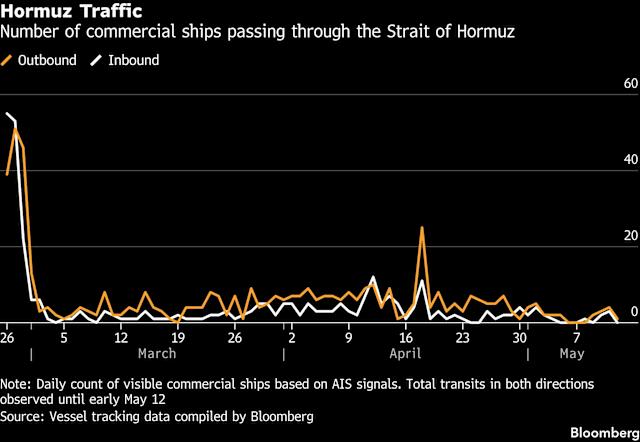
By Prejula Prem and Julian Lee (Bloomberg) — The Strait of Hormuz is mostly closed, with vessels linked to Iran making up most of the limited traffic that's flowing through. An Iraqi supertanker recently stopped its journey after retreating from the US naval blockade.
The Iraqi oil tanker, Agios Fanourios I, managed to pass through the strait but turned back before reaching Vietnam on Monday as it approached the US naval position. This unexpected change in course highlights the dangers that third-party ships face as the US and Iran each impose their own restrictions in the strait.
In contrast, a Qatari liquefied natural gas carrier, the Mihzem, successfully passed through the strait, marking the only transit that happened on Tuesday morning. Now heading to Pakistan, the tanker had previously turned back briefly and switched off its transponder on Monday, showing caution. A similar shipment crossed the strait successfully over the weekend.
Hormuz Transits
On Monday, ship-tracking data shows that only six Iranian vessels and one bulk carrier were observed making commercial transits in both directions.
Ships leaving the strait included an Iranian liquefied petroleum gas carrier, two smaller fuel tankers, and a bulk carrier. A regional cargo ship also exited the waterway.
Authorities in Qatar have told ships near their primary LNG export facility to turn off their tracking systems for safety, making it harder to see ship positions. The LPG tanker Xin Ming Long stopped transmitting its location on Monday while waiting for further instructions, so its transit status is unclear.
Diplomatic relations offer little hope for the situation. US President Donald Trump has rejected Iran’s latest proposal and indicated that a ceasefire is fragile. Meanwhile, Iran has sent small submarines to act as protectors in the strait.
US Central Command on X confirmed that the military has diverted 62 commercial ships since the blockade on Iran started.
On Monday, incoming commercial traffic included two Iranian bulk carriers and an oil product tanker, along with two smaller bitumen carriers that also passed through the strait.
Widespread AIS signal spoofing complicates the situation, making it harder to verify actual ship movements.
The presence of US naval forces may also be affecting the picture. Iran-linked vessels might be turning off their AIS signals when entering or leaving the Gulf to avoid being tracked, making real-time progress tracking more difficult. This means that transit counts could be adjusted later when ships reappear away from high-risk areas.
Even before the US began restricting movements to and from Iranian ports, it was common for Iran-linked vessels to stop transmitting their signals when nearing Hormuz. These signals often weren't restored until the ships reached the Strait of Malacca, which is about 13 days' sailing from Iran’s Kharg Island.
NOTES:
Since vessels can navigate without sending their location until they're far from Hormuz, automated positioning signals were collected over a wide area that includes the Gulf of Oman, Arabian Sea, and Red Sea, to detect potential entries or exits from the Persian Gulf.
When possible transits are spotted, signal histories are reviewed to determine if the movements are real or the result of spoofing, where electronic interference can change a ship's apparent location.
Some transits might not be detected if vessels haven’t turned their transponders back on. Oil tankers linked to Iran often leave the Persian Gulf without broadcasting their signals until they reach the Strait of Malacca, which typically occurs around ten days after passing Fujairah in the UAE. Other ships may be using similar strategies and might not appear on tracking systems for several days.
This tracking information will be released during times of heightened tensions with Iran, aiming to monitor traffic for all types of commercial shipping.