
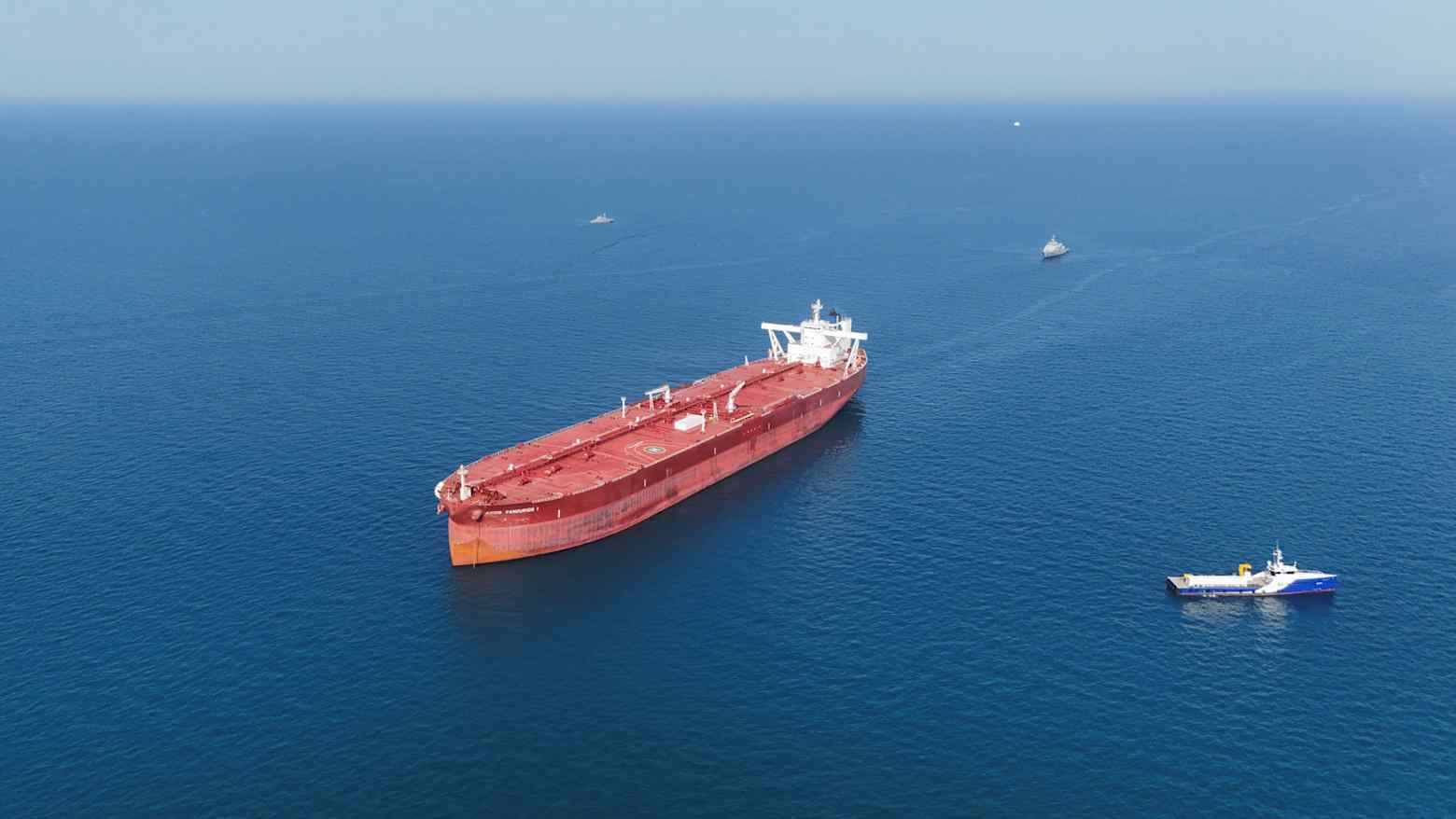
ATHENS, April 18 – On Saturday, merchant ships trying to navigate the Strait of Hormuz received radio messages from the Iranian navy stating they were barred from passing. Reports from shipping sources indicated that two vessels were even struck by gunfire.
Several commercial ships attempted to cross the strait after a notice sent to mariners the day before suggested that passage would be allowed, but only through lanes that Iran considered safe.
Read more about shipping risks in the region.
On Saturday, at least two ships reported that Iranian boats fired at them, according to maritime security sources. These incidents occurred in the waters between Qeshm and Larak islands. The ships turned around without completing their journey, the sources added.
The United Kingdom Maritime Trade Operations (UKMTO) agency confirmed receiving a report of an incident occurring 20 nautical miles northeast of Oman. The captain of a tanker reported that two gunboats from the Islamic Revolutionary Guard Corps approached and opened fire on his vessel, but thankfully, the tanker and its crew were unharmed.
A maritime security source also reported that a container ship was struck by gunfire.
Several vessels noted that the Iranian navy was broadcasting VHF messages stating that the Strait of Hormuz was closed once more.
One of the radio messages warned: “Attention all ships, due to the U.S. government's failure to meet its negotiation commitments, Iran declares the Strait of Hormuz completely closed again. No vessels of any type or nationality are allowed to pass through.”
Currently, hundreds of ships and approximately 20,000 seafarers remain trapped in the Gulf, waiting to traverse this critical waterway, which accounts for around 20% of global oil and liquefied natural gas traffic.