
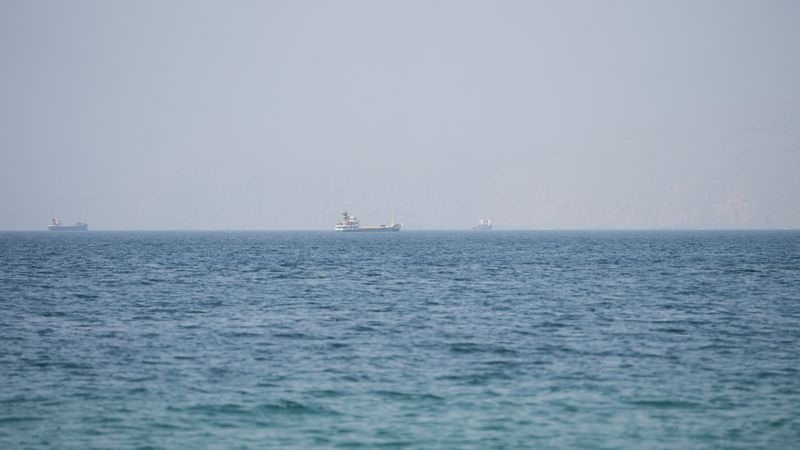
DUBAI/WASHINGTON/CAIRO, Aug 10 (Reuters) – Iran has announced that it is close to finalizing an agreement with Oman that will establish new shipping lanes through the Strait of Hormuz. However, Iran insists that the U.S. must meet various conditions first, including compensation and the lifting of sanctions and military threats, before the waterway can be reopened.
A U.S. official stated that the agreement between Iran and Oman could facilitate safe passage through the strait, which is a crucial route for oil and gas transport. This comes after Iran blocked the strait in response to U.S. and Israeli attacks on Tehran that started in late February.
Iranian Foreign Minister Abbas Araqchi mentioned on Sunday that they are in the “final stages” of an agreement with Oman regarding the strait but reiterated that they would not reopen it unless the U.S. complies with specific demands.
The agreement would outline new shipping routes that would come into effect once the U.S. meets these conditions, as reported by Iran's Mehr news agency.
Araqchi stated that Iran and the U.S. are not in direct negotiations and that Tehran will not initiate talks as long as Washington violates an interim agreement signed in June. He noted that communications were being conducted through intermediaries.
U.S. President Donald Trump mentioned in an interview that the U.S. is taking a low-key approach with Iran, saying, “We are only semi-negotiating with them. We are just observing Iran with its significant inflation and financial struggles.”
CONDITIONS INCLUDE COMPENSATION
Araqchi indicated that reopening the strait would partly depend on the U.S. compensating Iran for the damages caused by its attacks.
The secretary of Iran's national security council, Mohammad Baqer Zolqadr, listed several conditions: ending U.S. threats against Iran, halting aggressive actions towards Iran and its allies, removing the U.S. naval blockade in the Gulf, lifting sanctions on Iran, and releasing Iranian assets that have been frozen.
The U.S. and Israel have been conducting air strikes on Iran for over five months. Trump stated that these attacks aimed to prevent Iran from developing nuclear weapons and reduce its regional threats.
In June, the U.S. and Tehran agreed to a ceasefire, but the U.S. reinstated a blockade on Iranian shipping in July, which Tehran claimed violated the truce that had already collapsed.
A U.S. official noted that once the deal to restore commercial shipping is announced, the U.S. would lift the blockade of Iranian ports. However, this would depend on Iran fulfilling its commitments.
The U.S. comments suggest careful planning towards a deal that might give Tehran control over shipping traffic entering the Gulf through the strait, something shippers have expressed concerns about.
Recently, the United Arab Emirates reported that Iran attacked a ship connected to its state oil company. Iran has not yet commented on this allegation, although the Revolutionary Guard has previously attacked vessels it considered to be crossing the strait without permission.
HOUTHI ATTACKS
Alongside Iran's actions, its allied Houthi rebels in Yemen have increased their attacks, targeting vessels near another vital oil route between the Red Sea and the Gulf of Aden. They declared a naval blockade against Saudi Arabia last month, claiming it was in response to a Saudi siege in Yemen, which Saudi Arabia denies, asserting support for Yemen's internationally recognized government.
The Houthis claimed responsibility for an attack on the Saudi Aramco Jazan refinery on Sunday, just two days after Saudi Arabia formed a defense alliance with Turkey and Pakistan amid rising regional tensions due to U.S.-Israeli actions against Iran.
The Saudi energy ministry confirmed that a fire occurred at the refinery but was extinguished quickly, with no injuries reported and no cause provided.
Turkish Foreign Minister Hakan Fidan stated that the new alliance was not aimed at Iran or any other country but was intended as a general commitment to regional security.
Fighting has intensified between the Houthis and Yemeni government forces, with reports of several casualties from a recent Houthi attack in the Red Sea port city of Mocha. Yemeni military officials stated that air defenses intercepted and shot down 11 Houthi drones involved in the attack.