
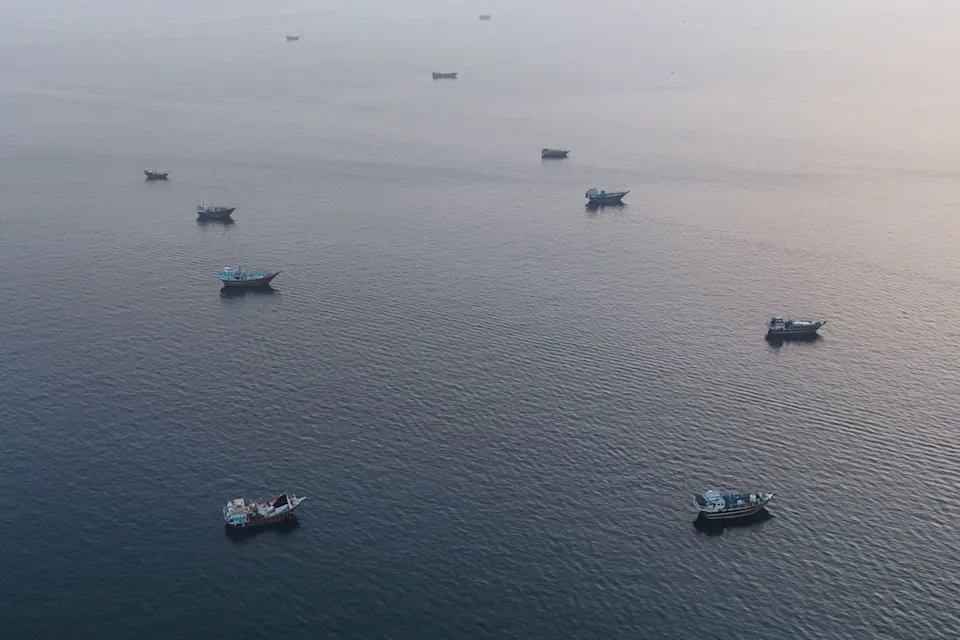
(Bloomberg) — Iran's military has announced a revenue-sharing deal with Oman regarding the Strait of Hormuz, amid ongoing tensions with the US over the control of this vital shipping route.
Iran's Islamic Revolutionary Guard Corps (IRGC) spokesman, Hossein Mohebbi, stated on Wednesday that agreements have been made about how to share the waters and revenues of the strait. He also mentioned that the US is hindering this process, resulting in delays, but did not provide further details.
These comments from the IRGC go further than a joint statement released by the foreign ministries of both countries earlier this week. That statement discussed a preliminary arrangement for resuming ship movements but did not confirm an agreement or mention any fees. Iran has indicated that reopening the strait will require more than just a deal with Oman.
Neither foreign ministry has replied to requests for comments.
The security of the Strait of Hormuz and the broader Persian Gulf has been a major conflict area since the US and Israel escalated military actions against Iran on February 28.
On Wednesday, US President Donald Trump claimed that “the mines are gone,” stating on the Glenn Beck Program that “the strait is open” and that around 10 million barrels passed through it the previous day.
Iran has dismissed Trump's claims, asserting that only Iranian officials know the locations of the explosives. Last week, the head of the International Maritime Organization said that the strait was not fully open and there was no confirmation that the mines had been removed.
The IRGC's statement follows the US announcement it would tighten sanctions on Iran's economy to weaken the country further. Iranian President Masoud Pezeshkian described these efforts on Wednesday as ultimately unsuccessful.
Nevertheless, the ongoing deadlock continues to disrupt shipping in the Persian Gulf and limits Iran's access to vital goods and foreign currency from oil exports, putting additional pressure on the already strained Iranian economy.
Iranian officials have warned repeatedly that an agreement with Oman will not lead to an immediate reopening of the strait. Before the conflict, the strait facilitated the transport of one-fifth of the world's oil and liquefied natural gas.
Tehran insists that any normalization of shipping traffic depends on the US adhering to a memorandum of understanding from June, which includes lifting sanctions, unblocking ports, and releasing Iranian assets abroad — none of which the US has indicated it is willing to do.
Despite this, discussions between Tehran and Muscat have eased oil prices recently as the market anticipates possible improvements in shipping through the Strait of Hormuz. Brent crude was priced above $88 a barrel, a decrease of about 7% this week.
Arne Lohmann Rasmussen, chief analyst at A/S Global Risk Management, remarked that these talks are the most constructive developments concerning Hormuz in a while. However, he warned that a temporary shipping corridor is still a long way from a full reopening, even as market sentiment shifts toward lower oil prices.
An interim ceasefire aimed at easing tensions that expired earlier this month was marred by repeated violations as US-Iran conflicts over the strait continued. An agreement to facilitate shipping could help revive discussions for a more permanent resolution to the situation.
In the early weeks of the conflict, Iran began charging some vessels transit fees, though later suggested these charges were service fees.
Oman has communicated to the International Maritime Organization that it opposes the imposition of transit fees in the Strait of Hormuz but has privately informed some European officials that vessels might need to pay for related services, according to reports from June.
Despite some vessels continuing to make crossings, the Strait of Hormuz has largely remained closed since the onset of US and Israeli military actions against Iran. Nevertheless, millions of barrels are still managed to escape the waterway, even amidst ongoing attacks on ships.