
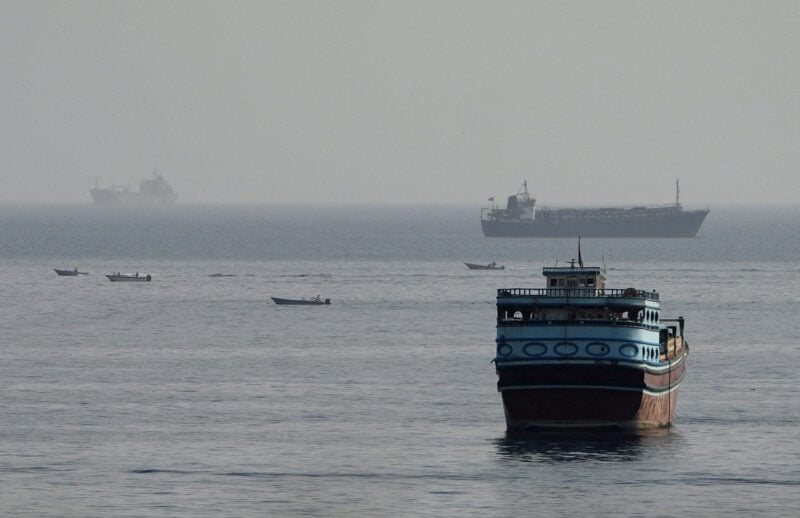
Iran and Oman have introduced a plan aimed at ensuring safe navigation through the Strait of Hormuz. This includes creating a temporary shipping corridor, conducting joint mine-clearing operations, and planning future discussions about managing this crucial waterway.
This initiative was revealed after meetings between Iranian Foreign Minister Abbas Araghchi and Omani Foreign Minister Badr al-Busaidi in Tehran.
In their joint statement, they emphasized that discussions were centered on resuming safe navigation through the Strait of Hormuz while respecting the sovereignty and rights of both nations.
The ministers discussed a phased approach to address the current situation in the Strait, which has been impacted by six months of war and disruptions to commercial shipping.
The proposed framework includes establishing a temporary joint navigation corridor and a plan for a collaborative project to clear mines from the waterway.
However, the longer-term aspects of the plan are expected to attract the most interest from maritime entities.
Iran and Oman stated that technical discussions will continue regarding a permanent navigation corridor and the future management of the Strait. They also plan to set up systems for information sharing, traffic management, and security services for navigation.
Additionally, both countries stressed the importance of engaging with other states bordering the Persian Gulf, ensuring that any agreements align with international law and uphold the rights of coastal nations.
Progress from June Agreement
This framework seems to be a step toward implementing aspects of the U.S.-Iran memorandum of understanding signed in June.
Article 5 of that agreement called on Iran to ensure safe passage for commercial ships through Hormuz and to engage in talks with Oman to define future maritime services and management in the Strait.
This language raised immediate concerns within the shipping industry about what "future management" might entail.
INTERTANKO expressed worries that the future status of transit passage remained uncertain, insisting that Hormuz should be free of fees and accessible to all shipping in accordance with international laws. The World Shipping Council echoed this call for secure and toll-free passage.
BIMCO also raised questions concerning safe routes, separation of traffic, reporting protocols, naval protection, and emergency response.
The statement from Tuesday starts to clarify some of these uncertainties. It explicitly mentions plans for a permanent shipping corridor, information sharing, traffic management, as well as navigational and security services.
Mine-Clearing Plan Announced Alongside U.S. Declaration
The mine-clearing aspect of the plan was announced on the same day that President Donald Trump claimed that the U.S. Navy had cleared mines from international waters in the Strait.
“I have just been informed by the United States Navy that all mines have been removed and/or detonated from within the International Waters of the Strait of Hormuz,” Trump stated on Truth Social.
He added that Iran was warned that any ships laying new mines would be immediately dealt with, implementing a "Zero Tolerance" policy against mine placement.
However, his statement does not guarantee that the entire Strait is free of mines.
The Joint Maritime Information Center issued a warning indicating that there is still a “continued risk of drifting or uncharted mines” within the Traffic Separation Scheme (TSS), and mine danger areas are still active. JMIC confirmed that de-mining and survey operations are ongoing throughout the Strait and maintained a SEVERE threat assessment.
The Iran-Oman statement adds to the uncertainty. Although both countries agreed to pursue joint mine-clearing efforts, they did not specify where mines are located or provide details about the operation's scope.
The June agreement had suggested that Iran would bear primary responsibility for de-mining, stating that safe traffic restoration depended on clearing technical and military obstacles and “de-mining by the Islamic Republic of Iran.” The new framework now indicates collaborative work between Iran and Oman on mine clearance.
The temporary corridor will serve as a short-term solution while discussions for a permanent system continue. However, the statement does not provide specifics on the corridor's coordinates, reporting processes, traffic procedures, or security measures.
For the shipping industry, the main concern remains what happens next.