
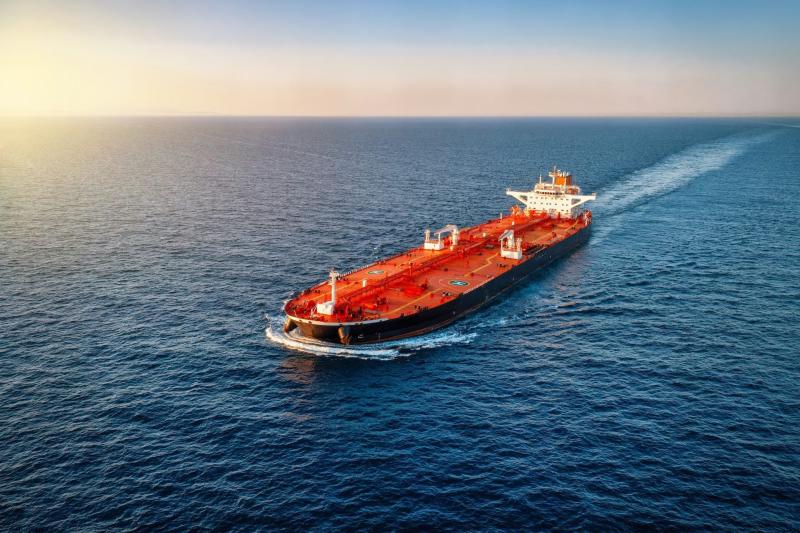
The United States is currently exporting record volumes of oil, and the demand for American crude is still strong. The many tankers visible on the ocean indicate a high level of incoming requests.
Easterly Clear Ocean is actively involved in this energy surge with nine chemical tankers and two offshore construction vessels.
Jake Scott, the company's Chief Operating Officer, shared his insights on the growing demand for U.S. energy.
Lori Ann LaRocco: Kpler reported that there are currently 235 vessels on their way to load up with U.S. energy. Do you expect more ships to shift from the Middle East?
Jake Scott: Absolutely. We've already noticed a significant shift. Ships without cargo are leaving India and heading to the Atlantic. Everyone’s coming here, and they are getting excellent rates for their ballast journeys. I anticipate more ships moving to the Atlantic Basin. However, as you know, there are limits to how much can be extracted.
LaRocco: What do you think about tanker rates?
Scott: They are coming down from extremely high levels. When VLCCs were earning $100,000 a day, it was considered a fantastic market. We should stop assuming that rates of $300,000 or $400,000 a day can last. I believe that Aframax and VL rates will stay high. But again, it depends on how you define 'high.' I think $100,000 a day for an MR is quite high, and that won’t last. I expect rates will settle between $50,000 and $75,000 because this disruption is more than just a brief event. The situation has fundamentally changed.
A new baseline has been set, and ships may need to travel further. Regardless of sanctions, major oil companies aren't interested in old, sanctioned vessels. So whether there are sanctions or not, these ships are not in demand. There are only a few vessels available to transport cargo, and they need to cover longer distances.
The West is taking over the market share lost from the Middle East. Ships aren't effectively distributed worldwide, leading to supply chain issues. Consequently, everyone is traveling farther, and daily rates are strong.
LaRocco: What major challenges are you currently facing?
Scott: One major issue is the limited capacity at the Panama Canal. There are ongoing delays, maintenance issues, and an auction process to navigate. The Panama Canal is the only option. You could take the longer route around the Strait of Magellan, but it will also be costly, much like the Panama Canal. There's no avoiding it.
It's a bottleneck, and it's causing delays that we have to deal with.
LaRocco: There’s been talk about potential demand destruction. What’s your perspective?
Scott: We're in a situation where people may not realize that demand destruction doesn't happen all at once. Instead, there's often a frantic push to secure commodities as quickly as possible. Airlines like Delta and Emirates will continue flying and securing their cargo.
The world will keep moving, and Western countries will fulfill their energy needs. Unfortunately, capacity is limited.
Europe has lost much of its production ability. The U.S., Guyana, and Venezuela can only increase their output at a certain pace. Some discussions about demand destruction are noteworthy.
We've seen oil prices rise from $50 to $100 per barrel, and gasoline prices in the U.S. have increased from $3 to $4 nationally. Oil prices have doubled, and gasoline has risen significantly, yet we haven't observed any demand destruction. So, we're not close to that point.
Will prices hit $120 or $150 per barrel? Demand destruction might be more evident in Europe, as they struggle to cope with supply shocks in a way the U.S. does. Their infrastructure can't support it, and energy prices are already extremely high, reaching their absorption limit.
LaRocco: If the strait reopens, how long do you think it would take for the market to settle?
Scott: It depends on the state of the Middle Eastern infrastructure. If it's intact, the market might stabilize quickly. However, Qatar has indicated it could take three to five years to repair some of the damaged infrastructure. We've also heard reports of damage from recent conflicts, such as Iran targeting the Saudi pipeline.
So, the market needs to assess how much of the infrastructure is functional for production. Before the war, the Strait of Hormuz supplied about 20 to 25 percent of the world’s energy. If production is impacted by infrastructure damage, even when the strait reopens, the energy flow won't match previous levels. The U.S. will likely capture that market share. Right now, there is uncertainty regarding how much capacity will return to service.
No one is openly discussing the extent of damage to infrastructure in the Middle East, possibly because no one knows. This is something that sovereign oil companies might not want to disclose. Ultimately, it will come down to output.
Depending on repairs, if there has been damage, we could face a wait of at least 12 months before infrastructure is back online. The focus should not just be on when the strait reopens, but whether the region can restore its previous export capacity.