
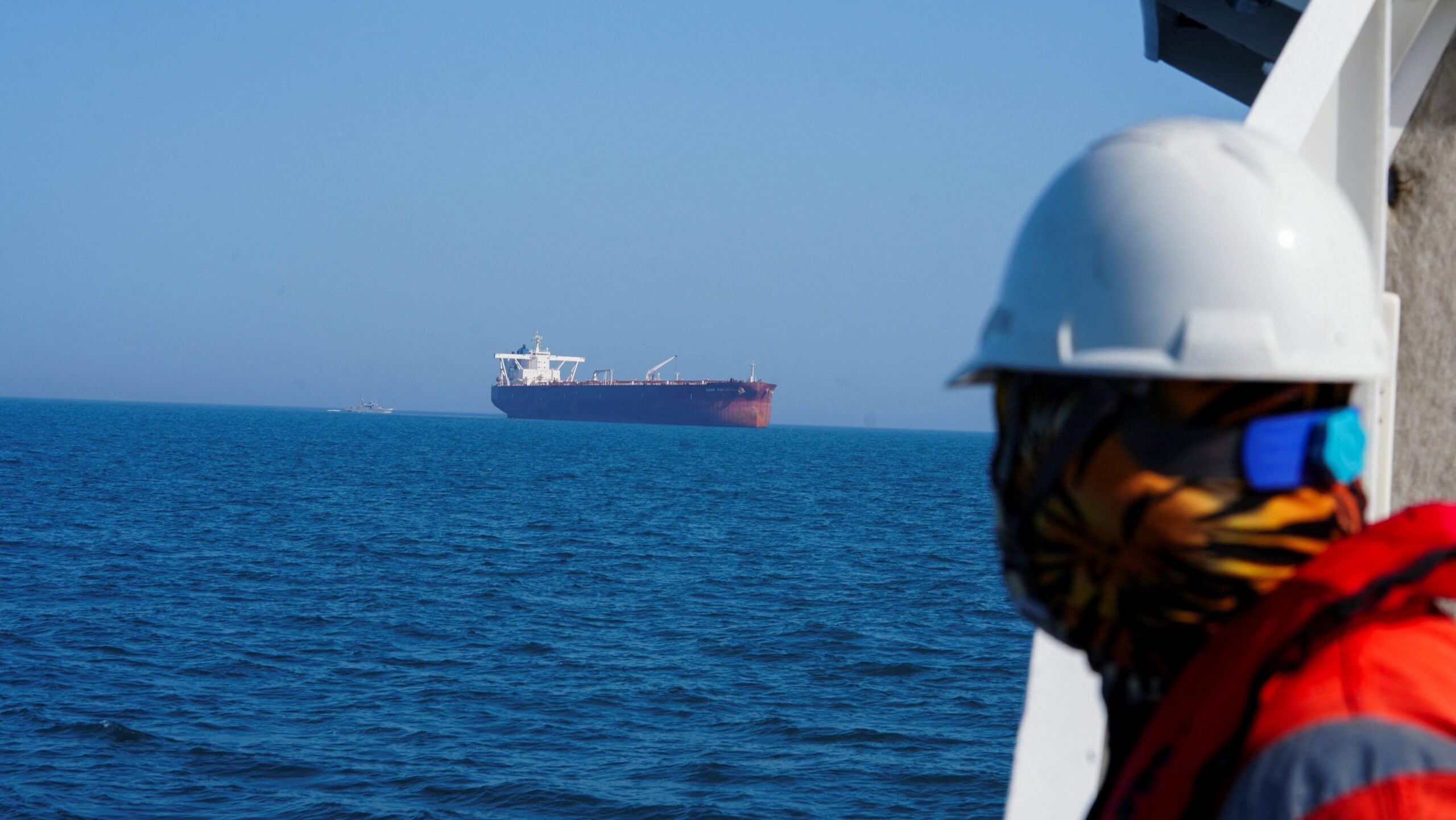
DUBAI, May 20 – The crew of the tanker Agios Fanourios I steered carefully along a route set by Iran, closely following the coastline and navigating through island checkpoints in the Strait of Hormuz.
Measuring 330 meters, the Agios Fanourios I was carrying Iraqi crude oil to Vietnam. It had been anchored off Dubai’s coast since late April but departed towards the strait on May 10, following a direct agreement made with Iran under the supervision of Iraq’s prime minister.
The orders given to the tanker were part of Iran's complex system for managing ship passages through the Strait of Hormuz. As Iran has gained effective control over the strait, the process involves government agreements, thorough checks by Iranian authorities, and sometimes fees for safe passage, according to Reuters.
The vessel's progress was closely monitored by officials in Vietnam, Iraq, Greece, and elsewhere. There were moments when the tanker’s tracking signal went silent, but the Agios Fanourios I continued its journey. Nearby on the same day, another ship was struck by a projectile, igniting a small fire, as reported by a British maritime safety agency.
Later on May 10, the tracking system for the Agios Fanourios I lit up again, but it was halted by speedboats from the Islamic Revolutionary Guard Corps (IRGC) as it approached Hormuz Island, according to an Iranian official.
Initially, the patrolling IRGC allowed the tanker to pass but then ordered it to stop due to suspicions of smuggled goods onboard. After hours of waiting, the vessel finally received permission from Iran to proceed, extending what typically takes five hours through the strait into a two-day journey.
“Once we learned the Agios Fanourios I made it past Hormuz, we breathed a sigh of relief,” one observer commented.
No payments were reported to have been made, as stated by the ship's manager, Eastern Mediterranean Shipping, and other knowledgeable sources.
“We believe the Iranians overlooked the transit of the Agios Fanourios I due to pressure from Iraq and Vietnam,” said Konstantinos Sakellaridis, operations manager for Eastern Mediterranean Shipping, in a response to Reuters inquiries.
Iran’s government did not reply to requests for comments regarding the new system or the Agios Fanourios I's journey.
Iran’s hold on the Strait of Hormuz, which handles about 20% of the world’s oil supply, has caused significant disruption in the global economy. To understand how Iran has been solidifying its control over this vital waterway, Reuters spoke with 20 sources familiar with the situation and analyzed Iranian documents, providing rare insights into the Iranian processes, with the IRGC playing a key role.
All sources requested anonymity due to the sensitive nature of the topic. Some aspects of the Agios Fanourios I's voyage could not be independently verified but aligned with accounts from multiple other maritime officials involved in similar routes.
SECURITY AND NAVIGATION FEES
By early May, roughly 1,500 vessels with around 22,500 sailors were stranded in the Gulf due to Iran's military capabilities to strike ships in the Strait of Hormuz. This situation has turned the conflict into what the head of the International Energy Agency described as the worst energy crisis ever. In response, the U.S. Navy has imposed a blockade on Iranian ships outside the strait.
Only a small number of vessels have successfully passed through the waterway. Between April 18 and May 6, fewer than 60 ships managed to transit, whereas typically around 120 to 140 ships, mostly tankers, would cross daily.
U.S. sanctions prohibit American citizens from engaging in transactions with the Iranian government, and non-Americans may also face "secondary sanctions." Furthermore, many Western governments maintain additional sanctions regarding Iran.
On May 1, the U.S. Treasury Department issued a warning about the risks associated with making payments to or requesting guarantees from the Iranian regime for safe passage.
The new Iranian system prioritizes ships associated with its allies, such as Russia and China, followed by countries with close ties to Iran like India and Pakistan, with additional government-to-government agreements allowing vessels like the Agios Fanourios I to pass, Reuters found.
“The department is ready to act against any foreign company aiding illicit Iranian commerce,” the U.S. Treasury stated in response to Reuters inquiries about the system.
It’s unclear how many vessels have utilized this scheme to date. Iran has indicated that ships connected to the U.S. or Israel, which initiated aerial attacks on Iran in late February, are prohibited from crossing the strait.
Some vessels not covered by government agreements are reportedly paying over $150,000 to Iranian authorities for safe passage through the Strait of Hormuz, according to two European shipping sources.
Security and navigation fees vary by cargo, per two senior Iranian officials, though specific figures were not disclosed, and one indicated that "not all countries are subject to these charges."
Reuters could not independently verify the charges imposed on vessels or the overall revenue directed to Iran.
'THE NEW NORM'
International maritime law forbids governments from charging for safe passage through straits. However, it permits fees for security or services, provided that ships are treated equally.
Details of payments and the identities of ship owners who have paid Iranian authorities are tightly controlled secrets due to the risk of violating U.S. sanctions. The mechanisms for transferring these payments or the Iranian recipients remain unclear.
If owners break these rules, they risk losing their insurance coverage for any payments that might benefit the IRGC, designated as a terrorist organization internationally, according to two maritime insurance experts.
The willingness of ship owners to negotiate directly with Iran despite the inherent risks indicates the level of control Iran has over the strait, noted Danny Citrinowicz, a former Israeli intelligence officer now with the Institute for National Security Studies in Israel.
“The straits will be either blocked or opened only upon the Iranian regime's approval,” he stated. “Some vessels will get through due to political connections, others may have to pay, and some will be turned back. This is the new norm.”
In response to Reuters’ findings about Iran’s control mechanism, China’s Ministry of Foreign Affairs called for opening the Strait of Hormuz and expressed concerns over future arrangements.
“Such arrangements should adhere to international law and practices while considering legitimate security concerns of coastal states and the demands of regional and international communities,” the ministry's statement emphasized.
AFFILIATION CHECKS
For those outside of government agreements, obtaining Iranian permission to pass requires a thorough vetting process conducted by the IRGC, as stated by three Iranian sources and a European shipping source. This process involves an "affiliation document" submitted by the ship owner through an intermediary.
“The affiliation check is designed to ascertain any links the vessel may have with the U.S. or Israel,” explained the European shipping source. The review process can take about a week, and the IRGC may want to inspect the ship physically.
Ship owners must provide extensive information, including cargo value, ship flag, origin and destination, registered owner, and crew nationalities, according to documents seen by Reuters sent to the shipping industry by Iran’s Persian Gulf Strait Authority, newly established to manage and tax vessel transit.
The vetting involves various Iranian state bodies, including the Ports and Maritime Organization and the Supreme National Security Council, with the IRGC overseeing ship evaluations.
Bilateral agreements for passage require countries to consult Iran’s foreign minister, who communicates requests to the Supreme National Security Council, including IRGC members and representatives of Supreme Leader Ali Khamenei.
A decision is made and communicated to the relevant bodies, including the IRGC, which provides the necessary coordinates and instructions for safe passage.
In the case of the Agios Fanourios I, the Iraqi government coordinated with its state oil marketer, SOMO, to finalize a deal with Iran under the supervision of former Iraqi Prime Minister Mohammed Shia al-Sudani, as shared by two sources knowledgeable about the arrangement.
Three Iraqi oil ministry officials noted that they submitted the tanker’s manifest and crew information to Iran prior to its passage.
The Iraqi government did not respond to inquiries regarding its arrangements with Iranian authorities or details about the Agios Fanourios I.
Other nations have arranged differently. India, which imports about 90% of its oil and 50% of its gas through Hormuz, coordinates through its embassy in Tehran to liaise with Iranian authorities, including the IRGC and Iranian navy.
“Once everything is confirmed, the captain is provided with a route to follow, and the ship departs with guidance from the Iranian navy. Captains are instructed to adhere strictly to the given route,” an official from India’s shipping ministry stated.
After Iran grants approval, the Indian Navy contacts the masters of Indian-flagged vessels to provide waypoints. The Indian Navy advised that if the Iranians signal to stop or move, the ships must comply.
As of May 14, 13 Indian-flagged vessels had successfully cleared the Strait of Hormuz, while another 13 were still stranded west of the waterway, according to India’s shipping ministry.
Requests for comments from India, Russia, Pakistan, and Vietnam regarding Iran's controls of the strait received no replies.
FRAUGHT PASSAGE
Many vessels navigating out of the Gulf through the Strait of Hormuz face multiple Iranian checkpoints, often staffed with armed personnel, noted two shipping industry sources and three Iranians.
The Agios Fanourios I passed Iranian military checkpoints at Abu Musa, Greater Tunb, and Larak, with these coordinates verified through publicly available data on the ship’s location and multiple sources aware of similar voyages.
As it approached Hormuz Island, the tanker was briefly halted by IRGC speedboats, according to an Iranian official familiar with the incident who mentioned suspicions of smuggled goods onboard.
However, this information ultimately proved incorrect, and after a brief inspection, the Agios Fanourios I was allowed to continue its journey.
Similar miscommunication contributed to an attack on two Indian-flagged vessels attempting to cross the Strait of Hormuz last month, according to an Indian shipping industry source. These incidents have caused fear among Indian sailors trapped in the Gulf.
“These ships lack armor or defenses,” the Indian shipping source explained. “The bullets easily penetrate. The crew quarters are the only targets because they can't shoot at the tanks carrying flammable materials.”
An Indian sailor who successfully navigated the Strait of Hormuz aboard a bulk carrier shared that their ship waited in the Gulf until the shipping company secured approval from the IRGC. The crew was then instructed by the Iranian navy and had to display the vessel's flag and provide operational details.
After receiving the route from the IRGC, the ship, accompanied by smaller Iranian navy vessels, was warned to be careful of possible sea mines. “It was a terrifying experience,” the sailor remarked. “Even in my wildest dreams, I couldn't envision going to sea during wartime again.”
For vessels that do clear the Strait of Hormuz, the challenges may still persist.
Just a day after leaving Iranian waters, the Agios Fanourios I was intercepted by the U.S. Navy as part of its blockade. For six days, the tanker drifted in a tight area while U.S. forces reviewed their paperwork.
“U.S. forces instructed the Malta-flagged vessel to turn around in accordance with our ongoing blockade enforcement,” stated Capt. Tim Hawkins from U.S. Central Command.
Sakellaridis, the operations manager for Eastern Mediterranean Shipping, said Vietnam influenced the U.S. to allow the vessel to proceed without valid reason for its initial stoppage, asserting that the “vessel and cargo had no Iranian links.”
It remains unclear how many other ships have been delayed by U.S. forces since the blockade began on April 13.
The Agios Fanourios I was eventually released on May 16 without explanation and is now heading to Vietnam with 2 million barrels of crude oil on board.