
By Chandra Asmara
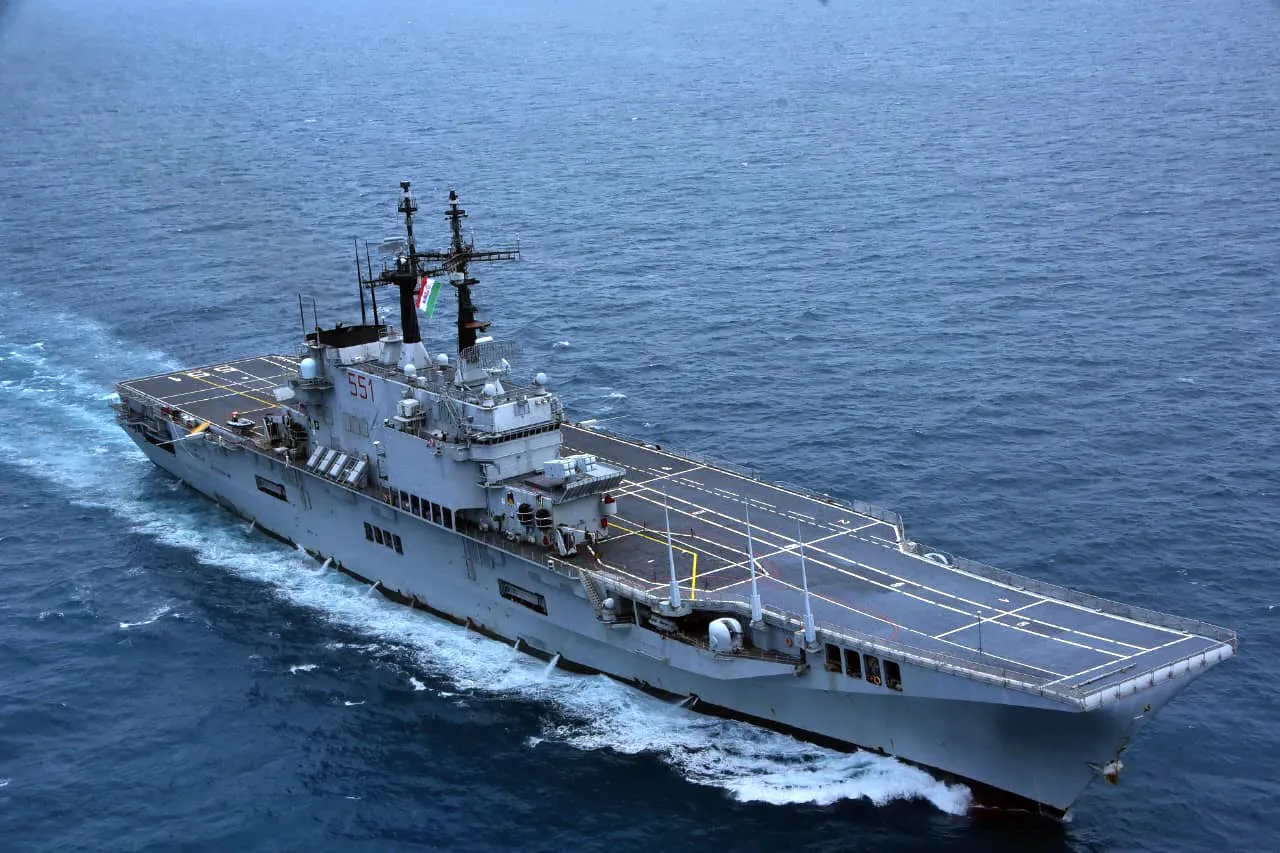
On September 17, 2026, a retired Italian aircraft carrier designed for Harrier jets arrived at Indonesia's main port, ready for a new mission: fighting forest fires.
The Giuseppe Garibaldi, which measures 180 meters and is being donated by Italy after about 40 years of service, will become Indonesia's first aircraft carrier and only the second in Southeast Asia. Plans include modifications to turn it into a mobile base for helicopters and drones, showcasing President Prabowo Subianto's military modernization goals and testing if Jakarta can effectively repurpose a ship that Italy deemed outdated.
Although the ship itself is free, the costs to make it operational could reach hundreds of millions of dollars, which is challenging for a government currently tightening its budget.
The carrier’s journey from Italy to Jakarta took nearly four weeks, and its history includes supporting military efforts in Afghanistan and Libya, as well as hosting performances on its deck. Now, it’s poised to launch firefighting missions in Kalimantan.
Upon arrival at Tanjung Priok on Friday morning, the ship was escorted by two frigates, two Panther helicopters, and two naval patrol aircraft. A military band welcomed the carrier with the traditional Betawi song Si Jali-Jali. After docking, Defense Minister Sjafrie Sjamsoeddin and high-ranking military officials inspected the ship amidst music, including Bella Ciao and Despacito.
Indonesian officials have highlighted the ship's potential role in humanitarian and disaster missions, while keeping options open for any combat use. Prabowo noted that the ship could support around 10 helicopters and drones for firefighting efforts, especially as fires in Kalimantan have sparked international concern and disrupted flights. Over 50 aircraft have already been deployed for firefighting, patrols, and weather modification across Indonesia.
Joseph Kristanto, an analyst at the Maritime Security Programme in Singapore, mentioned that using the Garibaldi for firefighting is feasible, depending on geographic factors. It could serve as a significant mobile base for firefighting near the coast but may face limitations when dealing with inland fires due to helicopter fuel consumption.
The Garibaldi arrived without offensive weaponry, equipped only with the essential systems for safety and operation.
For Italy, the transfer was a cost-saving move. Maintaining the retired carrier cost about €5 million in 2025, while dismantling it would have cost at least €18.7 million. However, the financial burden may shift to Indonesia for modernization efforts.
A government financing plan allows up to $450 million in foreign loans for the carrier and related upgrades. Reports also estimate modernization costs at around $900 million, although no official details have been released regarding the necessary upgrades or timelines.
The Navy plans to send the carrier to Kalimantan after its welcome ceremony, although the defense minister mentioned that state-owned PT PAL would handle the modifications, creating uncertainty around the ship’s immediate operational role.
Navy Chief Admiral Muhammad Ali stated that the modifications would mainly focus on adapting the ship for Indonesia’s needs and tropical climate. PT PAL will collaborate with Fincantieri, and other Italian companies may also contribute.
Ali emphasized that priority would be given to humanitarian missions, although the vessel could eventually see combat use, requiring accompanying ships capable of countering other military threats. The Navy aims to extend the carrier's service life for another 15 to 20 years from a planned base in Lampung province, in southern Sumatra.
When asked about the need for destroyer escorts in potential wartime scenarios, Ali suggested that frigates could suffice initially, with destroyers being an option for the future.
Using an aircraft carrier for disaster response is uncommon but has been done before; Thailand’s Chakri Naruebet, Southeast Asia’s only other carrier, was partly designed for search-and-rescue operations and played a significant role during the 2004 Indian Ocean tsunami.
This acquisition occurs amid broader financial considerations. Investor worries about fiscal responsibility under Prabowo's government have added to the pressure on the Indonesian rupiah, which is nearing record lows.
“The initial cost of acquiring the ship for free doesn’t eliminate the financial implications of the project,” noted Yusuf Rendy Manilet, a strategic research manager at CORE Indonesia. “The crucial question is whether Indonesia can maintain the carrier in operational condition.”
Currently, the carrier holds significant symbolic value for Indonesia, serving as a “badge of honor,” according to Nicholas Lim, a senior fellow at the S. Rajaratnam School of International Studies. He added that restoring its full combat capabilities would require years of preparation, including new aircraft, pilot training, and effective protection strategies.
Indonesia’s experience with significant defense purchases has been mixed. While the country has successfully made deals for Rafale fighters, Scorpene submarines, and Italian-built warships, a plan to acquire secondhand Mirage fighters was canceled due to budget constraints, and a proposed purchase of 24 Boeing F-15EX jets is on hold.
Italy views the transfer as an opportunity for future business, including six DRASS submarines estimated at about €480 million, M-346 aircraft valued at around €600 million, and three maritime patrol aircraft worth roughly €450 million.
Some of these programs are already progressing. DRASS has a contract to supply six DGK submarines to Indonesia, and Jakarta has confirmed the purchase of 12 Leonardo M-346F Block 20 aircraft. There is no evidence suggesting that these purchases were contingent on the carrier transfer.
A formal handover and reflagging ceremony is set for September 24, followed by the carrier’s participation in military anniversary celebrations in October. The Navy plans to rename it KRI Sriwijaya, after the historic maritime empire based in Sumatra.