
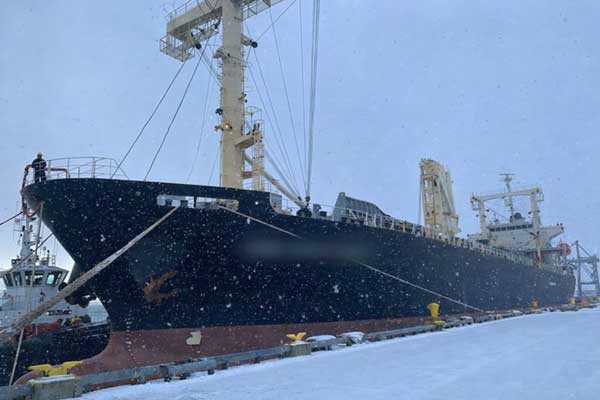
Improperly secured lithium-ion batteries caused fires on the Genius Star XI during harsh weather on Christmas Day 2023, according to the NTSB.
On Christmas Day 2023, severe weather and insecurely fastened lithium-ion battery cargo led to two major fires on the Panama-flagged bulk carrier Genius Star XI while it was crossing the North Pacific Ocean. This incident resulted in $3.8 million in damages and raises concerns about transporting large lithium-ion battery systems by sea, as stated in an investigation by the National Transportation Safety Board (NTSB).
The 410-foot cargo ship was carrying 192 energy storage system (BESS) units when failures in the lashing belts allowed 41 units to shift during rough seas. This caused internal damage, leading to three battery units overheating uncontrollably. The heating process can reach up to 572°F.
The investigation found that a problem with the equipment affected the entire securing system. Investigators noted that “the diameter of the D-ring was not compatible with the throat opening of the hook.” As a result, the hook could not fully fit onto the D-ring, which concentrated the stress at the bend of the hook instead of distributing it. This caused the hooks to break and separate under pressure.
On December 24, the vessel faced strong northwest winds reaching about 26 knots, with gusts over 30 knots, and waves up to 19 feet while passing near the Bering Sea. The next morning, the crew found that all BESS units in bay 4 of hold no. 2 had shifted, and smoke was coming from cargo hold no. 1.
The captain instructed the crew to use the ship’s fixed carbon dioxide fire suppression system, discharging all 153 CO2 cylinders into cargo hold no. 1. With no CO2 left to tackle another fire, the ship headed to Dutch Harbor, Alaska. Three days later, another fire broke out in cargo hold no. 2. Without CO2 available, the crew had to fight the fire with seawater from the outside for about four hours.
The Genius Star XI reached Dutch Harbor on December 29, where the Coast Guard ordered it to anchor two miles offshore to prevent any reflash risks. Fortunately, there were no reported injuries or pollution.
The investigation indicated that internal shelves weighing 300 pounds came loose from their supports, allowing lithium-ion battery packs to shift and damage the interior structure of the units. “Arcing and scorch marks were identified in those 13 units, likely caused by the exposed battery pack busbar hitting the unit and creating short circuits,” the report explained.
The NTSB investigators pointed out essential lessons for the maritime industry regarding securing large stationary lithium-ion battery units. The report emphasized that crews need to follow the vessel's cargo securing manual, inspect all securing arrangements during and after loading, and ensure that lashing belt hooks, wires, and chains are properly secured on D-rings and attachment points.
“Thorough inspection and verification are crucial to prevent cargo movement, structural damage to battery units, and potential overheating during severe weather,” the investigators concluded.
The vessel, owned by GS Navigation S.A. and managed by Taiwan-based Wisdom Marine International Inc., left Busan, South Korea, on December 18, heading to Long Beach, California. After the incident, the delivery location was changed to San Diego, where the vessel arrived on February 24, 2024, after securing the damaged cargo and refilling the CO2 system at Dutch Harbor.
This incident underlines the increasing concerns about transporting large lithium-ion battery systems at sea as the global energy storage industry continues to grow. The equipment incompatibility went unnoticed, despite having previously used a safe storage and lashing plan for five similar shipments.
The full NTSB report can be found here.