
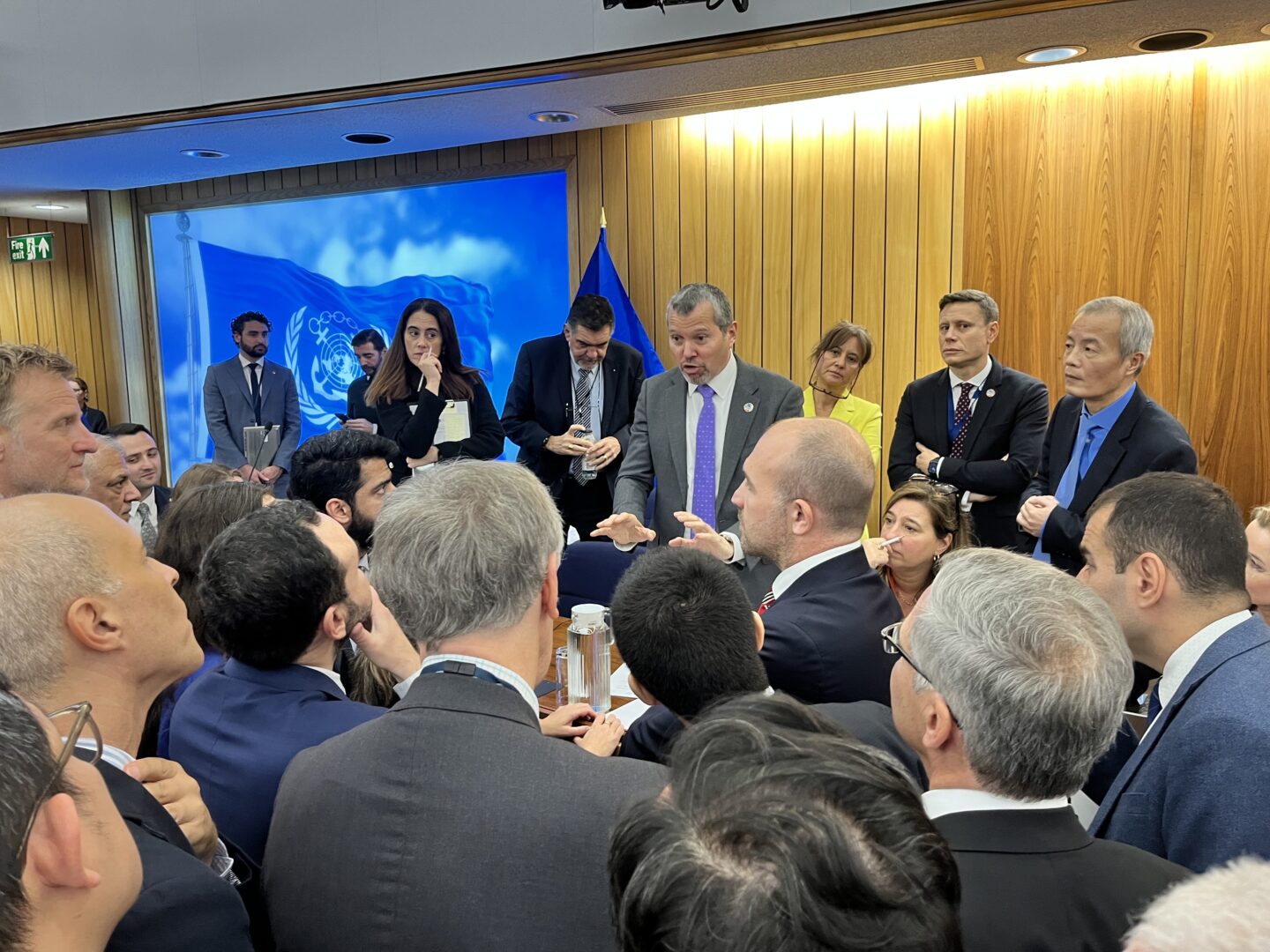
Next week, governments will gather in London for more talks on the International Maritime Organization's (IMO) Net-Zero Framework. Countries still have major differences regarding the future of this important shipping climate agreement.
The IMO’s Intersessional Working Group on Greenhouse Gas Emissions from Ships will meet from September 1 to 4, ahead of the Marine Environment Protection Committee's 85th session scheduled for later this year. The discussion will focus on suggested updates to the framework, its implementation guidelines, and rules concerning lifecycle greenhouse gas emissions.
A key issue in the talks is the framework that was agreed upon at MEPC 83, which includes gradually stricter fuel-intensity requirements and a pricing mechanism for emissions that rewards ships using zero or near-zero emission fuels.
This framework was expected to be formally adopted last October, but due to heated negotiations and a strong opposition campaign from the U.S., the extraordinary MEPC session was postponed for a year.
Despite this delay, negotiations have continued, as countries seek to resolve significant differences in the final regulations. The upcoming meeting will reveal if there is still enough support for the original framework or if the IMO will move toward a different compromise.
Different Perspectives
Before the meeting, INTERCARGO highlighted four competing proposals, along with additional suggestions to modify the framework.
Liberia has put forward the most extensive changes, linking greenhouse gas fuel intensity (GFI) requirements to the availability, affordability, and scalability of commercially viable fuels. This proposal aims to replace the IMO Fund-based mechanism with transferable Surplus Units that ships could trade, bank, or borrow. Liberia and Panama also suggested giving Surplus Units for verified operational and technological improvements, with support for developing countries being optional.
Brazil wants to keep most of the current framework but suggests a softer rollout with GFI reductions of 3% in 2029 and 4% in 2030 before increasing the pace. Brazil also retains the two-tier compliance system, with Remedial Units priced at $100 and $380 per tonne of CO2 equivalent.
Tuvalu recommends a stricter plan, proposing Tier 1 units priced at $300 per tonne and Tier 2 at $380, along with a GFI target that requires a 30% direct reduction in compliance and a 65% base-target reduction by 2035.
Countries like Australia, Canada, South Africa, and the United Kingdom suggest mostly keeping the existing framework, including the two-tier GFI system and the IMO Net-Zero Fund, while providing more details about Fund governance and revenue distribution.
China, on the other hand, seeks more flexibility in the framework, wanting to include shore power, wind propulsion, and solar power in GFI calculations.
Disagreement Over Carbon Pricing
A lot of the disagreement revolves around the economic aspect of the framework.
Norway, Pacific Island states, and various European countries argue that weakening the pricing mechanism would discourage investment in alternative fuels, making it harder to meet IMO's emissions targets.
Norway specifically opposes Liberia's proposal to tie requirements to the availability of commercial fuels, claiming it would lower environmental ambitions and create regulatory uncertainty.
Liberia, on the other hand, raises concerns about the legality, cost, and complexity of the proposed Fund, arguing that allowing compliance through payments may not always guarantee emissions reductions and could increase shipping costs for long-distance exports from developing nations.
Saudi Arabia and the United Arab Emirates share similar worries, pointing out that a uniform carbon price could impact global trade unevenly, particularly burdening remote and developing economies.
The stakes are high for the shipping industry, which prefers a global regime from the IMO rather than an inconsistent patchwork of regional regulations.
“Establishing the regulatory foundation now is crucial for guiding investments in the right direction,” said Andreas Enger, CEO of Höegh Autoliners. “We strongly back the IMO's effort to create ambitious mid-term measures that align with the 2023 IMO GHG strategy.”
Boudewijn Siemons, CEO of the Port of Rotterdam, also emphasized the need for a global framework, noting that the international nature of shipping requires a level playing field worldwide.
Significant Financial Implications
The upcoming discussions will also cover fuel certification, verification and reporting, incentives for zero and near-zero fuels, and governance of the proposed IMO Net-Zero Fund.
The economic mechanisms are projected to generate approximately $10 billion to $15 billion each year, making the collection and distribution of these funds a politically sensitive topic in negotiations.
Countries including Brazil, the Democratic Republic of Congo, Kenya, Solomon Islands, and Tuvalu have put forward proposals regarding revenue collection and distribution, clean-fuel rewards, infrastructure, food security, and a just transition. The fundamental structure of the mechanism is still in question, including whether it will operate as a “Fund” or a lighter “Facility.”
The working group will also continue its efforts on the IMO’s Life Cycle GHG Assessment framework, addressing areas such as emissions from conventional marine fuels and renewable natural gas.
While the next week's meeting will not finalize the Net-Zero Framework, it will provide insights ahead of MEPC 85, scheduled for November 30 to December 3, where the larger, unresolved question remains: is there enough common ground to transform the framework into binding global regulations?