
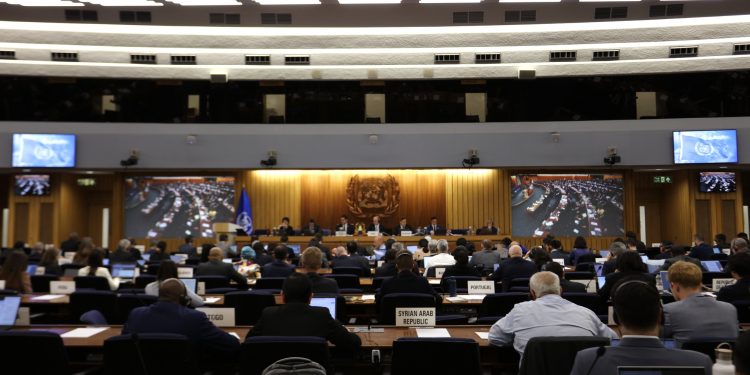
This week, the International Maritime Organization's Net-Zero Framework remained largely unchanged after negotiations, despite attempts from the United States and some oil-producing countries to weaken or change important elements of the agreement.
Delegates completed four days of talks in London on Friday, with discussions centering again around the carbon pricing mechanism.
Observers noted that 38 countries explicitly supported maintaining carbon pricing and the revenue mechanism as central to the framework, while 17 countries, mainly oil-producing nations, opposed it due to concerns about potential costs.
These numbers indicate that there is still significant support for the framework established last year, although governments are divided on some details.
The framework aims to enforce stricter limits on greenhouse gas emissions from marine fuels, alongside a system that charges ships for their emissions while rewarding the use of cleaner fuels. This economic mechanism is projected to generate about $10 billion to $15 billion annually, making decisions about the allocation of this money and who pays one of the main contentious issues.
Jamie Yates, Climate & Renewable Energy Manager at Pacific Environment, remarked, “This week’s discussions showed a strong determination among member states to reach an agreement by the end of this year.”
Yates added that there was “no clear shift towards any alternative proposals,” suggesting that the existing Net-Zero Framework remains the most viable option.
This outcome was uncertain going into the meeting.
Liberia suggested significant changes to the current framework, proposing that emissions requirements be more closely linked to the availability and affordability of cleaner fuels. Their proposal would replace the IMO Fund mechanism with transferable Surplus Units that ships could trade, save, or borrow.
Brazil proposed to maintain most of the framework while easing initial targets, while Tuvalu called for stricter requirements. Australia, Canada, South Africa, and the United Kingdom largely supported the existing structure but wanted additional rules for collecting and distributing revenues.
China also advocated for more flexibility, seeking greater acknowledgment of technologies like wind propulsion, shore power, and solar power.
However, the main debate continues to be about pricing for shipping emissions.
European nations, Pacific Island states, and Norway argue that weakening the pricing mechanism would hinder investments in alternative fuels and make it harder to achieve the IMO’s climate goals.
Conversely, Liberia, Saudi Arabia, and the United Arab Emirates caution that a global carbon price could increase transportation costs, disproportionately affecting remote and trade-dependent economies.
The United States has also strongly opposed the framework.
Although the Net-Zero Framework was agreed upon in April 2025, its formal adoption was delayed after a close vote of 57-49 due to pressure from the U.S. and Saudi Arabia. The framework aims to help the shipping sector meet the IMO's target of reaching net-zero greenhouse gas emissions by around 2050.
Supporters of the framework left the recent meeting asserting that attempts to make major changes had not garnered enough support.
Lukas Leppert, President of the Clean Shipping Coalition, stated, “The Net-Zero framework remains intact despite pressure from a minority trying to undermine climate action in shipping, and it must be adopted without further delay.”
Jesse Fahnestock, Director of Decarbonisation at the Global Maritime Forum, noted that the talks revealed a continued willingness among nations to seek consensus while adhering to the broader goals set in 2023.
Much still needs to be negotiated. The IMO will host another technical working group meeting from November 23-27, followed by the Marine Environment Protection Committee’s MEPC 85 session from November 30 to December 3. The framework is expected to be up for adoption at an extraordinary MEPC meeting on December 4.
For now, this week’s discussions have left the central framework unchanged: it remains alive, highly debated, and continues to be the leading option for a global shipping emissions regime.