
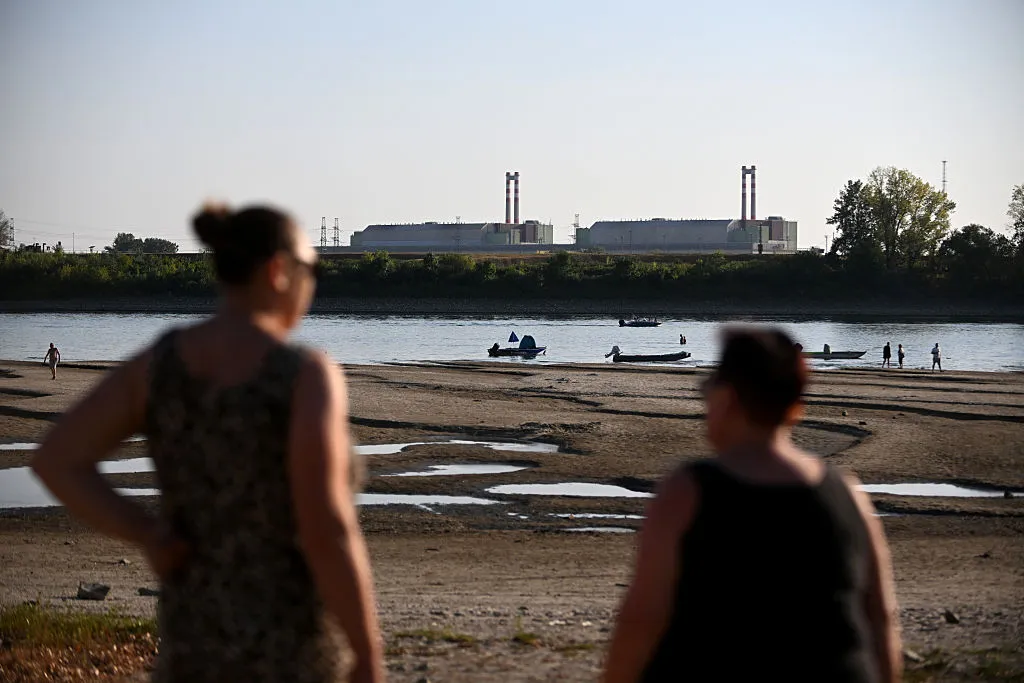
By Zoltan Simon
August 2, 2026 (Bloomberg) – Hungary is shutting down its only nuclear power plant for the first time ever because of extremely low levels in the Danube River. This is putting pressure on energy supplies and testing the new Prime Minister, Peter Magyar.
One of the two reactors at the Paks plant was turned off early Sunday, and the second one powered down later that day. Magyar explained that the falling water levels are causing a shortage of cooling water for the facility, which is now running at just over 10% of its 2,000 megawatt capacity.
This closure marks a historic first for the 44-year-old plant, driven by ongoing drought conditions across much of central Europe.
Located about 120 km (75 miles) south of Budapest, the Paks plant produces 40% of Hungary's electricity. Meanwhile, Romania has declared an alert in the energy sector after reducing output at its own nuclear facility.
To address the energy shortfall, Hungary's government is increasing power imports and has asked major industrial companies, including car and battery manufacturers, to voluntarily reduce their energy use. Companies may face mandatory cuts if necessary.
A new crisis plan aims to limit electricity cuts at homes, prioritizing cuts for businesses instead. For instance, from Monday, rail freight will stop during peak hours, and decorative lighting on public buildings has been turned off. Trams and subways in Budapest are being slowed down to conserve energy. Additionally, the government has halted the watering of grass and sports fields due to strained water supplies.
This situation is a significant challenge for Magyar's leadership, just four months after he won election by defeating Viktor Orban. While he has highlighted the decline of energy and water infrastructure over Orban's 16-year rule, including delays in updating the cooling system at Paks and its controversial Russian-led expansion, the current energy crisis is the main focus now.
“We inherited a fragile, expensive, and vulnerable system,” said Magyar in a social media address. “We must now operate, defend, and fundamentally rebuild this system all at once.”
Before the drought hit, Magyar was quickly acting on his promises to dismantle Orban’s regime, tackle corruption, restore the rule of law, and hold previous officials accountable. The energy crisis has now overshadowed all other issues.
The push for companies to cut energy use could hurt industrial production, which had just started to show signs of recovery after nearly three years of decline. The drought is also expected to severely impact agriculture, limiting economic growth and possibly driving up food prices. This situation could pose a problem for central bankers who had expected a third consecutive monthly interest rate cut in August, with more possibly in the future.
The unexpected costs from electricity imports are complicating efforts to stabilize the budget. The government is still revising this year’s fiscal plan, which Magyar claims was based on manipulated figures and did not account for much of the spending that Orban made before the elections.
Concerns about the energy crisis are affecting the markets as well. The forint, one of the best-performing currencies after Magyar’s election win, dropped to its weakest level in three months against the euro on Friday and had its worst month in July since October 2024.
“The @EU_Commission is closely monitoring the electricity supply situation in Romania, Hungary, and the wider South-East European region due to the ongoing heatwave and drought conditions. We are in close contact with the national authorities and @ENTSO_E.” — Dan Jørgensen (@DanJoergensen) August 1, 2026
Even before the drought began, Magyar’s government had started addressing vulnerabilities in the energy and water systems. They opened bids for significant investments in wind energy, planning to use newly available EU funds for these projects. Discussions had also begun on modernizing the country's irrigation system.
However, these long-term plans will not help with the immediate crisis, as Hungary braces for another heat wave. Temperatures in Budapest are expected to reach 37 or 38°C (98.6°F-100.4°F) over the next six days, with no rain in sight.
The most pressing challenge remains at Paks, where cooling the nuclear reactors is crucial, even after they are shut down. The Hungarian Atomic Energy Agency stated that they can still cool the reactors under extreme conditions, even if water flow is as much as 90% below average and water temperatures are high.
However, with Europe warming faster than any other continent, the long-term outlook looks bleak, and the immediate situation is not encouraging either.
Historical data shows that the Danube usually reaches its lowest water levels in August or September, according to Laszlo Nagy, the deputy director of the Paks plant. He added that it would take about a week to bring the reactors back online once water levels rise again, suggesting Hungary may be without its main energy source for several months.
“Unfortunately, the outlook is not good,” Nagy told reporters during a joint briefing with Magyar. “We’re facing an unprecedented situation.”