
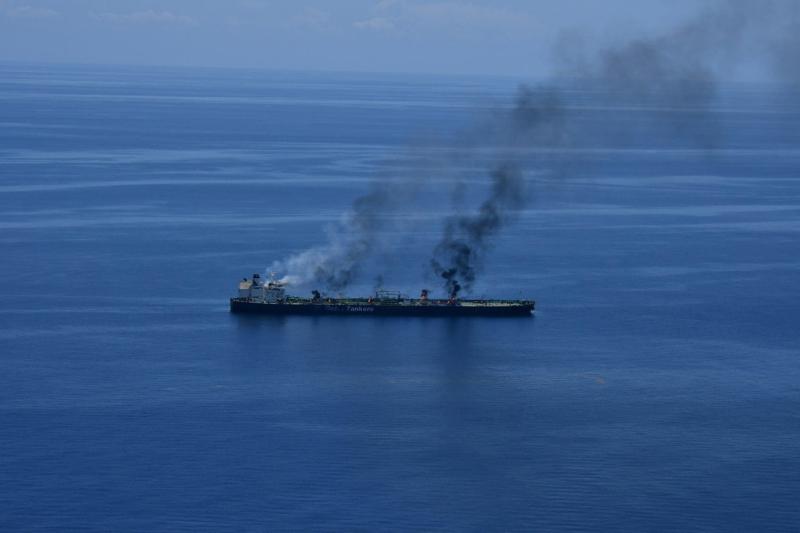
The energy trade in the Middle East is changing once again following attacks on two tankers in the Red Sea by Houthi militants backed by Iran.
In a recent webinar focused on maritime security, analysts from Lloyd’s List who monitor ship movements and attack patterns warned that the situation in the Red Sea has shifted from a period of “gradual normalization” back to a state of heightened uncertainty.
Bridget Diakun, a senior analyst at Lloyd’s List, stated, “The circumstances in the Red Sea, the Middle East, and the Strait of Hormuz have fundamentally altered, and we’re unlikely to return to what it was before.” She added, “We’re not going back to the conditions we had before February 28 in the Strait of Hormuz. It’s not a no-go area, but caution is necessary.”
Diakun pointed out that during the peak of the crisis in the Red Sea, tanker traffic decreased by about 60%.
She also mentioned, “Depending on the actions of the Houthis, we might see even more than a 60% drop in transits. However, perceptions of risk vary, and operators will adjust accordingly.”
Fatigue also plays a role in the decision to navigate through a conflict zone, as tanker owners and operators eventually become accustomed to the situation. The risks associated with war start to feel like the new normal.
Diakun noted, “The longer this situation persists, the more we’ll observe fluctuations in transit levels. I expect these to rise and fall based on geopolitical developments.”
Matthew Rajendra, a senior reporter for Lloyd’s List, added that even vessels not linked to Saudi interests that carry crude oil from Saudi Arabia could be targeted. To enhance safety, some commercial ships, including tankers, are publicly sharing their crew affiliations and nationalities via tracking systems.
While some tankers have diverted away from the Red Sea, others are still entering the area.
Tracking data from Vortexa shows a sanctioned Iranian tanker transporting crude oil from Kharg Island passing through the Red Sea.
Additionally, Lloyd’s List has reported that a vessel owned by COSCO has successfully navigated through the blockade.
Rajendra confirmed, “COSCO received clearance from the Houthis to exit the Red Sea.” However, this raises broader questions about whether any payments were made for this passage, which remains unclear.
The Houthi militants have claimed responsibility for attacks on at least two tankers linked to Saudi Arabia, including the Ann Ciao, which was confirmed as the vessel that was struck by UKMTO. Another alleged attack on the Layla has not been verified by Lloyd’s List. This vessel reportedly went dark in mid-July and has not reappeared on the AIS system, complicating efforts to determine its status.
Vortexa informed gCaptain that they've noticed some vessels passing through Bab el-Mandeb with their AIS turned off, particularly those tied to Saudi Arabia.
George Morris, a graduate market analyst at Vortexa, commented, “For Yanbu, we saw three liftings in the past two days compared to seven the previous two days. If attacks in Bab el-Mandeb persist or escalate, we might see shipments move around the Cape of Good Hope to load at Yanbu, instead of using the Suez Canal.”
Yanbu has become a crucial alternative export route for Saudi Arabia during the crisis in the Strait of Hormuz. If conditions in the Red Sea worsen severely, Saudi crude exports from Yanbu and other western ports could face significant challenges, while eastern port exports would still be affected by the Strait of Hormuz.
Andy Lipow, president of Lipow Oil Associates, noted, “The impact is even larger because both crude oil and refined products traveling through the Suez Canal from the Mediterranean to the Red Sea are affected.” He added, “The blockade affects around 3.1 million barrels per day of Saudi crude oil and another 3.0 million barrels per day of crude and refined products in north-to-south traffic, totaling 6.1 million barrels per day, according to shipping analytics.”
The U.S. Energy Information Administration reported that during the first half of 2025, about 4.9 million barrels per day of crude oil and petroleum products traversed the Suez Canal and the SUMED pipeline.
Lipow explained, “If the SUMED pipeline moved 1.0 million barrels per day, then 3.9 million barrels per day were on tankers passing through the canal both ways—south to north and north to south. The effect primarily impacts the north-to-south flow, which appears to average around 3.0 million barrels per day. A large portion of this flow consists of Russian, North African, and even U.S. crude heading towards India and Asia.”