
By Weilun Soon
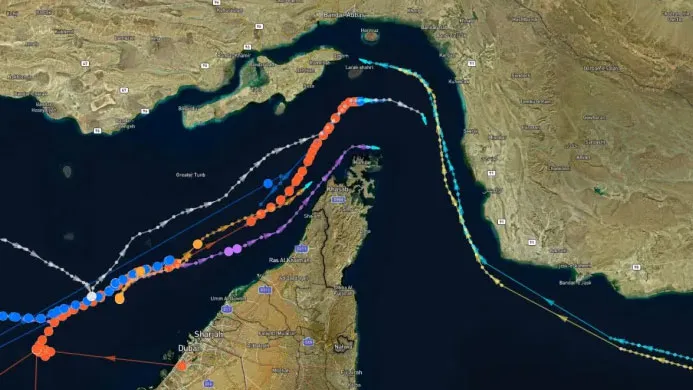
June 23, 2026 (Bloomberg) — More ships are now openly indicating their plans to pass through the Strait of Hormuz, which shows that shipowners and traders are becoming more confident as tensions decrease.
On Tuesday morning, seven tankers were visible in the strait according to tracking signals. This included two fully-loaded non-Iranian supertankers leaving the Persian Gulf. Additionally, three product carriers departed, and two Iran-flagged Suezmaxes approached from the opposite side. There was also an eighth tanker, a very large crude carrier, that entered the gulf without broadcasting its location during transit, only reappearing afterward.
This change “shows a growing confidence among shipowners, as Iran is believed to avoid targeting vessels,” said Muyu Xu, a senior oil analyst at Kpler Ltd. However, it’s still unclear if safe passage can be guaranteed, Xu warned.
Financial markets, especially commodities, are paying close attention to conditions in the waterway following a temporary agreement between the US and Iran last week, which has allowed traffic to resume. Recently, millions of barrels of crude oil have been spotted going through this key route that connects the gulf to global markets, along with natural gas tankers moving inwards.
The improving conditions — along with ongoing talks between Washington and Tehran in Switzerland for a permanent deal — have contributed to a significant drop in crude futures. On Tuesday, Brent crude was priced below $77 a barrel, compared to just under $73 before the conflict, indicating that most of the war-related price increases have been reversed.
Ship activity in the strait had nearly halted since the war began in late February. Now, more vessels are broadcasting their locations, allowing oil and shipping markets, as well as global investors, to better understand traffic patterns through this critical waterway.
During normal times, around 135 vessels pass through daily, including those carrying oil, crude products, natural gas, bulk goods, containers, and livestock. They typically use an automated identification system (AIS) to share their locations. All the tankers observed on Tuesday utilized this system.
This broadcasting is usually required by major insurers, financiers, and lawyers who need it to support trading activities. Some significant insurers even mandate that transponders must remain active for coverage to be provided.
On Tuesday morning, the VLCC Universal Glory entered the strait from the Persian Gulf, transporting 2 million barrels of Saudi crude oil. It is on a route that takes it through the middle of the strait, with South Korea as the destination.
Following it are two product tankers, while a Norwegian-flagged vessel and another VLCC navigated close to the Omani coast. Just a day before, three VLCCs carrying Iranian crude also openly announced their crossings.
In the other direction, Suezmaxes Sarak and Sobar are coming in from waters near Pakistan. These two tankers originated from areas near Pakistan. On Monday, a non-Iranian VLCC and four liquefied natural gas carriers reported their crossings into the gulf.
Despite the increasing number of ships signaling their movements, some still choose to turn off their transponders during parts of their journey. Just hours before Universal Glory began its transit, a VLCC heading to Taiwan entered the strait but then became invisible while loaded with Saudi and UAE crude. Later, it reappeared in the Gulf of Oman.
Similarly, an empty Liberia-flagged VLCC was spotted again in the Persian Gulf on Tuesday according to its AIS signal. Previously, it indicated that it was off Khor Fakkan in the Gulf of Oman before turning off its signal.
HMM Co. Ltd., the operator of Universal Glory, did not immediately respond to requests for comment sent by email.