
DUBAI/CAIRO, July 29 – The United States and Saudi Arabia launched airstrikes against Iran-backed armed groups in Iraq on Wednesday. This marked the first U.S. airstrikes in the Middle East since President Trump halted the bombing campaign against Iran last week.
In response, Iran rejected a proposal from Oman to collaborate on managing the Strait of Hormuz and claimed responsibility for firing at ships in the strait as well as U.S. bases in Jordan.
The renewed fighting, along with diplomatic challenges, caused oil prices to rise for the first time since last week, indicating that the conflict initiated by the U.S. and Israel in February is far from over.
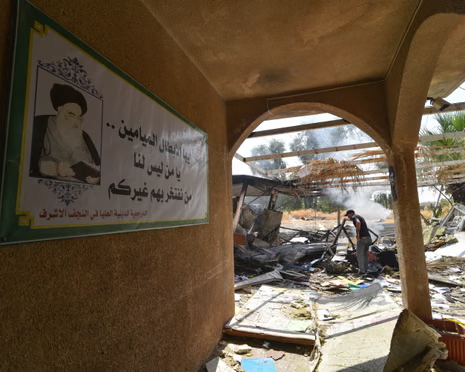
Footage from Iraq's Al-Ahad television showed Iraqi men chanting sectarian slogans and "Death to America!" while carrying the bodies of fighters out of a Mosul hospital.
According to Washington and Riyadh, the airstrikes were a response to drone attacks on Saudi oil facilities, which were launched from Iraq.
Iraq’s Popular Mobilisation Forces, which include powerful Iran-backed paramilitary groups that are part of the Iraqi security forces, reported that at least 20 of their members were killed and 32 were wounded in the U.S.-Saudi strikes targeting multiple locations across Iraq.
This was the first major U.S. military action in the Middle East since Trump suddenly halted an intensive bombing campaign last Friday after 13 days, following advice from commanders that the strategy had reached its limit.
It also marked the first time Saudi Arabia openly acknowledged its involvement in coordinated strikes alongside the U.S. This could potentially broaden the conflict, as Saudi Arabia, a Sunni-majority country, engages in combat against Iran’s Shiite proxies on a new front.
Iraq’s Shiite-led government, maintaining close military and diplomatic ties with both Tehran and Washington, convened an emergency meeting.
The U.S. has long urged the Baghdad government to take action against Iran-aligned paramilitary groups, although previous attempts to do so have resulted in domestic unrest.
The strong bonds between Iran and Iraq, both predominantly Shiite nations, were evident this week as hundreds of thousands of Iranian pilgrims visited religious sites in Iraq for an annual holiday, some carrying pictures of Iran's revered former supreme leader, Ayatollah Ali Khamenei.
Saudi Arabia is also facing challenges on another front, as the Iran-aligned Houthi movement in Yemen declared a blockade of Saudi oil exports in the Red Sea last week and targeted ships and oil facilities.
Just hours before the joint attacks with Saudi Arabia, the U.S. military reported that its defenses thwarted an unexpected Iranian attack on U.S. forces in the region.
Jordan's military confirmed that its air defenses intercepted and shot down five Iranian missiles, with three of four U.S. service members killed this month in Jordan, where U.S. bases are prime targets for Iran.
Iran's Revolutionary Guards stated they had launched several ballistic missiles at U.S. military sites in Jordan and had hit three tankers trying to pass through the Strait of Hormuz on an unauthorized route.
TEHRAN REJECTS OMANI PROPOSAL
Fighting resumed earlier this month as a U.S.-Iran agreement from June aimed at ending the conflict fell apart over control of the Strait of Hormuz, a critical energy shipping route that Iran claims to oversee and from which it intends to collect fees.
Oman proposed a joint regional control plan for the strait with Gulf states' support, allowing for voluntary service payment; however, a senior Iranian official called the proposal "unreasonable."
The official indicated that a 50-50 control arrangement with Oman would not align with Iran's interests, though Iran values its relationship with Oman. Iran is seeking full control of the inbound route and partial control of the outbound route.
The U.S. has advised ships to use a route closer to Oman's shore rather than sailing near Iran. The Revolutionary Guards Navy stated it would respond to any "unlawful U.S. military interference."
The recent fighting raised oil prices by 4.6%, with Brent crude futures approaching $88 a barrel. The price had briefly exceeded $100 last week for the first time since May, before dropping to the mid-80s this week following the announcement that Trump canceled the bombing campaign.