
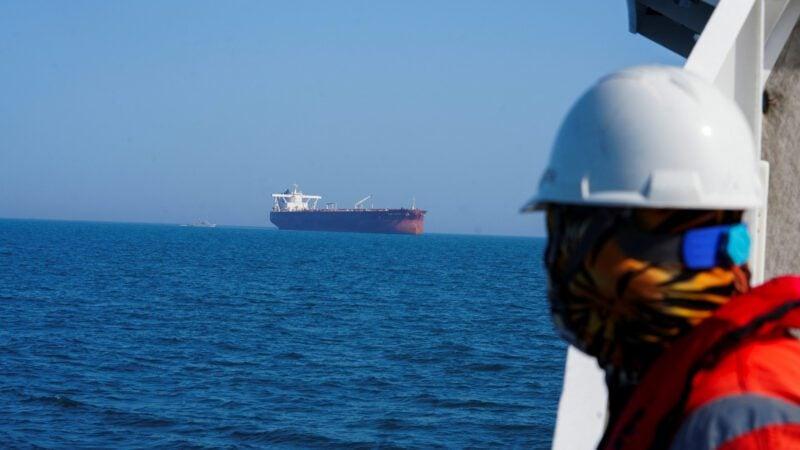
Recent trade data shows stable conditions in the trade routes through the Strait of Hormuz and Bab el-Mandeb, with no significant changes.
According to Lloyd’s List Intelligence, there was an 18% drop in total transits through the Strait of Hormuz compared to the previous week. Outbound journeys saw a 30% decrease, while inbound traffic declined by 6%.
In the Red Sea, 269 transits were observed through Bab el-Mandeb, a slight drop from 273 the week before.
Maritime analysts suggest it's too early to make assumptions about the reduced traffic in Bab el-Mandeb, following the earlier decline after the Houthis imposed restrictions on Saudi Arabia.
Traffic through the Suez Canal also saw a minor decrease last week, with 263 transits compared to 275, but this remains within the usual range. There was an increase in Very Large Crude Carriers (VLCCs) passing through as operators adapted to the circumstances.
“We continue to see a shuttle service where ships linger in the Gulf before transitioning or moving, including ship-to-ship transfers in the Gulf of Oman,” said Tomer Raanan, a senior maritime intelligence analyst at Lloyd’s List Intelligence.
Most of the tankers involved in this shuttle service are operated by ADNOC (Abu Dhabi National Oil Company), Sinokor, and the Kuwait Oil Company.
Richard Meade, Editor-in-Chief of Lloyd’s List, pointed out that the repetitive announcements from the U.S. and Iran about the status of negotiations create more confusion.
“The statements are increasingly divergent,” Meade noted. “This situation provides no clarity for the shipping industry. Ship owners are left to decide whether to opt for the safer route with the risk of paying for passage or take the southern route and face potential escalation.”
Payments to Iran for safe passage might breach U.S. sanctions enforced by the Treasury Department's Office of Foreign Assets Control (OFAC).
“As this situation drags on, people will start assessing which side they fear more,” said Claire O’Neill McCleskey, co-founder of Clarity Compliance Consulting.
O’Neill highlighted that shipowners are weighing the risks of paying Iran for safe transit against the chance that the U.S. might impose sanctions on those who do.
“I’d rather face the consequences from OFAC and hire a good lawyer than risk not paying and end up with a costly situation if a ship is hit,” O’Neill added.
At the time of this report, Ambrey issued an alert indicating that the Houthis reportedly launched a drone attack on the Saudi Aramco refinery in Jazan, Saudi Arabia. The extent of the damage to the facility has not been released yet.