
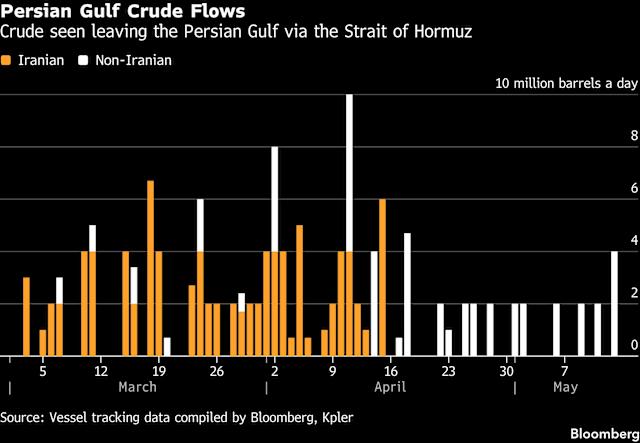
In recent days, there has been an uptick in the number of supertankers carrying unregulated oil through the Strait of Hormuz. This comes as the oil market grapples with the biggest supply disruption ever.
Since May 10, four supertankers, each carrying around 2 million barrels of mostly Iraqi crude oil, have exited the strait. This rate is nearly 2 million barrels a day, according to vessel tracking data. However, before the conflict began, roughly 20 tankers of different sizes crossed the strait every day.
Oil traders are keeping a close eye on the flow of oil through Hormuz, as the blockage has already cut about a billion barrels from global supply. Although shipments from countries other than Iran have increased slightly, oil exports from Iran have plummeted due to a U.S. blockade.
The Strait of Hormuz has faced significant restrictions since the conflict started in late February, leading to ongoing international diplomatic efforts to address the situation.
Earlier this month, Iran outlined a new process for ships wishing to navigate Hormuz, which involves coordination with the Persian Gulf Strait Authority. Meanwhile, the U.S. continues its blockade from the Gulf of Oman on Iranian ports.
This has slowed maritime traffic, but some vessels have successfully passed through due to agreements between different governments. Nonetheless, there's uncertainty about whether those who have managed to leave will return, given the shipping risks involved.
Recently, some commercial vessels have been crossing the strait with their satellite signals turned off. This means that once they reappear outside the Middle East, the number of crossings could increase. In the last seven days, a total of 38 various vessels have made the journey through Hormuz in both directions, three times more than in the previous week. Most of these vessels traveled without signaling until they reached the Gulf of Oman.
Georgios Sakellariou, a freight analyst at Signal Maritime, noted, “There has been an increase, but the numbers are still very low and won’t significantly impact supply. The main concern is that even if all current tankers leave, new ones won’t be coming in soon.”
Of the four supertankers that left with their signals on, three were loaded with crude oil from Iraq, while the fourth carried cargo from the United Arab Emirates and Kuwait.
Iran announced that it is now permitting Chinese ships to pass through the Strait of Hormuz following talks with China's foreign ministry. Just a day prior, the supertanker Yuan Hua Hu became the third Chinese Very Large Crude Carrier (VLCC) to navigate the strait.
A similar increase in crossings has been observed in other markets, with several very large gas carriers contributing to the recent uptick.
Tracking the number of ships crossing Hormuz has proven complex, as some vessels have been turning off their satellite transponders during transit. Last month, the leader of commodity trader Mercuria Energy Group mentioned that they have successfully navigated vessels out of the strait, but refrained from providing further details.
Middle Eastern oil companies, including Saudi Arabia's Aramco Trading Co. and the UAE’s Abu Dhabi National Oil Co., have also managed to move crude shipments through the strait since it became restricted, according to sources familiar with the situation.