
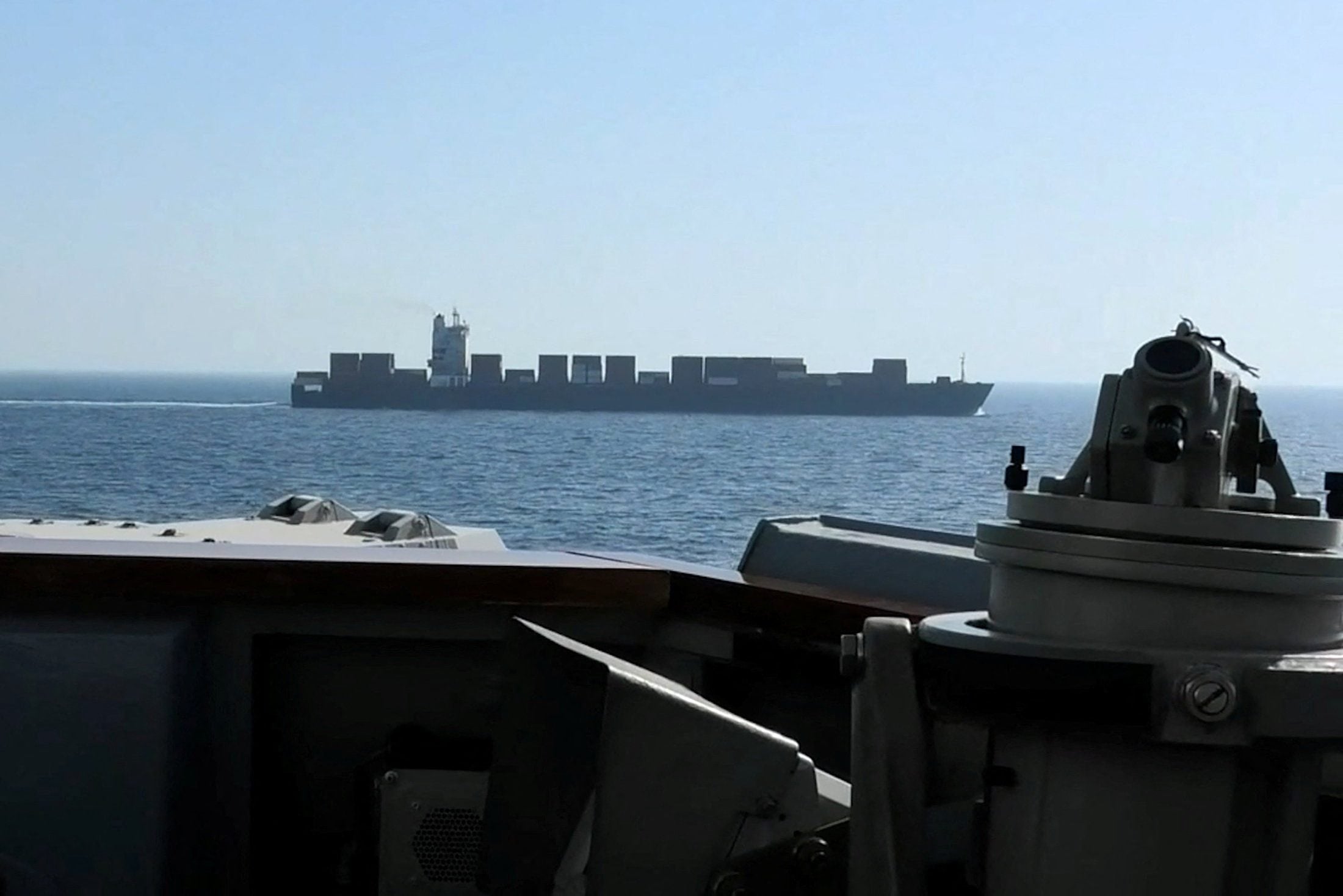
The situation over the weekend in the Strait of Hormuz has revealed a significant difference between political statements claiming that the waterway is “open” and the real conditions affecting commercial shipping. Attacks, enforcement actions, and inconsistent transit approvals have pushed the crisis into a more precarious state.
In just 48 hours, several vessels were shot at near Oman, a U.S. Navy destroyer disabled and seized an Iranian-flagged cargo ship, and maritime tracking data showed an unpredictable pattern of movement through the strait—some ships are moving through, others are turning back, and many are stuck in place.
These events indicate that the Strait is not reopening but is instead becoming a contested corridor under both Iranian control and U.S. enforcement.
Attacks Resume After Ceasefire Lull
On Saturday, the weekend escalation began with the first confirmed attacks on commercial shipping since the ceasefire on April 7.
As reported by the United Kingdom Maritime Trade Operations (UKMTO), a containership was hit by an unknown projectile northeast of Oman, and a tanker was fired upon by vessels linked to Iran’s Islamic Revolutionary Guard Corps (IRGC) Navy. Additionally, there was an incident where a projectile landed near a cruise ship moving close to Omani waters.
These attacks ended a 10-day period of calm and reinforced warnings from industry groups that regional threat levels remain high, despite diplomatic assurances.
U.S. Enforces Blockade With Vessel Seizure
The situation escalated further on Sunday when the U.S. Central Command confirmed that American forces disabled and boarded the Iranian-flagged cargo vessel Touska, as it failed to heed repeated warnings while trying to reach an Iranian port.
This interception, carried out by the guided-missile destroyer USS Spruance, represents a significant step in Washington’s expanding maritime blockade, which now includes the authority to stop, board, and seize vessels associated with Iranian trade.
U.S. officials noted that many vessels, specifically 27, have complied with orders to turn back since the blockade began on April 13.
This incident signals a shift from deterrence to direct action, increasing the risk of retaliatory measures.
“Iran recently announced that they were closing the Strait, which is strange because our blockade has already closed it,” President Donald Trump stated on social media.
Iran Tightens Control Under ‘Maritime Regime’
Meanwhile, Iran is formalizing its own control system over the strait.
Officials have indicated that vessels must coordinate with IRGC forces and travel along designated routes, establishing a new “maritime regime” for access. Within this framework, commercial shipping is effectively restricted unless explicitly approved, with permissions seemingly arbitrary and subject to quick changes.
Over the weekend, several vessels faced challenges or had to change course despite having prior clearance—emphasizing the fragility of the permission-based system.
Selective Transits Highlight Fragmentation
Despite increased controls, some limited movements through the strait did occur.
MarineTraffic reported that six cruise ships stuck in Gulf ports since late February managed to transit between April 17 and April 19 during a brief window following Iran’s initial reopening announcement.
In contrast, other vessels encountered disruptions.
Two sanctioned tankers—G SUMMER and MEDA—had to turn back while attempting to leave, while the Chinese cargo vessel ATLANTIC HARMONY was reported anchored near Larak Island amid uncertainty over routing and authorization.
Additionally, tracking data shows that while a cargo-laden vessel like Touska was intercepted, an Iranian-flagged tanker without cargo successfully entered the Gulf, suggesting that factors like cargo type and compliance are now influencing outcomes.
Dual-Control System Emerges
The weekend's events showcase a system increasingly characterized by two overlapping and conflicting forces: Iran controlling routing and access through specific authorization and lanes, while the United States enforces a blockade targeting Iranian-connected cargos and vessels.
This situation creates a complicated risk environment for shipowners, where complying with one system may expose vessels to enforcement from the other.
Moreover, renewed attacks introduce an additional layer where ships and crews face physical threats.
Ceasefire Under Pressure
The escalation comes just days before the current U.S.–Iran ceasefire is set to end on April 22.
Both parties have taken firm stances. Iran has stated it will not negotiate further unless the U.S. lifts its blockade, while Washington has indicated that enforcement will continue.
U.S. President Donald Trump accused Iran of violating the ceasefire over the weekend, citing reported gunfire incidents in the strait and warning of further consequences if an agreement is not reached.
“If they don’t take the deal… the United States is going to knock out every single power plant and every single bridge in Iran,” President Trump warned.
A Corridor in Crisis
Overall, events from the past 48 hours strengthen the conclusion that the Strait of Hormuz no longer functions as a reliable commercial corridor.
Even vessels attempting neutral transit now face uncertainties regarding routing, compliance, and security.
The idea that the Strait of Hormuz has reopened is increasingly hard to maintain. What has emerged instead is a fragmented and unstable system that is far from normal. With insurers, charterers, and shipowners still evaluating the risk environment, a quick return to normal traffic levels seems unlikely.
As the ceasefire deadline approaches and both sides ramp up their positions, the next phase of the crisis could have significant implications for global shipping and energy markets.