
In 2025, South Korea's HMM managed to remain profitable despite tough challenges in container shipping. The company reported a 13.4% operating margin, even as freight rates dropped significantly and many global competitors faced losses.
HMM, based in Seoul, announced a full-year revenue of KRW 10,891 billion (approximately $8.38 billion). Their operating profit was KRW 1,461 billion ($1.12 billion), while the net profit reached KRW 1,879 billion ($1.45 billion). Although these numbers were much lower than in 2024—operating profit dropped by 58.4% and net profit fell by 50.3%—HMM's ability to stay in the black was notable when many rivals struggled.
The overall container market faced consistent pressure throughout 2025. The Shanghai Containerized Freight Index averaged 1,581 points, a decrease of 37% from 2024's average of 2,506. Freight rates plummeted across major routes, with spot prices falling by 49% on the U.S. West Coast, 42% on the U.S. East Coast, and 49% in Europe.
Larger global shipping companies were also affected. A.P. Moller-Maersk reported a $153 million loss in its Ocean division in the fourth quarter—the first quarterly loss in years—despite an 8% increase in volume, as excess capacity continued to impact pricing negatively.
Germany-based Hapag-Lloyd also felt the strain, posting full-year EBITDA of $3.6 billion, down from $5.0 billion in 2024, while EBIT dropped to $1.1 billion from $2.8 billion. The company attributed this decline to higher costs associated with redirecting ships around the Cape of Good Hope and startup expenses linked to its Gemini Network partnership with Maersk.
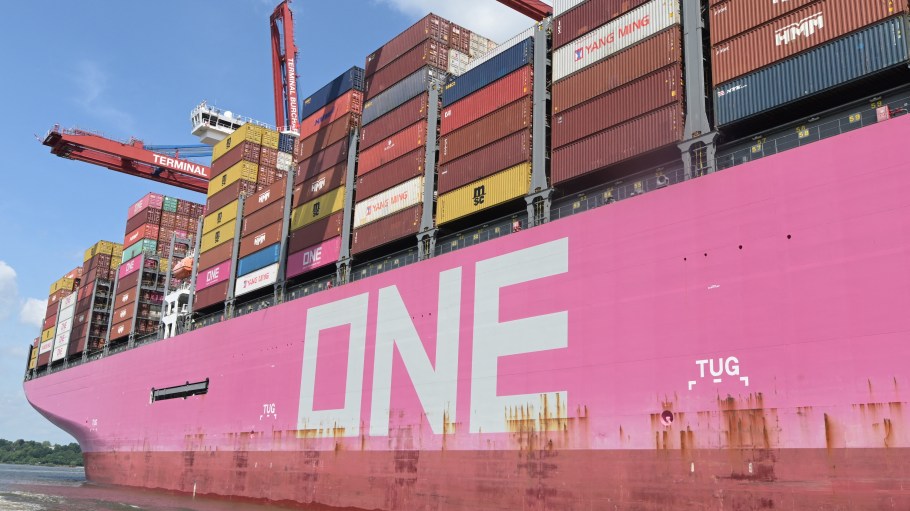
Ocean Network Express experienced a net loss of $88 million during the October–December period, despite earning $4.07 billion in revenue. CEO Jeremy Nixon mentioned a "challenging operating environment," partly due to steady new ship deliveries that kept the supply of vessels ahead of demand.
In contrast, HMM showed some signs of recovery in its quarterly results. Operating profit in the fourth quarter increased by 6.9% compared to the previous quarter, while net profit rose by 19.7%. Revenue remained relatively stable quarter-over-quarter at KRW 2,708 billion ($2.08 billion).
Looking forward, HMM cautioned that the oversupply of vessels is still a significant risk. A large number of new container ships are expected to be delivered, which could put more strain on the supply-demand balance amidst slow demand growth.
To address these challenges, HMM plans to expand its hub-and-spoke network, enhance low-emission services, and improve cost efficiency through optimized feeder operations. The company is also looking to diversify its bulk offerings to create new revenue streams.
Additionally, geopolitical risks added uncertainty in 2025, as most shipping companies continued to reroute their vessels around the Cape of Good Hope to avoid attacks from Houthi forces in the Red Sea. By mid-January 2026, only around 26 container ships per week were using the Suez Canal, a significant drop from the approximately 80 weekly transits before the attacks that started in late 2023.
In February, Maersk and Hapag-Lloyd announced plans to cautiously restart selected services in the Red Sea, beginning with their Gemini Cooperation's ME11 route. Whether this marks a sustainable reopening or merely a calculated risk will depend on the security situation in one of the world's most crucial shipping corridors.