
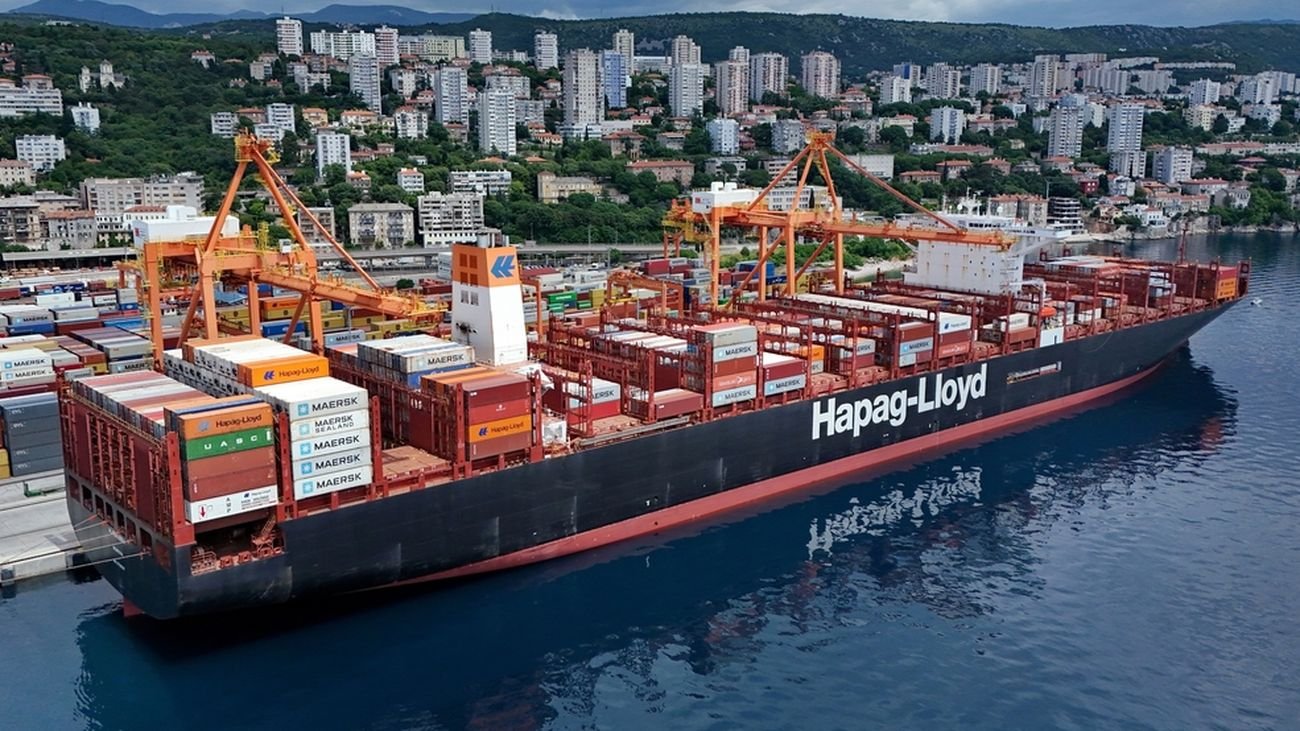
Hapag-Lloyd has shared its preliminary financial results for 2025, showing figures at the higher end of its expectations. However, earnings dropped significantly compared to last year due to increased operational costs and lower freight rates.
The Hamburg-based shipping company reported total revenues of $21.1 billion for the year, with EBITDA of $3.6 billion and EBIT of $1.1 billion. While these results met the company's forecasts, they represent a noticeable decrease from 2024, when EBITDA was $5.0 billion and EBIT was $2.8 billion.
On a positive note, Hapag-Lloyd's shipping volumes increased. The company transported 13.5 million TEU in 2025, marking an 8% rise from the previous year. This growth was fueled by stable global trade and the introduction of the Gemini Network. However, average freight rates fell by 8% to $1,376 per TEU, which offset most of the gains made from the increase in volume.
The company explained that “higher costs resulting from the ongoing rerouting of ships via the Cape of Good Hope and start-up costs for the Gemini Network affected the annual results.” They also noted that cost savings related to the Gemini Network began to take effect in the second half of 2025 and will be fully realized in 2026.
These savings are part of Hapag-Lloyd’s partnership with A.P. Moller-Maersk under the Gemini Cooperation, which officially began on February 1, 2025. This network offers 29 joint mainline services and 29 shuttle services across East-West trade routes.
Recently, the companies made a significant operational move by announcing plans to resume one shared service to the Red Sea and Suez Canal area. This will replace the longer route via the Cape of Good Hope, which was implemented due to security concerns in the Red Sea. The first service to change will be the IMX, connecting India, the Middle East, and the Mediterranean, with modifications starting in mid-February under naval protection.
The companies confirmed, “The highest security measures will be put in place, as the safety of the crew, vessels, and customers’ cargo is the top priority for both carriers,” emphasizing that this decision supports the Gemini Network’s goal of maintaining schedule reliability. Any further expansion of Suez transits will depend on continued stability in the Red Sea.
Hapag-Lloyd operates a fleet of 305 container ships, offering a total capacity of 2.5 million TEU and serving over 600 ports worldwide. The company employs around 14,000 staff across 400 offices in 140 countries.
The complete 2025 Annual Report, including audited results and projections for 2026, is set to be published on March 26, 2026.