
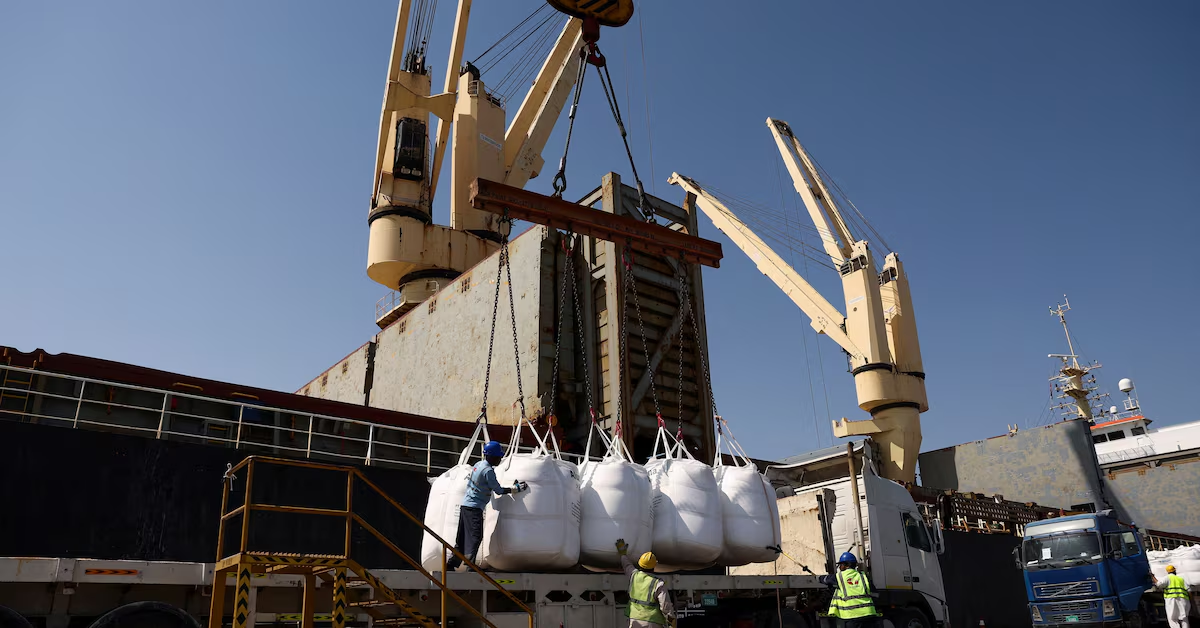
FUJAIRAH, May 6 (Reuters) – At the UAE port of Fujairah, grain was being unloaded from bulk carriers on Wednesday, while crude oil was pumped through pipes to tankers docked at the port.
Many loaded trucks were lined up near the port, with others waiting outside for their turn. Offshore, vessels from shipping companies like Cosco and Gardenia anchored, with service boats moving between them.
Fujairah and Khor Fakkan, another eastern port with access to the Indian Ocean, have become crucial for the UAE’s economy since the Strait of Hormuz was effectively closed.
These ports now handle most of the UAE's maritime trade instead of the main terminals on the western coast, where ships have become stuck.
Since the conflict with Iran began, crude exports through Fujairah have risen by 38%, nearing the pipeline's maximum capacity that supplies the port. At Khor Fakkan, terminal operator Gulftainer reported that the number of containers it manages has increased almost 25 times.
However, on Monday, Iran demonstrated the vulnerability of these ports when drones struck the Fujairah Oil Industry Zone, causing a fire at one of the UAE's key energy facilities and injuring three workers.
Before this, Iran’s Revolutionary Guards Navy shared a map suggesting an expansion of its control over the UAE’s eastern coastline, including both ports. Shipping sources indicated that, as of Tuesday, neither port had been affected, but the message from Tehran was clear.
The UAE foreign ministry directed Reuters’ inquiries to official statements from UAE federal and Fujairah authorities, ADNOC, and the state news agency WAM. Top UAE officials have emphasized that maintaining navigation freedom in the Strait of Hormuz is vital and have stated their right to respond to any attacks on the UAE.
“No country has the right to disrupt international trade or threaten supply routes,” said Energy Minister Suhail Al Mazrouei at a logistics forum in St. Petersburg last month.
Fujairah is at the end of the Abu Dhabi Crude Oil Pipeline, which transports between 1.5 million and 1.8 million barrels per day (bpd) from inland oil fields to the Gulf of Oman, bypassing the Strait and allowing ADNOC to keep exporting oil globally.
According to Kpler analyst Johannes Rauball, crude exports from Fujairah increased to an average of 1.62 million bpd by late March, up from 1.17 million bpd in February. Since the war started, Fujairah has begun to regularly accept container ships for the first time, based on data from Kpler.
KHOR FAKKAN TRANSFORMED
The changes at Khor Fakkan have been even more significant.
Gulftainer, which runs the container terminal there, says it now handles around 50,000 import and export containers each week, up from just 2,000.
Kpler data shows that the number of container ships calling at Khor Fakkan daily has nearly quadrupled since the onset of the war.
“It has become a vital national gateway,” Gulftainer's CEO Farid Belbouab told Reuters, describing a port that was previously designed for transshipment but has now turned into a key hub for imports ranging from groceries to medical supplies.
Truck movement reflects this growth as well. “Before the war, we were handling about 100 trucks daily; now we’re up to about 7,000 a day,” Belbouab noted, adding that the Sharjah-based company hired 900 people within two weeks when the conflict began.
Shipping data supports this trend. Rebecca Gerdes, an analyst tracking vessel movements, stated that traffic at both ports remained steady despite the attacks on Monday.
At Khor Fakkan, six container ships were docked, with an additional 10 waiting, while Fujairah had two vessels at the dock and one more waiting, reflecting its smaller capacity.
Logistics firms report that operations are currently running smoothly.
Eric Martin-Neuville, executive vice president for Asia-Pacific and the Middle East at GEODIS, mentioned that his company is not facing significant disruptions at either port, apart from congestion.
“These are currently the only direct UAE port options for cargo going to the UAE, avoiding lengthy road trips and border crossings through Saudi Arabia or Oman,” he added.
GEOGRAPHY COUNTS
The UAE is not the only region looking for alternatives. Saudi Arabia benefits from a dual coastline, and its East-West Pipeline has facilitated the flow of about 7 million barrels per day during the conflict, bypassing the Strait via the Red Sea port of Yanbu.
However, earlier this spring, Iran targeted both the pipeline and the port, highlighting that they are not free from threat.
For Qatar, Kuwait, and Bahrain, the geographic situation is more challenging since their marine routes are all behind Hormuz, making them reliant on Khor Fakkan for sea imports or on costly and congested overland shipments through Saudi Arabia, which emphasizes the UAE’s eastern ports' growing importance beyond its borders.
Belbouab from Gulftainer is already looking to the future for Khor Fakkan, planning to announce a new logistics hub in Al Dhaid, about 50 km from the port.
This facility will cover over 100 hectares and will connect to Khor Fakkan via road and rail, handling container transshipment and general cargo storage. The project is a joint investment with the Sharjah government and is expected to exceed $100 million in its first phase.
Yet, Monday’s strikes highlighted the vulnerability of the new Gulf trade system. Fujairah’s energy infrastructure was affected by a drone attack on March 14, which sparked fires and halted some oil-loading operations.
Belbouab acknowledged the uncertainty of the situation, stating, “I don’t know when the straits will reopen or what the long-term impact will be,” while also noting that a coordinated regional response allowing cargo to move across Saudi Arabia and Oman serves as a fallback option.