
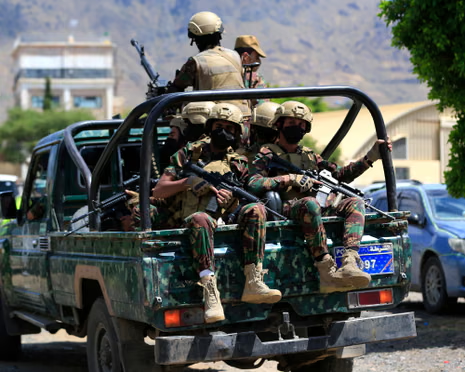
TAIZ, Yemen/DUBAI, Sept 14 (Reuters) – Gulf Arab nations have canceled a meeting with Iran that was scheduled for Monday, while Yemen's Houthis launched a new strike on Saudi Arabia. This development has escalated the conflict in the Middle East and further threatened global oil supplies.
The Houthis, who are aligned with Iran, reported that they launched dozens of missiles and drones targeting a military airbase in Khamis Mushait, southern Saudi Arabia. They claimed to have hit aircraft hangars, radar systems, runways, and ammunition depots, describing the attack as retaliation for numerous Saudi airstrikes on Yemen in recent days.
In response, Saudi officials issued several emergency alerts in Khamis Mushait and three other southern cities that have previously faced Houthi attacks.
Last week, the Houthis made rapid advances in Yemen, culminating in the capture of an island at the entrance to the Red Sea on Friday. On the same day, another attack, blamed by Riyadh on Iran-backed fighters in Iraq, disrupted Saudi Arabia’s east-west oil pipeline, a vital route for Middle Eastern oil outside the blockaded Strait of Hormuz.
OIL PRICES JUMP
Following these events, crude oil prices surged more than 4% when the market reopened on Monday, with Brent crude futures surpassing $109 a barrel. The average retail price of diesel in the United States reached a record high of over $6.23 a gallon.
Traders warn that if the Saudi pipeline remains closed for more than a few days, it could significantly impact global oil supply by up to 4%. Satellite images reveal sections of the pipeline damaged by fires, but Riyadh has not provided a clear estimate for its re-opening.
Oman was supposed to host a meeting on Monday that included Iran and Gulf countries to discuss negotiations for reopening the Strait of Hormuz, a crucial oil shipping lane that has remained largely closed since the U.S. and Israel attacked Iran in late February.
However, Oman’s Foreign Minister, Sayyid Badr Albusaidi, announced that the meeting had been postponed for the sake of consensus. Iran cited Saudi Arabia's request for the postponement.
In the meantime, Iran released a list of 77 ships it claims have violated its operational protocols in the Strait of Hormuz. Ships on this list could face restrictions on future passages, such as fines, detention, or confiscation of vessels.
The exact amount of oil passing through the strait is hard to verify since ships often turn off their tracking devices and transfer cargo to other vessels once they clear it.
U.S. Energy Secretary Chris Wright indicated that the average number of ships crossing the strait with U.S. support is increasing. However, independent monitors suggest that oil flows may have decreased this month as fighting intensified after a relatively calm August.
EXPANSION OF WAR TO YEMEN POSES DILEMMA FOR TRUMP
The resurgence of fighting in Yemen presents a challenge for Washington, which faces pressure to support its Saudi allies while avoiding an expansion of the costly conflict.
Saudi Arabia has been leading an Arab coalition fighting the Houthis since they took Yemen’s capital in 2014. While there was a ceasefire for the past few years, fighting has now reignited, with the Houthis pushing back a Saudi-backed government in the south.
The International Organization for Migration estimates that 82,000 Yemenis have fled their homes due to combat since the start of the month, as the Houthis took control of several cities, including the historic port of Mocha last week.
Aisha Muhammad, an elderly woman in government-controlled territory near Taiz, shared that she had to leave behind her two daughters and three sons who are unable to escape. She told Reuters, “They can’t even go out to buy food and water. They are trapped inside their homes, being shot at.”
On Friday, the Houthis captured Perim Island, located in the Bab el-Mandeb strait, known as the “Gate of Tears” at the mouth of the Red Sea.
U.S. President Donald Trump is facing pressure to resolve the conflict to address the global energy shortage, which is impacting his party’s fortunes ahead of the midterm elections in November.
Saudi state media reported that Crown Prince Mohammed bin Salman met in Jeddah with U.S. regional military commander, Admiral Brad Cooper, on Monday.
According to three sources, Washington has so far declined requests from the prince for greater involvement in Yemen, except for providing intelligence. Trump confirmed over the weekend that he had spoken with the prince, stating that the Houthis had also contacted the U.S. to request non-intervention.
The U.S. bombed Houthi positions in 2025 for two months, but Trump ended the campaign after reaching a ceasefire agreement with them, stating they committed to not attack ships in the Red Sea.
While attending a golf tournament at one of his resorts in Ireland, Trump mentioned that he expects the Iran war to conclude shortly after the elections, predicting that oil prices will “drop like a rock” afterward.