
By Weilun Soon
Apr 18, 2026 (Bloomberg) – Several oil tankers turned around in the Persian Gulf after trying to pass through the Strait of Hormuz. Ship owners and oil traders are confused about whether Iran will keep its promise to keep this narrow passage open for everyone.
The halted journeys of five Greek and Indian tankers early Saturday morning show the current situation regarding traffic through this energy corridor. This follows claims made by Iran's foreign minister on Friday that the passage was completely open. However, later, the semi-governmental Iranian news agency Fars reported that the passage would remain closed if the US naval blockade continued.
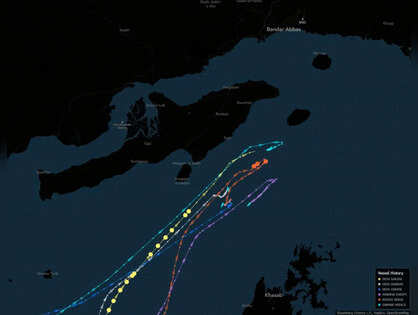
The Greek and Indian tankers, loaded with oil, were heading northeast toward Hormuz from Dubai's waters before they turned around on Saturday morning. Some are now near where they turned back, close to the Iranian island of Qeshm, while a sixth tanker has not sent a location signal for several hours.
These six vessels became part of a monitored group late Friday after announcements about their attempts to approach Hormuz. They are among the tankers stuck in the Persian Gulf due to ongoing Middle East conflicts.
Together, these six tankers hold about 8.3 million barrels of oil. If they were able to pass, it would mark the highest daily oil volumes transported from the Gulf since the start of the conflict.
Bloomberg News could not immediately confirm if the tankers turning around were related to a decision to halt passage or if there was some control over the movement, as several vessels are heading toward the strait. Near the tankers that turned around, three gas carriers and one oil products tanker were seen also heading east toward the Gulf of Oman.
Ship owners reported hearing radio warnings late Friday that they would still need permission from the Iranian navy, according to sources familiar with the situation.
There was no immediate response to emails sent to the owners and managers of the six tankers by Bloomberg.