
A recent report from a federal watchdog highlights ongoing issues with training, coordination, and emergency planning that hinder responses to ship fires at U.S. ports. This comes three years after two firefighters lost their lives while fighting a fire on a cargo ship in Port Newark.
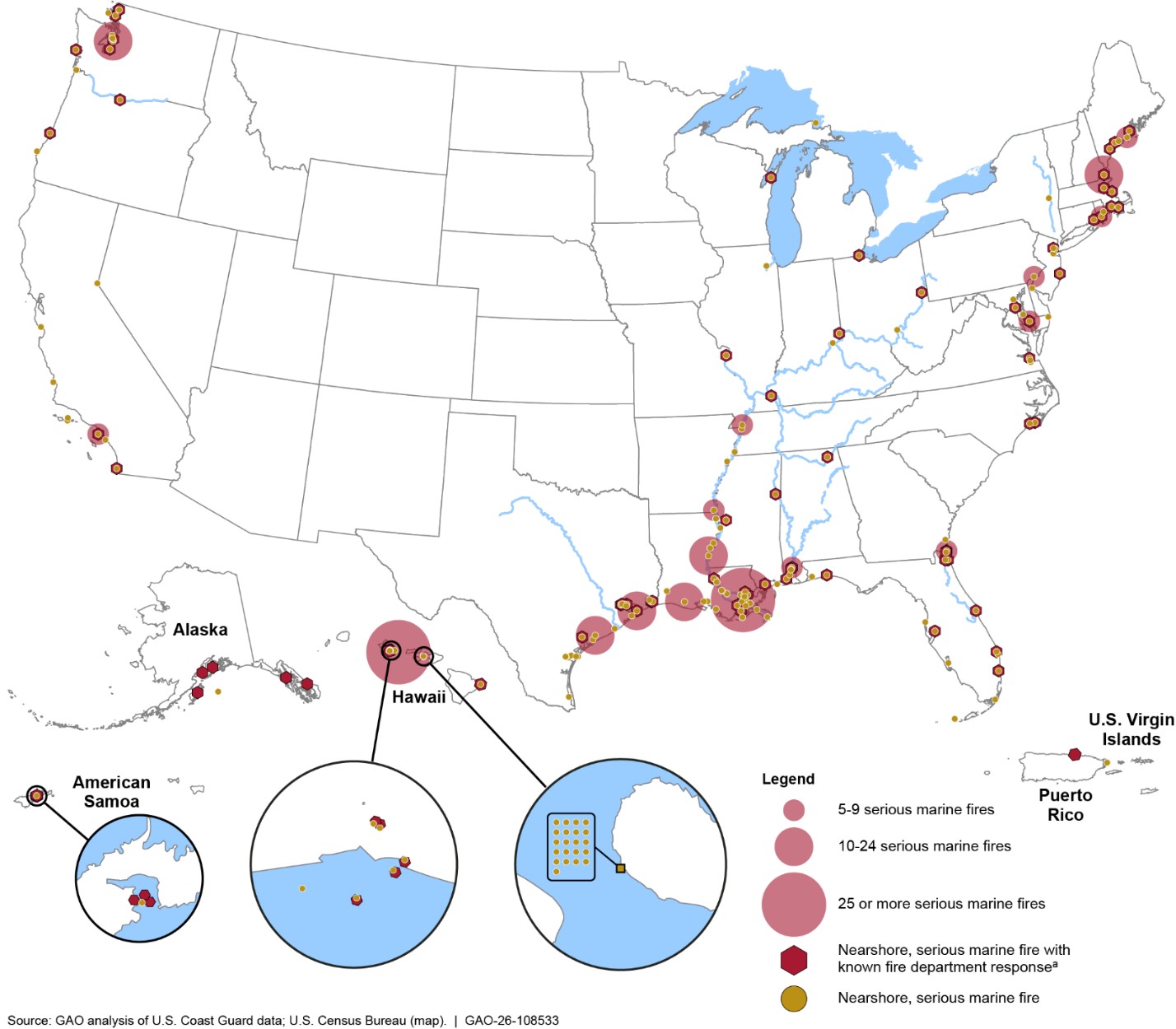
According to the Government Accountability Office (GAO) report, there were 886 reports of nearshore marine fires to the U.S. Coast Guard from 2015 to 2025. Out of these, 206 fires—almost one-quarter—led to a death, injury, over $200,000 in damages, or the complete loss of a vessel.
When a ship catches fire, the responsibility for responding is often shared among multiple parties. The Coast Guard typically coordinates the federal response, while local fire departments handle the firefighting efforts. They often receive support from the ship's operators, port authorities, and marine firefighting and salvage companies.
GAO points out that this setup can leave local firefighters dealing with unfamiliar ships, tight spaces, and dangerous cargo without adequate experience in shipboard firefighting.
This concern was underscored during a fire in July 2023 on the Italian-flagged Grande Costa D’Avorio at Port Newark. Firefighters struggled to navigate through smoke and the unusual layout of the vessel. Tragically, firefighters Augusto Acabou and Wayne Brooks Jr. died, and several others were hurt. The fire lasted five days and resulted in an estimated $23 million in damages, according to the Coast Guard. gCaptain provided coverage of the firefighting efforts at that time.
Following the incident, the Coast Guard launched an investigation into the fire on the Grande Costa D’Avorio, which revealed deficiencies in shipboard firefighting training. GAO noted that the last training exercise for the responding firefighters had occurred nine years earlier, and only one firefighter had attended it.
GAO found that officials from six Coast Guard sectors informed investigators that firefighters require more practical training, including tours of vessels and realistic shipboard exercises. However, fire chiefs reported challenges in gaining access to ships since they only have limited time in port, and they cannot board for training without approval from the vessel's owner.
In January 2024, the Coast Guard established a National Salvage and Marine Firefighting Task Force, which has since created online training and other resources. However, as of September, GAO noted that no guidance had been developed for a practical exercise program.
Another issue raised is the speed at which vessel response plans (VRPs) are activated.
In the case of the Grande Costa D’Avorio, the vessel's response plan was not activated until about eight hours after the fire began, and only after firefighters had already boarded the ship. The Coast Guard's investigation indicated that an earlier activation might have prevented the fire from spreading and minimized damage.
GAO reported that officials from the Coast Guard and marine firefighting providers described a wider "wait and see" mentality, where vessel operators may hesitate to trigger response plans due to the costs associated with deploying commercial firefighting and salvage resources.
Challenges from Alternative Fuels
The report also expresses concerns regarding the increasing number of ships powered by batteries and other alternative fuels.
Current laws restrict the Coast Guard's ability to enforce certain requirements on non-tank vessels using alternative fuels, such as battery-powered ferries, to maintain VRPs for hazardous substance emergencies. GAO pointed out that these regulations were established before alternative-fuel vessels became common.
According to GAO data, the global fleet of battery-powered vessels expanded from 142 ships in 2017 to 1,006 in 2024, with an additional 1,584 vessels on order through 2027.
Lithium-ion batteries pose unique challenges because they can cause intense heat and toxic gases in a situation known as thermal runaway, leading to fires that are hard to put out. This risk has gained attention due to several significant incidents, including the 2025 fire and sinking of the car carrier Morning Midas in the North Pacific.
GAO recommended that Congress look into revising federal law to require non-tank vessels using alternative fuels to create response plans for worst-case hazardous substance discharges.
Additionally, GAO presented five recommendations to the Coast Guard, which include assigning specific field personnel to coordinate marine firefighting efforts, collaborating with local fire departments for vessel tours and exercises, creating a system to share lessons and best practices, and providing clearer guidance on when to activate vessel response plans.
The watchdog also recommended that the Coast Guard establish regulations for tank vessels to create response plans for worst-case hazardous substance discharges, not just oil spills.
The Department of Homeland Security expressed agreement with all five recommendations.
The full GAO report and summary highlights were released on September 29.