
By Mark Smith, Director – Decarbonisation, NorthStandard
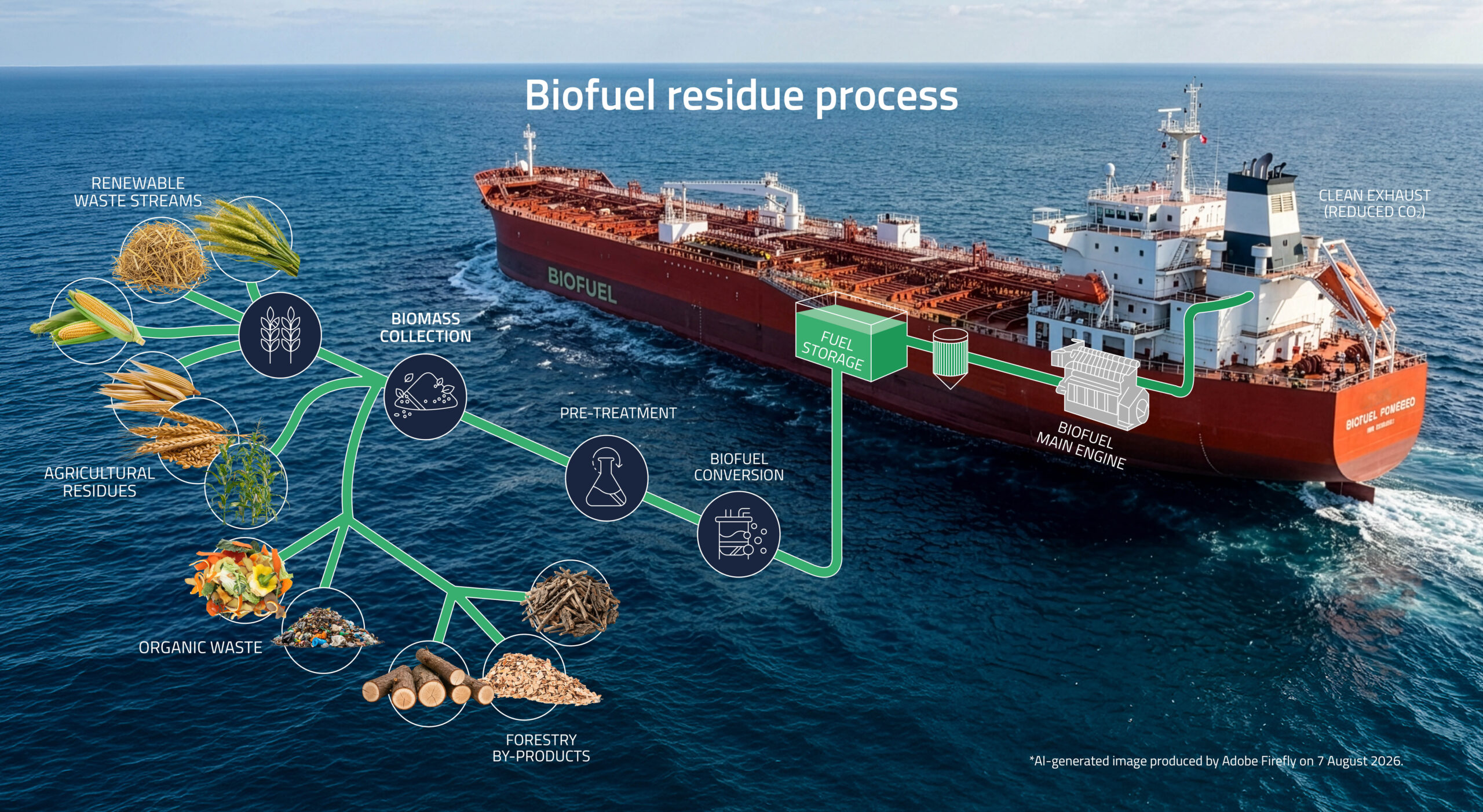
While fuels can be made from crops such as corn, sugarcane, wheat, or vegetable oils, using these for food pushes demand to explore alternatives. This includes utilizing waste or by-products from agriculture, forestry, food processing, and other biological industries. Bio-residues can be transformed into fuels or blended with other fuels, providing viable replacements for traditional oils to help ships lessen their greenhouse gas emissions (GHGs).
Currently, the Fuel EU Maritime regulations provide financial incentives to use bio-residues. Here, a surplus in emissions reductions can be sold to ship operators facing deficits to avoid penalties.
An upcoming revision to the EU Emissions Trading System (ETS) plans to introduce a technology-neutral approach called SMAP (Sustainable Maritime Alternative Propulsion) to help bridge the cost gap between fossil fuels and low-carbon options.
Additionally, the Renewable Energy Directive (RED III) promotes biofuel production from residues. This includes used cooking oil (UCO), certain animal fats, palm oil mill effluent, tall oil (a by-product of pine wood pulp), and lignocellulosic residues (from non-food parts of plants), as well as agricultural, forestry, and some industrial residues.
In its original format, the IMO Net Zero Framework (NZF) also included ‘GHG pricing’ and a mechanism for incentivizing lower emissions. However, there is still a division among administrations on whether this approach is practical or desirable. Between November 30 and December 3, the 85th Marine Environment Protection Committee meeting will assess the future steps for the NZF.
Residual Fuel Demand
Despite these discussions, the demand for marine biofuels continues to rise. According to DNV's latest ‘Maritime Forecast to 2050’, a staggering 89.8% of currently operational tonnage depends solely on oil fuels.
“This indicates that there is a reliance on drop-in fuels like fatty acid methyl ester (FAME) or hydrotreated vegetable oil (HVO) to achieve decarbonization, unless these vessels are converted to alternative fuels or equipped with onboard carbon capture technologies,” DNV notes. “For new vessels being built, 60.6% of the tonnage and 79.5% of the ships face similar limitations.”
Given this scenario, suppliers aiming to meet maritime demand will likely seek out more complex bio-residue sources instead of sticking to traditional feedstocks.
It’s important to keep in mind that bio-residues should be treated as waste-derived fuels, necessitating better fuel quality management and pollution readiness.
Potential Unintended Consequences
Since RED III applies across all industries, competition for bio-residues will arise from airlines and heavy transport sectors, which could heighten risks for the maritime industry.
Sector buyers might encounter lower-quality residues, such as chemically inconsistent feedstocks or mixtures from diverse residue streams. There may be increased pressure on traceability systems, a rise in fraud risks (due to incorrect sustainability classifications in Proof of Compliance documents), and growing disputes regarding the chain of custody.
For ship operations, these risks could lead to issues like oxidation instability, greater fluctuations in acidity and cold flow properties, or degradation during storage. Poorer quality fuels could clog injectors or contribute to fuel pump wear. There may also be more sediment formation and blockages in purifiers and filters, along with increased microbial growth where contaminants or water are present.
Incompatibility with standard marine fuels and risks of cross-contamination could emerge if biofuel specifications are unreliable. This fuel incompatibility might create issues for seals, gaskets, coatings, and certain alloy metals.
Variability in fuel composition from batch to batch can also impact ship performance during a single voyage and over time, resulting in uncertainty about long-term engine performance and higher maintenance costs.
Loss Prevention and Bio-residues
With the increasing use of biofuels and the associated risks, NorthStandard recommends careful management of marine fuel. Members are encouraged to ensure stringent tank cleaning standards are maintained before usage.
As standard fuel testing may not cover aspects like microbial growth, chemical contamination, or other impurities, NorthStandard advises its members to consult fuel testing agencies for enhanced testing focused on biofuels.
General advice includes using reliable suppliers and requesting detailed fuel specifications and quality statements. Specific guidance also suggests avoiding blending with other fuels unless compatibility has been verified through testing. Members of the P&I Club can utilize VPS fuel insights to check ISO Grade data as well as identify the most common off-spec biofuel parameters and suppliers with frequent ISO 8217 off-specs.
Additionally, to minimize the duration of fuel storage, NorthStandard advises continuous monitoring of temperature, water drainage, and to keep a close watch on purification, filtration, sludge production, and abnormalities in the fuel transfer system. Owners should also enhance monitoring of fuel pumps, injectors, and cylinder condition.
Those using fuels derived from bio-residues must ensure their transfer protocols, spill contingency plans, Shipboard Oil Pollution Emergency Plans (SOPEP), and crew training are fully adequate. They should also gather and keep documentation of fuel composition, including any blending information, which is crucial for any potential pollution clean-up.
To prevent uncertified products from entering the supply chain, it is vital to focus on certifications like the widely recognized International Sustainability & Carbon Certification (ISSC EU). Having the correct documentation is essential to prove that a biofuel is derived from waste or residue rather than crops, to confirm life cycle GHG calculations, and to assist with third-party compliance audits.
Read more about Biofuels in NorthStandard’s whitepaper here.