
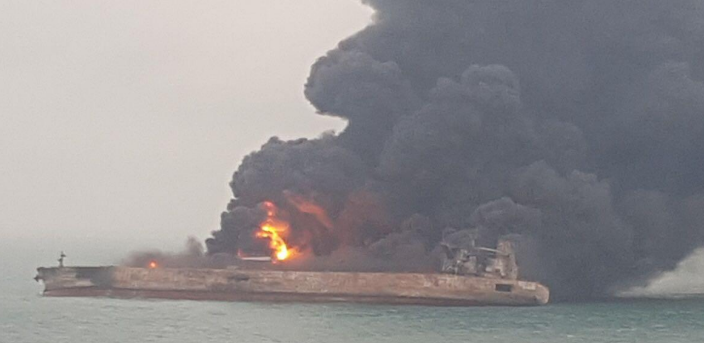
A serious accident occurred in the South China Sea in 2024 when two tankers collided, highlighting major issues such as crew fatigue, malfunctioning safety systems, and poor watchkeeping. This tragic event resulted in one death and left two others injured.
On July 19, 2024, at around 6:02 a.m., the Singapore-registered tanker Hafnia Nile crashed into the anchored Ceres I east of Malaysia. At that time, Hafnia Nile was carrying approximately 300,000 barrels of naphtha intended for Japan. The collision led to fires on both vessels, significant fuel and cargo loss, one fatality, and two injuries.
At the moment of the incident, the Ceres I, an older large crude carrier, was believed to be carrying sanctioned Iranian oil.
The final report from Singapore’s Transport Safety Investigation Bureau, released on December 28, 2025, labeled the incident a “very serious marine casualty.” It demonstrated how small issues can quickly escalate into a major disaster.
Crew Fatigue
The officer on watch aboard Hafnia Nile had only recently boarded the ship after a long flight from Colombo via Kuala Lumpur. He joined at noon, had little time to settle in, and subsequently took over the midnight to 6 a.m. watch.
Investigators found that he had less than two hours of uninterrupted rest during a 38.5-hour period before his shift. Even that short rest was disrupted by an unexpected fire alarm drill. By the end of his watch, as the collision was about to occur, he was likely extremely fatigued.
The report indicated that this fatigue “may have reduced his alertness and impacted his performance and judgment” during the critical moments leading up to the crash.
Disabled Alarms
Fatigue was not the only issue. Both radar systems on Hafnia Nile had their collision-avoidance alarms either turned off or silenced. The alarms meant to warn the crew of potential collisions were muted or completely disabled.
This failure removed an important layer of safety that might have alerted the crew as Hafnia Nile approached Ceres I and another nearby vessel.
Compounding the situation, at a critical juncture, the officer of the watch left the wheelhouse to handle paperwork in the chartroom, leaving only a capable crew member at the helm. The ship was navigating through a narrow gap of just 0.7 nautical miles between the anchored tanker and another ship.
Communication Lapses
On Ceres I, the crew noticed Hafnia Nile when it was still over six nautical miles away and deemed the risk low. As the distance decreased, they tried signaling with lights and horns, but they never used VHF radio to communicate with the approaching tanker.
The investigation revealed that Ceres I’s safety management system did not provide clear guidelines on how to communicate with a ship in close proximity while anchored.
Legal Actions and Recommendations
In July 2025, Singaporean authorities charged two crew members from Hafnia Nile under the Merchant Shipping Act. The officer in charge is accused of failing to assess risks appropriately and maintain awareness of the situation. The lookout allegedly noticed the closing ships but did not report it.
In response, the tanker’s operating company has revamped its safety protocols, which now include requiring navigation officers to rest in hotels before boarding, banning administrative tasks on the bridge unless someone is monitoring the lookout, and conducting surprise bridge audits throughout 2025.
Moreover, the United States imposed sanctions on Ceres I in December 2024 as part of its efforts to curb the transportation of Iranian oil. It was alleged that the vessel, owned by Hong Kong’s Ceres Shipping Limited, participated in a substantial ship-to-ship transfer of nearly 300,000 metric tons of Iranian crude oil near Singapore in January 2024.
Singapore also issued three official safety recommendations: keeping radar alarms active, reinforcing bridge manning standards, and providing clearer communication guidelines for close-quarters situations.
This accident serves as a stark reminder that even the best navigation equipment is ineffective without alert and well-rested crews. Routine tasks, like stepping away to complete paperwork, can have dire consequences under the wrong circumstances.