
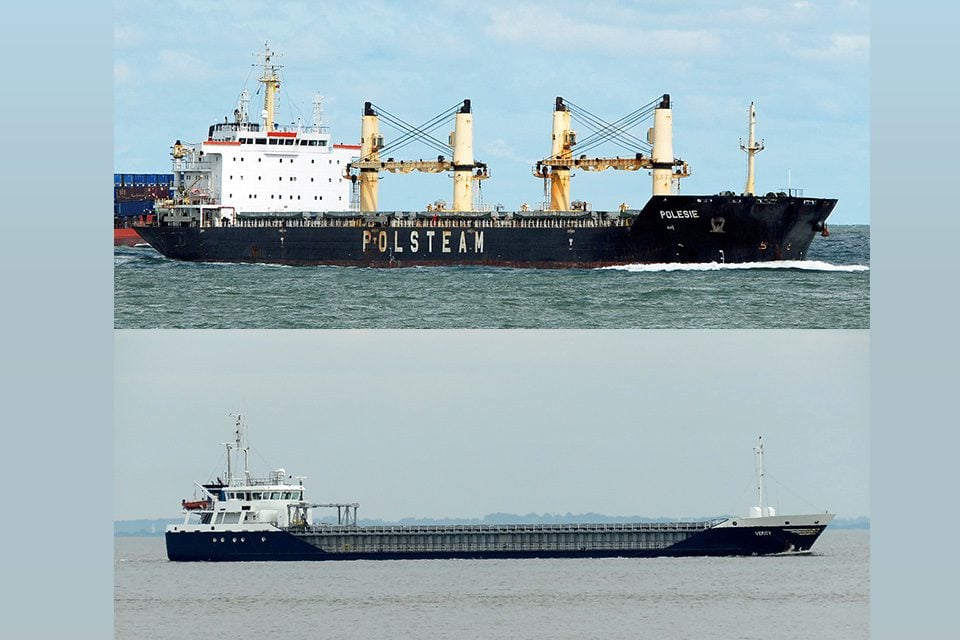
Over two years after the cargo ship Verity sank following a collision in the German Bight, the UK's Marine Accident Investigation Branch has published its final report. The report is clear: the loss of five lives was completely avoidable.
The Isle of Man-registered Verity collided with the Bahamas-flagged bulk carrier Polesie early on October 24, 2023, in a busy traffic area about 12 nautical miles southwest of Helgoland. The collision caused Verity to sink within minutes. Out of the crew, two survived and five lost their lives.
“This accident could have been completely avoided,” stated MAIB Chief Inspector Andrew Moll. "Neither ship followed the collision regulations properly and both chose to pass very close when it wasn't necessary.”
Inaction Until It Was Too Late
The investigation revealed that both vessels were on a clear path with plenty of sea room. According to the International Regulations for Preventing Collisions at Sea, Verity was supposed to give way and take early action to avoid a collision. However, this did not happen.
Instead, both watch officers allowed the ships to come dangerously close—never more than 0.5 nautical miles apart—while making only minimal course changes with autopilot. The report noted that these small adjustments were not enough to indicate their intent to avoid a collision to the other ship or the coastal authorities.
By the time action was finally attempted, it was too late. It appears Verity’s officer tried to go in front of the larger and faster Polesie, a move the report labeled as risky and against the rules, especially as the distance between them shrank. At the same time, Polesie made matters worse by turning left—going against its obligation as the stand-on vessel and adding confusion to an already unstable situation.
Investigators found that a decisive move could still have averted the collision in the last moments. At 4:52:55 a.m., Polesie had the ability to turn away from Verity. Instead, the officer kept adjusting the autopilot rather than taking manual control for an emergency turn.
Scrutiny of Vessel Traffic Services
Germany's vessel traffic services (VTS) faced criticism as well. Although operators were monitoring traffic, the MAIB discovered that their first intervention was late and lacked urgency.
Moreover, the VTS was using a duplex VHF channel, which required the assistant to relay messages between the two ships instead of allowing direct communication. This setup wasted valuable seconds as the vessels approached each other.
By the time the VTS supervisor issued a strong order to Polesie, the ships were so close that any external intervention was "counterproductive." Although the officer complied, there wasn't enough time left to prevent the crash.
Radio Communication, Survival Limits, and Missing Information
While VHF radio is typically not recommended for collision avoidance, the report mentions that earlier direct communication could have clarified intentions and resolved the dangerous situation. If used correctly and timely, radio contact could have made a difference—but it never occurred.
When Polesie hit Verity at 4:55 a.m., the damage was severe. Flooding quickly overtook the cargo ship, which sank before the crew could put on life jackets or immersion suits. The cold water and unavailability of survival gear left little chance for survival.
Search and rescue operations were swift and coordinated by German authorities, following established procedures. However, the report highlights that it is still uncertain whether any missing crew members reached the surface but remained unnoticed.
The investigation was further complicated due to the lack of a voyage data recorder on board Verity, which was not a requirement under current regulations. With the ship gone and the watch officer among the deceased, investigators could not completely reconstruct the final decisions made on the bridge.
Recommendations Made, No New Rules
The MAIB has offered several safety recommendations, reminding both operators about proper watchkeeping and collision-avoidance procedures. German authorities were asked to reconsider their use of duplex VHF channels and intervention protocols, while the Isle of Man Ship Registry was encouraged to push for expanded voyage data recorder requirements at the International Maritime Organization.
Interestingly, the investigation did not call for changes to the collision regulations themselves.
“This investigation found no indication that the current rules need to be changed,” the report states. “The regulations were sufficient; they were simply not followed.”
The key takeaway, according to Moll, is a timeless lesson in seamanship: “Give-way vessels must take early, clear action that is visible to others to ensure safe passing.”
You can find the final report here on the UK MAIB website.