
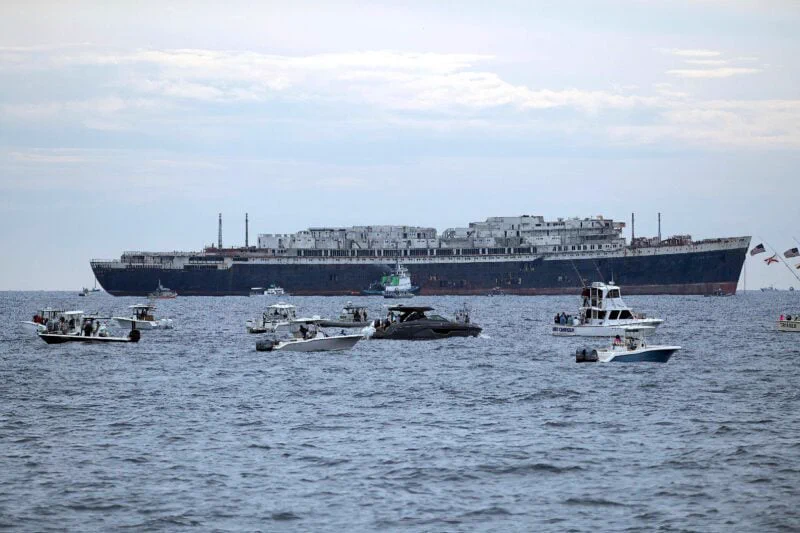
The famous ocean liner, which still holds the record for the fastest transatlantic crossing, took several hours to sink off Florida's Gulf Coast, marking the end of a significant era in American maritime history.
The SS United States, the fastest ocean liner ever created and a symbol of America's maritime legacy, sank off Florida's Gulf Coast on Wednesday night, November 11, concluding a journey that lasted 74 years.
The 990-foot long ship sank around 9 p.m. Central Time after a controlled sinking operation about 22 nautical miles southwest of Destin-Fort Walton Beach.
Once known as America’s Flagship, the ship is now set to become the world's largest artificial reef.
However, the sinking was not without its challenges.
Even with thorough preparations for water to fill the ship, it took longer than expected to sink. As night fell, the SS United States remained afloat, gradually sinking deeper into the water.
In its last moments, video captured the ship going down stern-first, with the front rising sharply before it ultimately submerged.
This dramatic conclusion raised doubts about whether the ship would settle on the seabed as planned. Initial reports suggested it landed upright, but an underwater survey would confirm its final position.
UPDATE (Nov. 12, 2026): The SS United States has been confirmed to be upright on the seafloor of the Gulf of Mexico. Initial inspections show that it settled close to its intended location, and the safety zone has now been lifted, allowing divers to explore the world’s largest artificial reef.
The sinking operation was managed by Coleen Marine, a company that specializes in the disposal of old vessels. Unlike the use of explosives for rapid sinkings, the SS United States was brought down through controlled flooding.
Workers removed hundreds of portholes, created openings between decks, and made preparations for water to enter the ship. This careful approach aimed to control the descent, but the ship's large size and design made it complicated.
For many sailors and ocean liner fans, the sinking was a bittersweet farewell to a ship that once represented the peak of American passenger shipping.
Built to Be the Fastest
The SS United States was designed by the renowned naval architect William Francis Gibbs, who dedicated much of his career to creating an American ocean liner that could outpace Europe's best vessels.
Constructed by Newport News Shipbuilding in Virginia for United States Lines, the ship began its service in 1952 as a technological marvel.
At 990 feet long, it was longer than the RMS Titanic and powered by steam turbines with around 240,000 shaft horsepower, emphasizing speed, lightweight design, and fire safety.
Her design also aligned with the military needs of the early Cold War, intended to function as both a luxury liner and a potential high-speed military transport.
Her maiden voyage secured her place in maritime history.
In July 1952, the SS United States crossed the Atlantic in just three days, 10 hours, and 40 minutes, averaging 35.59 knots, earning the prestigious Blue Riband from Britain’s RMS Queen Mary.
More than 70 years later, her speed record remains unbroken by any ocean liner.
The ship quickly became a symbol of national pride, carrying presidents, celebrities, business leaders, and thousands of everyday passengers between the U.S. and Europe. Notable passengers included Grace Kelly, Elizabeth Taylor, and John F. Kennedy.
For almost two decades, her unique red, white, and blue funnels became iconic on the North Atlantic.
The End of an Era
Despite her impressive speed and status, the SS United States couldn’t escape the shifts in transatlantic travel.
The growth of commercial aviation steadily reduced the demand for passenger liners, making it hard to justify the high operating costs of a speed-focused ship.
In November 1969, after making about 800 crossings, the SS United States was taken out of service.
She would never carry paying passengers again.
The following years saw changes in ownership, failed redevelopment plans, and long stretches of inactivity.
The ship spent years in Virginia before arriving in Philadelphia in 1996, where she remained for almost three decades, her once-great appearance gradually deteriorating along the Delaware River.
Though her engines had stopped and much of her interior had been stripped, the ship still inspired preservation efforts.
The SS United States Conservancy, led by Susan Gibbs, the granddaughter of the ship's designer, worked to find a permanent solution for the liner, including ideas to turn her into a floating hotel, museum, or waterfront attraction.
None of these plans ever came to fruition.
In June 2024, legal issues over pier fees and the ship's long-standing berth brought preservation efforts to a critical point, as reported by gCaptain.
A federal court decision that required the vessel to leave Philadelphia forced her owners to face a tough reality: without a practical redevelopment project or a new docking location, the ship risked being scrapped.
A Final Journey South
In October 2024, ownership of the SS United States was transferred to Okaloosa County, Florida, under an agreement to convert the historic liner into an artificial reef.
This decision offered an alternative to destruction but also meant giving up the long-held dream of preserving the entire ship above water.
On February 19, 2025, the SS United States departed Philadelphia, traveling down the Delaware River and leaving behind the city that had been her home for nearly 30 years.
She arrived in Mobile, Alabama, the next month, where preparations began for her deployment.
Okaloosa County reported that all 128 fuel and lubricant tanks were emptied and cleaned, environmental safety measures were taken, and many historic objects and components were preserved.
Saved items included the ship's iconic funnels, radar mast, and other artifacts intended for a future land-based museum dedicated to her history.
The project faced a last-minute legal challenge from preservationists who raised environmental concerns, but an emergency request to stop the sinking was denied.
On November 9, the SS United States left Mobile for the last leg of her journey.
This time, there were no passengers on board, no records to break, and no destination other than the ocean floor.
Preservationists Mourn a Different Ending
For those who fought for years to save the ship, Wednesday's sinking was particularly heartbreaking.
In a statement issued after the sinking, the SS United States Preservation Foundation, which opposed the reefing project, honored the vessel and all generations of Americans who built, operated, and worked to preserve her.
The foundation regarded the ship as a triumph of American craftsmanship and engineering, stemming from the vision of William Francis and Frederic Herbert Gibbs and built by American shipbuilders, many of whom were World War II veterans.
For over a year, the group sought to stop the sinking, appealing to policymakers, raising environmental concerns, and looking for alternatives to keep the ship above water.
“We believed then, as we believe now, that a nation should preserve the greatest achievements of those who came before us, not merely remember them after they are gone,” said the foundation.
Despite losing their battle to save the ship, they vowed to continue preserving her history and honoring those who built and sailed her.
“You deserved a different ending, and will never be forgotten,” they stated in their farewell.
This statement highlighted the division over the ship's fate. While Okaloosa County and supporters of the reef project view the sinking as a way to provide the vessel with a new purpose, many preservationists see it as a permanent loss of a unique part of American maritime heritage.
A New Life Beneath the Gulf
The ship's sinking on Veterans Day adds historical significance. Although it was never used as a troop transport, its design was closely related to U.S. national defense during the Cold War.
The SS United States now rests about 180 feet underwater, where it is expected to draw marine life, divers, and recreational fishermen, creating a new attraction along Florida's Emerald Coast.
The project will also serve as a research opportunity. Scientists from the Woods Hole Oceanographic Institution plan to study how marine organisms adapt to the ship's large steel structure and how an artificial reef ecosystem develops over time.
The sinking is still controversial among those who had hoped the ship could remain as a museum or landmark. Others believe the artificial reef is a more dignified outcome than scrapping the vessel.
Both perspectives show the deep emotional connection the ship inspired long after it ceased commercial operations.
The SS United States was built during a time when a nation’s prestige was measured by the speed, size, and quality of its merchant fleet. Created in American shipyards using American engineering, it symbolized the belief that the U.S. merchant marine could compete with the world's finest.
Today, no American-flagged ocean liner operates regular transatlantic routes like the SS United States once did.
Her sinking signifies the physical closing of that chapter above the water, but the accomplishment she represented will remain.
For 74 years, no ocean liner has surpassed the transatlantic speed record she set during her maiden voyage.
The ship that once flew across the Atlantic faster than any other now rests beneath the Gulf, her days of ocean crossings finally over.
The SS United States will never sail again, but her record and her legacy in American maritime history will continue.